
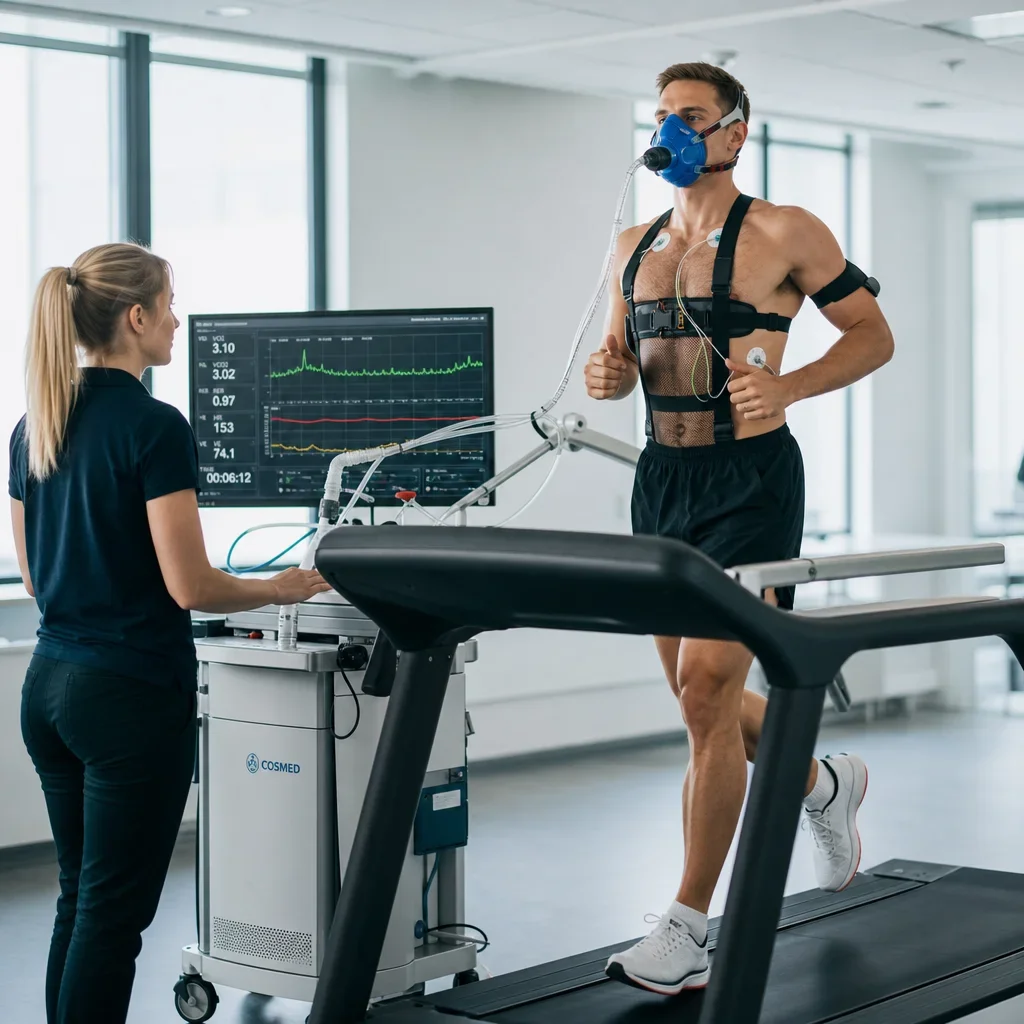
VO2 max testing for athletes is useful, but it is not a magic score. It tells you how much oxygen your body can use at maximal effort, and that helps explain aerobic capacity, training intensity, and endurance potential. It does not tell the whole story by itself.
What VO2 max testing for athletes actually measures
VO2 max is your maximal oxygen uptake, and the full form of VO2 max is maximal oxygen consumption or maximal oxygen uptake . It is usually reported in millilitres of oxygen used per kilogram of body weight per minute, written as mL/kg/min . That number reflects aerobic capacity, not total athletic ability.
A VO2 max test is usually a graded exercise test with respiratory gas analysis . In plain English, you exercise harder and harder while equipment measures the oxygen you breathe in and the carbon dioxide you breathe out. That is the standard way to determine the VO2 max of an athlete.
VO2 max matters because it helps benchmark fitness, guide training, track adaptation, and support return-to-sport decisions . For endurance athletes, it can be useful for setting context around performance. For rehab clients, it can help show current capacity against future goals. Your result still needs to be interpreted beside threshold, movement efficiency, fatigue resistance, and sport demands.
How a VO2 max test works step by step
A professional VO2 max test usually uses a treadmill or cycle ergometer and gets progressively harder until you stop from fatigue or the protocol reaches its endpoint . The hard-effort phase is commonly about 8–20 minutes , while the full appointment is often longer because setup, warm-up, screening, and review are included.
A treadmill-based VO2 max test protocol often starts easy, then increases speed, incline, or both at set stages . Bike protocols usually raise power output in steps. Runners are often tested on a treadmill because it better matches running mechanics. Cyclists are often better served on a bike because local muscular fatigue and pedalling economy matter to the result.
A full testing visit commonly runs about 45–90 minutes . That window usually includes intake, equipment fitting, baseline measurements, calibration, warm-up, the test itself, a cool-down, and an explanation of results. Exact timing depends on the protocol and the provider.
What equipment is used in a professional VO2 max test
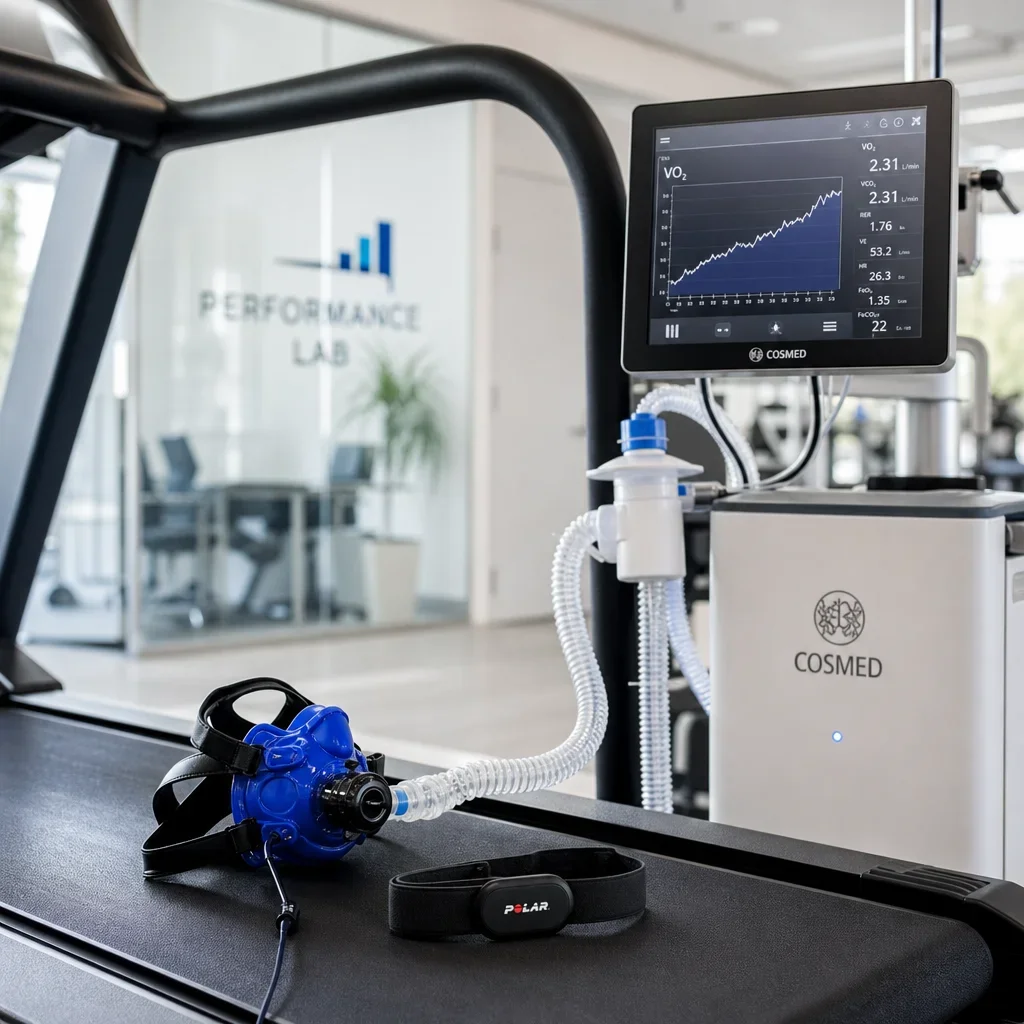
Professional testing uses more than a treadmill and a heart rate strap. The usual setup includes a treadmill or cycle ergometer, a fitted breathing mask or mouthpiece, a metabolic cart or gas analyzer, and heart rate monitoring . The gas analysis piece is what separates measured data from an estimate.
The core method is indirect calorimetry, which measures oxygen consumption and carbon dioxide production during exercise . That is how the system calculates your VO2 max rather than guessing from pace, distance, or pulse alone. Some providers also use portable systems for field testing, but data quality depends heavily on calibration, fit, environment, and protocol consistency.
How to prepare for a VO2 max test
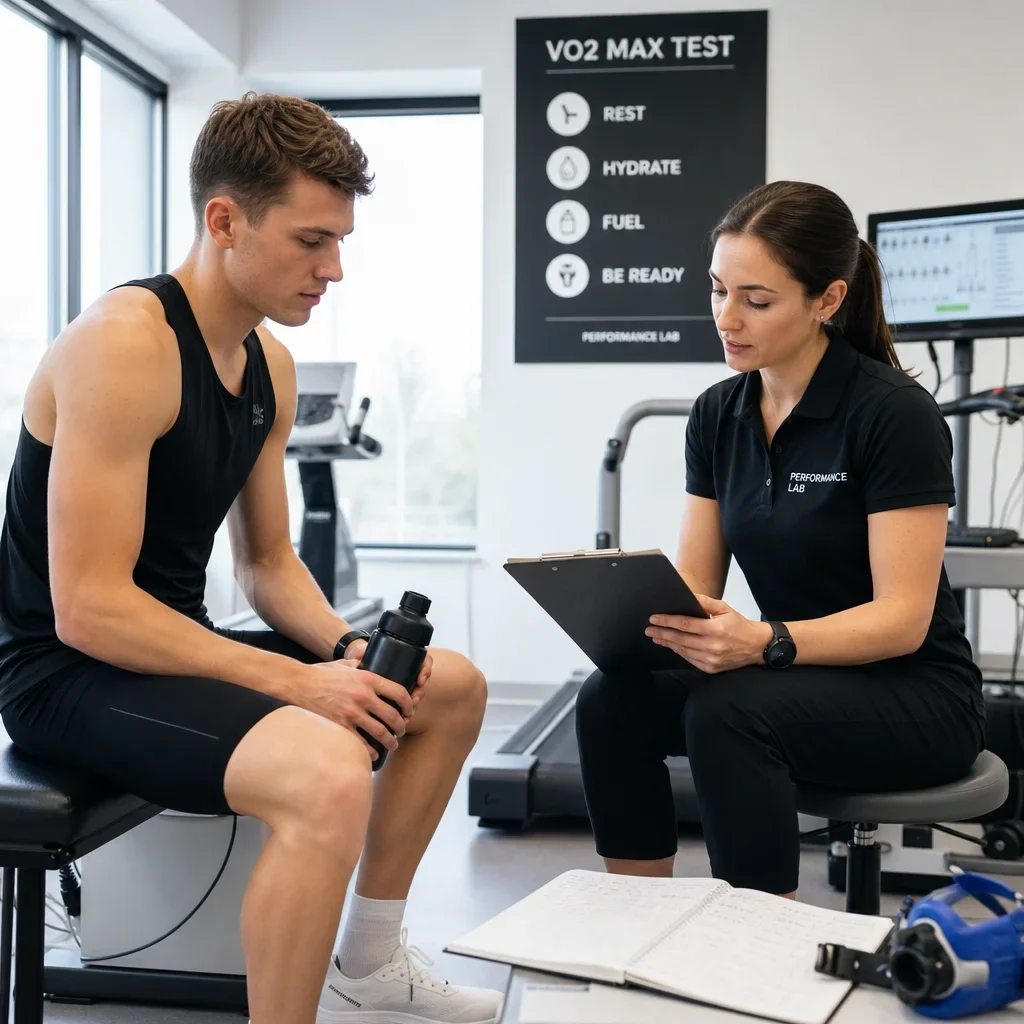
Good preparation improves both safety and data quality. Arrive rested, hydrated, and in sport-specific clothing and footwear . If you are comparing one test to another, try to keep conditions similar each time.
Hard training, poor sleep, dehydration, illness, heat stress, and unusual caffeine intake can all distort results . That is why we tell athletes to follow the provider’s exact pre-test instructions on food, stimulants, alcohol, medications, and training load, rather than guessing. This is general information, not a clearance for maximal testing in your situation.
Training history matters almost as much as the test itself. Bring recent training volume, race goals, injury history, and return-to-sport details so the result can be interpreted in context . A strong report is only useful if it connects the number to your sport and current training phase.
What counts as a good VO2 max for athletes
A good VO2 max for athletes depends on age, sex, sport, body size, training age, and competitive level . There is no single cutoff that applies to every runner, cyclist, triathlete, or return-to-sport client.
The most useful comparison is three-layered. First compare your score to age- and sex-based norms. Then compare it to your sport. Then compare it to your own training history and performance. Two athletes can post a similar VO2 max and race very differently because lactate threshold, movement economy, technique, and durability are different .
Female athletes should be compared against female-specific normative data, not male benchmarks . If a provider cannot explain how age and sex affect interpretation, the number gets oversimplified fast.
Because the brief requires a verified norms chart and none was supplied, we will not invent one here. A credible provider should be able to show you the reference source they use and explain where your result sits within it.
How to interpret VO2 max results beyond the headline number
VO2 max testing for athletes results mean more than one top-line score. A useful report may include VO2 max, peak heart rate, speed or power at peak effort, test duration, and sometimes ventilatory thresholds if they were measured .
The most actionable point is usually how the result connects to training. An athlete with a high ceiling but a low threshold may need more tempo and threshold work. An athlete with a modest ceiling but strong threshold and excellent economy may already race very well. That is why VO2 max vs lactate threshold is not an either-or argument.
VO2 max training zones should never be copied from a generic chart without context . Good zone-setting depends on the exact test method, the sport, and whether threshold data was measured directly, estimated, or not collected at all. One test should inform a plan, not replace coaching or clinical judgment.
VO2 max vs lactate threshold: which matters more for performance?
VO2 max is the ceiling. Lactate threshold shows how much of that ceiling you can sustain . For events lasting more than a few minutes, threshold often relates more directly to race pace than VO2 max alone.
Ventilatory threshold is a breathing-based marker that often tracks meaningful changes in sustainable intensity . In practice, many athletes get more training value from knowing both ceiling and threshold than from knowing either one alone.
For a 5K, 10K, half marathon, long cycling time trial, or triathlon, performance is shaped by several systems at once . VO2 max helps set the outer limit. Threshold, economy, pacing, and fatigue resistance help determine what you can actually hold on the day.
Lab vs field vs smartwatch vs VO2 max calculator: which option should you choose?
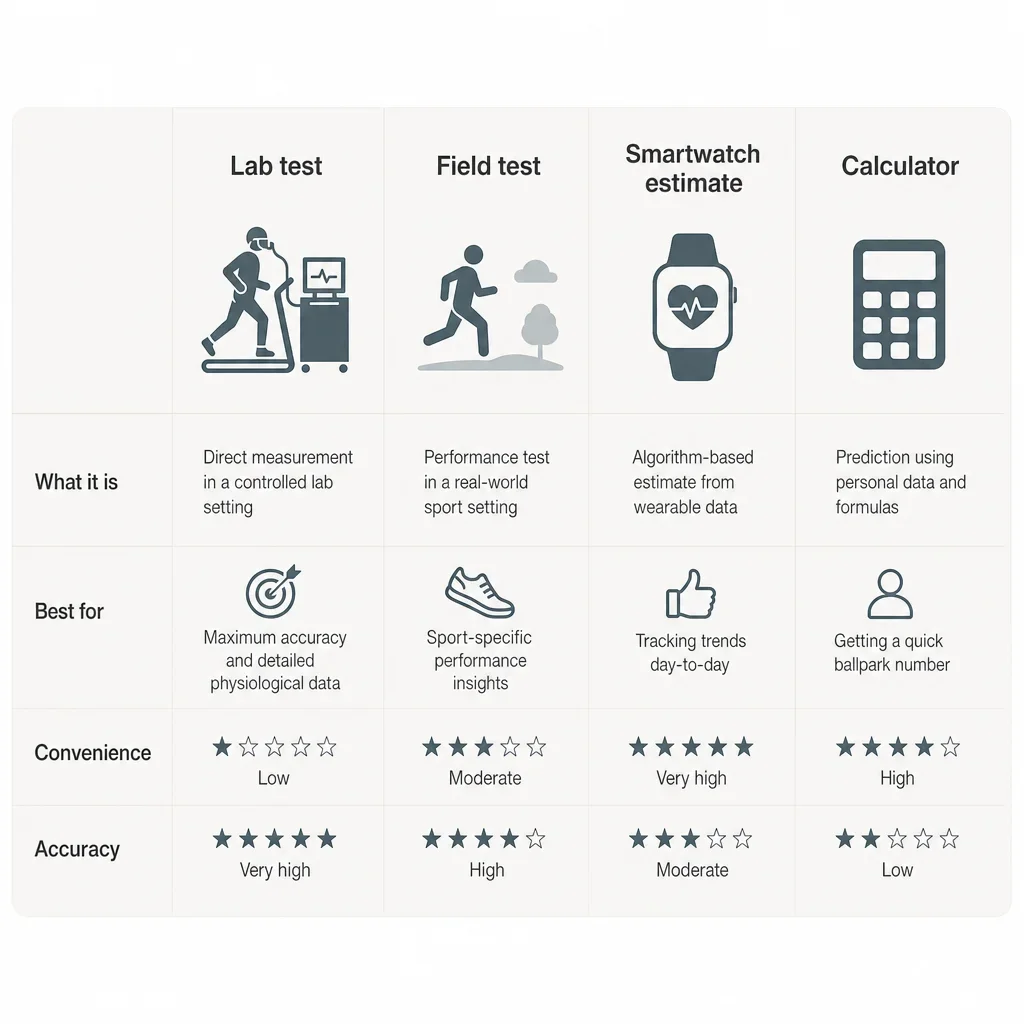
The best option depends on what decision you need to make. Direct lab testing gives the most complete physiology picture. Field testing gives more sport specificity in real conditions. Smartwatch estimates and a VO2 max calculator are easier and cheaper, but they are still estimates .
| Method | What it uses | Main strength | Main limit | Best fit |
|---|---|---|---|---|
| Lab test | Gas analysis during graded exercise | Direct measurement and detailed report | Higher cost and booking needed | Serious endurance athletes, return-to-performance cases |
| Field test | Timed efforts, pace, power, or portable gas systems | Sport-specific context | More environmental noise | Athletes who want practical outdoor relevance |
| Smartwatch estimate | Heart rate, speed, pace, device algorithm | Convenience and trend tracking | Not interchangeable with direct measurement | Recreational users watching long-term trends |
| VO2 max calculator | Formula using race time, pace, heart rate, or workload | Fast starting point | Accuracy depends on assumptions | Rough estimate only |
Lab vs field VO2 max testing is really a trade-off between control and specificity . Lab testing gives tighter control over protocol and environment. Field testing may better reflect the actual movement pattern of your sport. Smartwatches and calculators can be useful for trend tracking, but they should not be treated as equal to respiratory gas analysis.
If your training decisions are simple, an estimate may be enough to start. If you are plateaued, returning from injury, preparing for a season, or trying to separate threshold limits from aerobic-capacity limits, professional testing is usually more useful .
Sport-specific interpretation: runners, cyclists, and triathletes
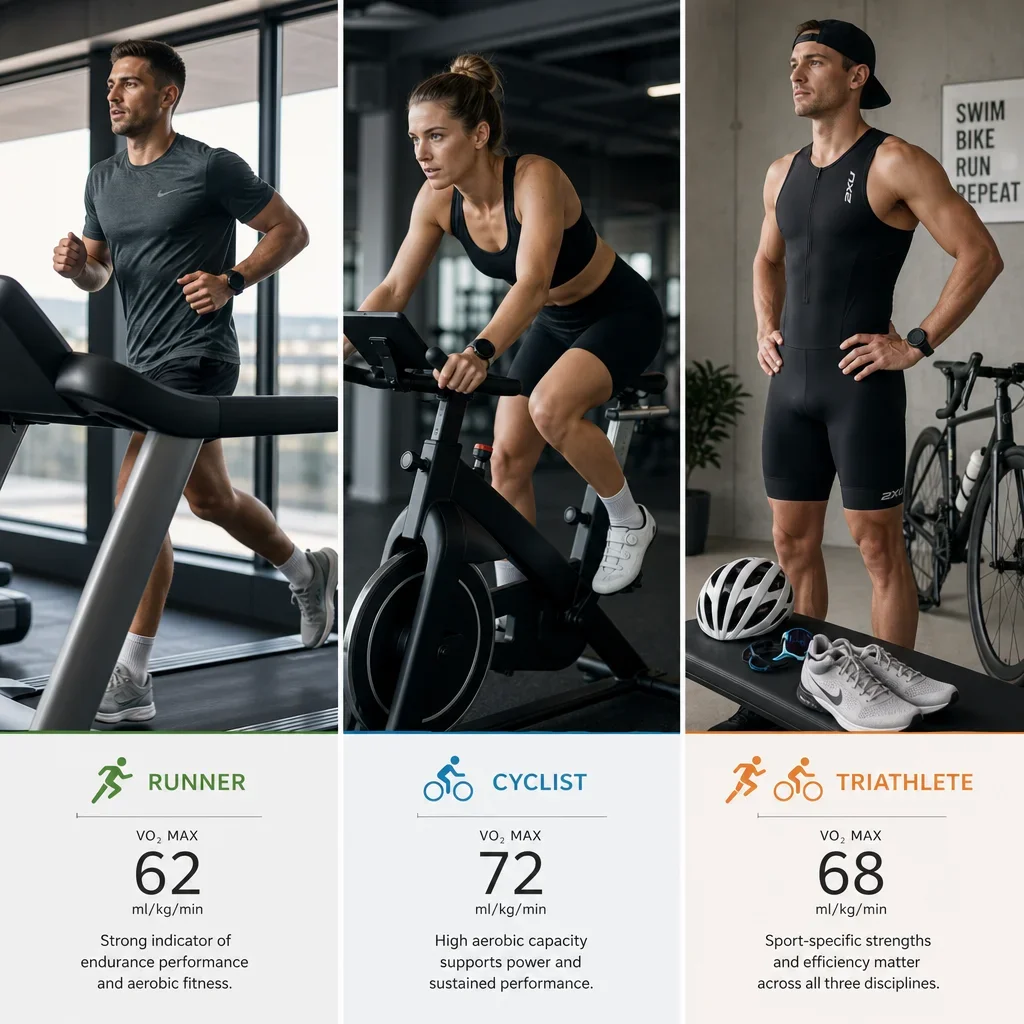
VO2 max for runners is best interpreted alongside running economy and speed at peak oxygen uptake . Treadmill testing is often the more specific format because it reflects running mechanics. A runner with a strong VO2 max but poor economy may still underperform compared with a more economical runner.
VO2 max for cyclists should be read with power data, not just the oxygen number . Bike-based testing is more specific for cyclists because local leg fatigue, cadence preference, and power production all shape the result. In cycling, the link between VO2 max and threshold or FTP-style markers matters a lot for training decisions.
VO2 max for triathletes is more complex because run and bike values can differ meaningfully . That is normal. A triathlete may be more trained in one discipline, more economical in one discipline, or limited by injury history in one discipline. Cross-sport comparison without context usually leads to bad conclusions.
How VO2 max results should change training week to week
The best use of a VO2 max test is to improve how you train, not just how you label yourself. Results can help anchor easy days, tempo work, threshold sessions, and VO2-oriented intervals .
A common mistake is making easy days too hard because the athlete chases a pace that does not match current physiology. Better testing can help keep easy work genuinely easy, which supports recovery and quality on hard days .
The training response should match the athlete in front of you. A newer athlete may benefit most from consistency and aerobic volume. A trained athlete with a high ceiling but weaker sustainable output may need more threshold work. A return-to-sport athlete may need careful load progression before any high-intensity block .
How athletes improve VO2 max
VO2 max usually improves through a mix of aerobic base work, sport-specific volume, structured intervals, and enough recovery to absorb the training . Less-trained athletes often have more room to improve than highly trained athletes, but the exact size of change is not something we would promise from a generic article.
Performance can improve even if VO2 max changes only modestly . Threshold, movement economy, pacing skill, durability, and tissue tolerance often drive just as much progress, especially in trained runners and cyclists.
Athletes dealing with pain, recent surgery, or recurring overload should connect performance testing with sports medicine, physiotherapy, or return-to-sport planning . Sometimes the right next step is not harder intervals. It is better mechanics, better load management, or better tissue capacity.
When to book, retest, or skip VO2 max testing
VO2 max testing is most useful when the result will change a decision. Good windows include the off-season, pre-season, a race-build checkpoint, or a structured return from injury or illness .
Retesting is commonly done about every 8–16 weeks when athletes are in a defined training block and the data will affect planning . That is a practical range, not a rule. A recreational athlete may retest less often. A rehab athlete may retest when function and training tolerance have meaningfully changed.
Maximal testing is not right on every day for every person. Acute illness, chest symptoms, unexplained dizziness, uncontrolled medical issues, recent major injury, and post-surgical restrictions may all be reasons to defer or modify testing . If there is any doubt, screening comes first.
Common testing errors and how to get reliable results
Reliable results come from consistent conditions and a good protocol. Common errors include poor calibration, wrong modality selection, inadequate effort, residual fatigue from recent training, dehydration, heat stress, and using different protocols at each retest .
Treadmill versus bike choice is not trivial . If you test a cyclist on a treadmill or a runner on a bike without a good reason, the number may reflect local limitation more than true sport-specific capacity. I tell athletes to compare repeatability and relevance, not just convenience.
Field testing carries more environmental noise than controlled indoor testing . Wind, temperature, surface, pacing, and terrain all matter. If you want to compare results over time, use the same setup as closely as possible.
A trustworthy provider should explain the protocol before testing and explain the result after testing . If all you get is one number without context, that is not much help for training.
How to choose a trustworthy VO2 max testing provider in Toronto
The right provider should be able to explain who the test is for, how the protocol is chosen, what equipment is used, what you will receive afterward, and how the result informs training or rehab . That matters more than flashy marketing.
In Toronto, look for a provider with relevant exercise physiology, sports medicine, physiotherapy, or performance-testing expertise appropriate to the service offered . If you are also managing injury, biomechanics and movement analysis can be just as important as the physiology test itself.
If you are searching for VO2 max testing near me or a VO2 max test Toronto athletes can actually use, ask practical questions first. Ask whether the report includes interpretation, whether threshold data is available, whether the modality matches your sport, and whether the result can be tied to a training or return-to-sport plan .
Cost, appointment length, and what is included
Professional VO2 max testing cost depends on the provider, whether threshold testing is added, and whether interpretation or follow-up planning is included . A broad market range is roughly CAD 140–300+ , but local pricing should always be confirmed directly because this article will age faster than the physiology.
Appointment length is commonly about 45–90 minutes . What is included often matters more than the fee alone. A strong package may include intake, setup, the maximal test, cool-down, interpretation, a written report, and a follow-up discussion.
We will not claim that every downtown Toronto clinic offers the same service or the same report depth. If you are comparing options, compare the quality of interpretation, not just the headline price. That usually matters more for athletes who want the data to change training.
Quick answers on celebrity numbers and edge cases
Celebrity VO2 max numbers are often repeated without primary sourcing, and they are poor benchmarks for most athletes . Testing modality, body size, era, sport demands, and whether the number was measured or estimated all change the meaning.
Questions like Michael Phelps VO2 max, Lance Armstrong VO2 max, Messi VO2 max, or David Goggins VO2 max are noisy search topics, but they do not help you train better unless the numbers are verified and interpreted in full context . Most are not.
You cannot run an entire 5K at true VO2 max in the literal laboratory sense . A 5K pace is influenced by VO2 max, but also by threshold, economy, pacing, and fatigue resistance. That is exactly why one score should not be treated as the whole performance picture.
FAQ
What is the test to determine the VO2 max of an athlete?
The standard VO2 max test is a graded exercise test with respiratory gas analysis . Exercise intensity rises in stages while oxygen use and carbon dioxide output are measured directly.
What is a good VO2 max for athletes?
Good depends on age, sex, sport, training level, and performance context . The best interpretation compares your result to norms, your sport, and your own history.
How long does a VO2 max test take?
The hard test segment is often about 8–20 minutes, while the full appointment is commonly 45–90 minutes .
What is the difference between VO2 max and lactate threshold?
VO2 max is maximal aerobic capacity. Lactate threshold reflects the highest intensity you can sustain more efficiently for longer .
Can VO2 max be tested at home?
Not directly with the same accuracy as respiratory gas analysis . At home, you are usually estimating it through a wearable, calculator, or field protocol.
Can a smartwatch estimate VO2 max accurately?
A smartwatch can be useful for trends, but it is still an estimate and not interchangeable with measured lab data .
How often should athletes retest VO2 max?
A common practical window is every 8–16 weeks when the result will affect training decisions .
Can you run 5K at VO2 max?
Not in a simple one-number sense . 5K performance depends on VO2 max, threshold, economy, and pacing.
What should I do before a VO2 max test?
Show up rested, hydrated, and in sport-specific gear, then follow the provider’s instructions on food, caffeine, medications, and training beforehand .
How do I choose between lab and field VO2 max testing?
Choose lab testing for control and direct measurement. Choose field testing for greater sport specificity when conditions and protocol can be controlled well enough .
What should be included in a professional VO2 max test report?
At minimum, look for the measured result, protocol details, exercise modality, heart rate data, and interpretation that connects the result to training or rehab decisions .
How much does VO2 max testing cost in Toronto?
A broad market estimate is about CAD 140–300+ , but actual Toronto pricing depends on what is included and should be confirmed with the provider.
If you are in downtown Toronto and deciding whether formal testing makes sense, the right next step is usually an assessment conversation first. For some athletes, VO2 max testing is the right tool. For others, sports medicine, physiotherapy, gait analysis, or return-to-sport planning will be more useful right now.