
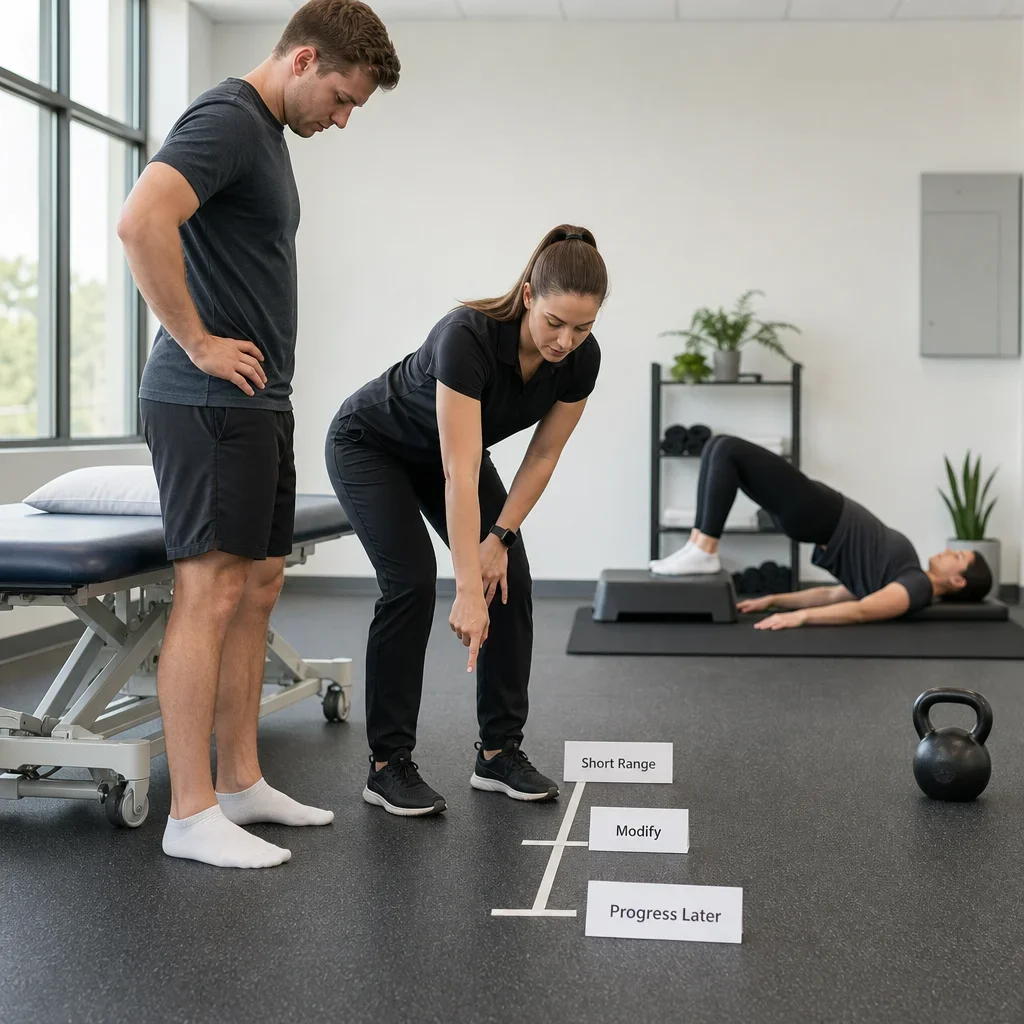
Exercises to avoid with hamstring injury are usually the movements that recreate sharp pain, a strong pulling sensation, limping, or worse symptoms later that day. That commonly includes sprinting, jumping, kicking, aggressive stretching, and heavy hamstring loading early on.
Avoiding an exercise does not mean avoiding it forever. The goal is to reduce the load your hamstring cannot yet tolerate, then rebuild strength, range, and running capacity gradually.
This guide is general education, not a diagnosis or a personal treatment plan. Hamstring pain can come from a strain, tendon irritation, referred back pain, nerve sensitivity, cramping, or another condition. Severe symptoms or uncertainty deserve assessment by a regulated physiotherapist or sports-medicine clinician.
Quick Answer: What to Avoid With a Hamstring Injury
Pause or reduce movements that cause sharp pain, obvious pulling, limping, or symptom escalation after activity. Early hamstring strain exercises to avoid commonly include maximal sprinting, rapid acceleration, hard cutting, jumping, forceful kicking, deep forward folds, and heavy hip-hinge exercises.
Avoid forceful end-range stretching after a fresh strain. A hamstring that feels tight may be guarding after injury, fatigued, sensitive to load, or irritated by nearby nerve tissue; tightness alone does not prove that more stretching is needed.
Avoid returning to high-load eccentric work too early. Nordic hamstring curls, sliding curls, heavy Romanian deadlifts, stiff-leg deadlifts, and loaded single-leg hinges can be useful later, but they place substantial demand on the hamstring while it lengthens.
Treat high buttock or sit-bone pain differently from a sudden mid-thigh pull. Pain near the sit bone can fit proximal hamstring tendon irritation, where deep hip flexion, prolonged sitting, and aggressive stretching may be more provocative than they are for a typical muscle strain.
| Situation | Usually limit first | Consider instead, if comfortable | Why |
|---|---|---|---|
| Fresh hamstring strain | Sprinting, kicking, jumping, deep stretching | Comfortable walking and upper-body training | Reduces sudden high-force hamstring loading |
| Improving strain | Heavy hinges and maximal running | Controlled strengthening with a tolerable range | Rebuilds capacity without jumping to peak demand |
| High hamstring or sit-bone pain | Deep toe touches, long-lever bridges, deep RDLs | Shorter ranges and lower-compression positions | May reduce tendon compression and irritation |
First, Know Which Hamstring Problem You May Be Managing
A hamstring strain usually follows a sudden overload. Sprinting, acceleration, deceleration, kicking, slipping, or an unexpected stretch can overload the muscles at the back of the thigh.
A suspected tear may involve a sudden pop, marked weakness, bruising, swelling, difficulty walking, or a visible change in the muscle contour. Those findings do not confirm a diagnosis at home, but they are reasons to stop testing the injury with exercise and seek assessment.
Proximal hamstring tendinopathy usually presents as pain high in the back of the thigh or near the sit bone. Sitting, uphill running, deep hip flexion, toe-touching, and stretching can aggravate that pattern, although similar symptoms can also come from the low back, hip, or sciatic nerve.
Post-exercise soreness can also resemble a strain. Delayed soreness typically follows an unfamiliar or demanding session and affects a broader area, while a strain more commonly has a distinct onset during a specific movement.
| Pattern | Common presentation | Common aggravators | Exercise implication |
|---|---|---|---|
| Hamstring strain | Sudden pain during a forceful movement | Sprinting, kicking, long-stride running | Reduce fast and lengthened loading initially |
| Possible significant tear | Pop, major weakness, bruising, gait change | Weight bearing and active contraction | Seek timely medical assessment |
| Proximal tendon-related pain | Pain near the sit bone or upper hamstring | Sitting, hills, deep hip flexion, stretching | Reduce compression and rebuild loading tolerance |
| Referred or nerve-related pain | Symptoms extending from the back or buttock | Spinal movement or prolonged positions | Requires assessment before assuming a strain |
Red Flags: Get Assessed Rather Than Exercise Through It
Stop training and seek timely assessment if you felt a pop, cannot walk normally, have major bruising or swelling, notice marked weakness, or see a visible contour change. Numbness, tingling, severe pain, or symptoms that are progressing also need medical attention rather than an online exercise plan.
Persistent or recurrent hamstring pain also warrants assessment. Repeated strains can reflect incomplete rehabilitation, insufficient exposure to high-speed running, strength deficits, training-load spikes, or movement demands that have not been rebuilt.
Imaging is not necessary for every hamstring injury. A clinician may consider ultrasound or MRI when examination findings and the suspected severity or location would change management.
Downtown Toronto athletes and active adults can use a physiotherapy or sports-medicine assessment to clarify the likely pain pattern, assess movement and strength, and plan a safe return to running or sport. Studio Athletica evaluates biomechanics, loading tolerance, and sport-specific demands without assuming every posterior-thigh symptom is the same condition.
Exercise Decision Guide: Avoid, Modify, or Progress?
Use symptom response and movement quality to guide exercise choices. Sharp pain, limping, altered movement, and symptoms that clearly worsen later that day or the next day are signs that the current load is too demanding.
Stop and seek assessment when symptoms are severe, worsening, associated with a limp, or accompanied by bruising, weakness, neurological symptoms, or concern for a tear. Continuing to sprint, stretch aggressively, or lift heavily through those signs can make rehabilitation harder.
Use low-irritability movement when symptoms are acute but settling. Comfortable walking, gentle movement within a symptom-tolerated range, and non-provocative upper-body training may help maintain activity without repeatedly stressing the injured tissue.
Progress strength and range when everyday movement is improving and exercises do not produce a meaningful symptom flare. Progression should follow function and response to load, not a calendar date alone.
Reintroduce sport demands only after controlled strength work and running drills are tolerated. Athletes need exposure to acceleration, deceleration, faster running, cutting, kicking, or jumping before full competition, because walking comfortably is not the same as tolerating sport speed.
Exercises and Movements to Avoid or Modify After a Hamstring Strain
All-out sprinting and fast acceleration are commonly limited after a hamstring strain because they create high force at long muscle lengths. Controlled running may be introduced later when it is comfortable and movement quality remains normal.
Aggressive static stretching and ballistic stretching are usually poor early choices when they reproduce symptoms. Deep straight-leg stretching, forceful toe-touching, and bouncing into range can load an injured hamstring when it is already sensitive.
Heavy Romanian deadlifts may aggravate a fresh strain because they load the hamstrings in a lengthened hip-hinge position. A shorter-range hinge, a lighter supported variation, or another lower-irritability exercise may be more appropriate during early rehabilitation.
Squats are not automatically forbidden with hamstring injuries. Tolerance depends on squat depth, trunk position, load, stance, range of motion, and the individual symptom response; reducing depth, using support, or selecting a pain-tolerated variation can be reasonable modifications.
Nordic hamstring curls are demanding eccentric hamstring exercises. They are generally progressed later, after the hamstring tolerates simpler strengthening and controlled lengthened loading.
Bridges can be useful or irritating depending on lever length and hip position. A shorter-lever bridge may be more comfortable than a long-lever bridge when the hamstring is sensitive.
| Exercise or movement | Why it may aggravate symptoms | Common early modification |
|---|---|---|
| Sprinting or acceleration | High-force hamstring loading at speed | Walk, then progress running under guidance |
| Cutting, jumping, or kicking | Rapid force and stretch demands | Remove explosive drills temporarily |
| Deep hamstring stretch | Can reproduce strain pain or tendon compression | Use comfortable mobility without forcing range |
| Romanian deadlift | Lengthened hamstring load under resistance | Reduce load and range, or use another exercise |
| Nordic hamstring curl | Heavy eccentric demand | Reserve for later-stage progression |
| Sliding hamstring curl | High hamstring demand as the leg extends | Begin with simpler controlled loading |
| Squat | Depth and trunk angle can increase symptoms | Reduce depth, load, or use support |
| Long-lever bridge | Can increase hamstring load | Shorten the lever or reduce range |
| Machine hamstring curl | Direct knee-flexion load may be too intense early | Use lighter, controlled resistance if tolerated |
Fitness can still be maintained when activity is comfortable and does not worsen symptoms. Upper-body training and selected low-impact conditioning may be options, but the right choice depends on the injury pattern and your response to the activity.
Exercises to Avoid With Proximal Hamstring Tendinopathy
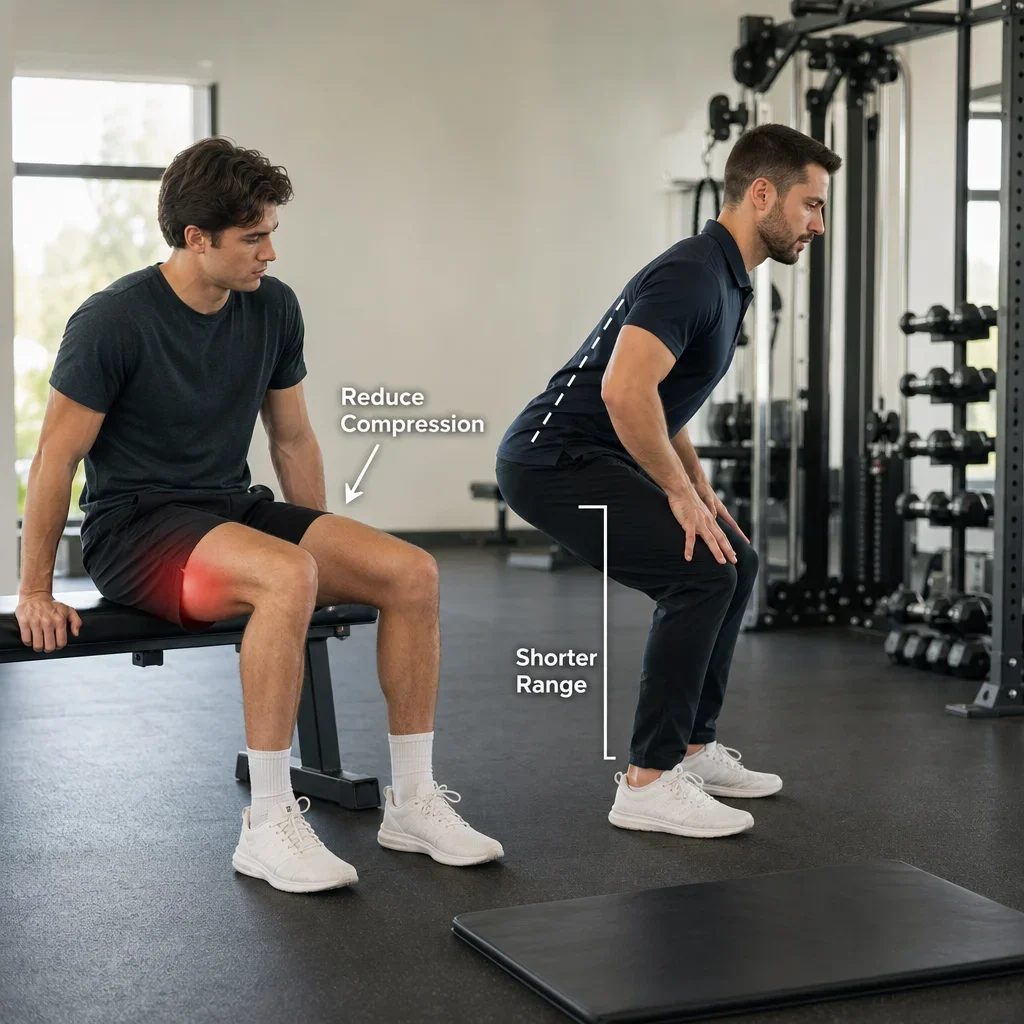
Exercises to avoid with hamstring tendinopathy are usually those combining high hamstring load with deep hip flexion. This pattern can increase compression near the upper hamstring tendon where it attaches close to the sit bone.
Long-duration seated stretching, deep forward folds, aggressive toe-touching, and deep split positions may aggravate high hamstring pain. These movements are not harmful for every person, but they are common symptom triggers when the proximal tendon is irritable.
Heavy or deep Romanian deadlifts can aggravate proximal symptoms when the bottom position creates both high load and deep hip flexion. Reducing the range, lowering resistance, or using a more upright hip-hinge variation can reduce the demand.
Some glute exercises may also irritate high hamstring pain. Long-lever bridges, certain hip thrust variations, and deep squat patterns can load the hamstring substantially, even when the exercise is intended to target the glutes.
Break up prolonged sitting when high hamstring pain is sensitive to pressure at the sit bone. Position changes and gradual load rebuilding are generally more useful than relying on stretching alone.
Should You Walk, Stretch, Massage, or Keep Training?
Gentle walking may be acceptable when it does not cause limping, sharp pain, or worse symptoms afterward. Walking that changes your gait or clearly increases pain should be reduced and assessed as needed.
Stretching should not be forced after a fresh hamstring strain. Flexibility work may become useful later, but it should match the diagnosis, stage of recovery, and symptom response rather than chase the feeling of tightness.
Massage may help comfort for some people, but it does not repair a tear or replace progressive rehabilitation. Avoid using massage to delay assessment of major bruising, weakness, a pop, or inability to walk normally.
Continue training only around the injury, not through it. Upper-body lifting, trunk training, or selected conditioning can maintain routine when they do not reproduce symptoms or alter your movement.
Do: reduce aggravating speed and load, keep comfortable movement, monitor later symptom response, and rebuild strength gradually.
Do not: sprint through pain, stretch aggressively into pain, test a suspected tear with heavy lifting, or assume every tight hamstring needs more flexibility work.
Hamstring Rehab Exercises: What to Progress Toward Instead
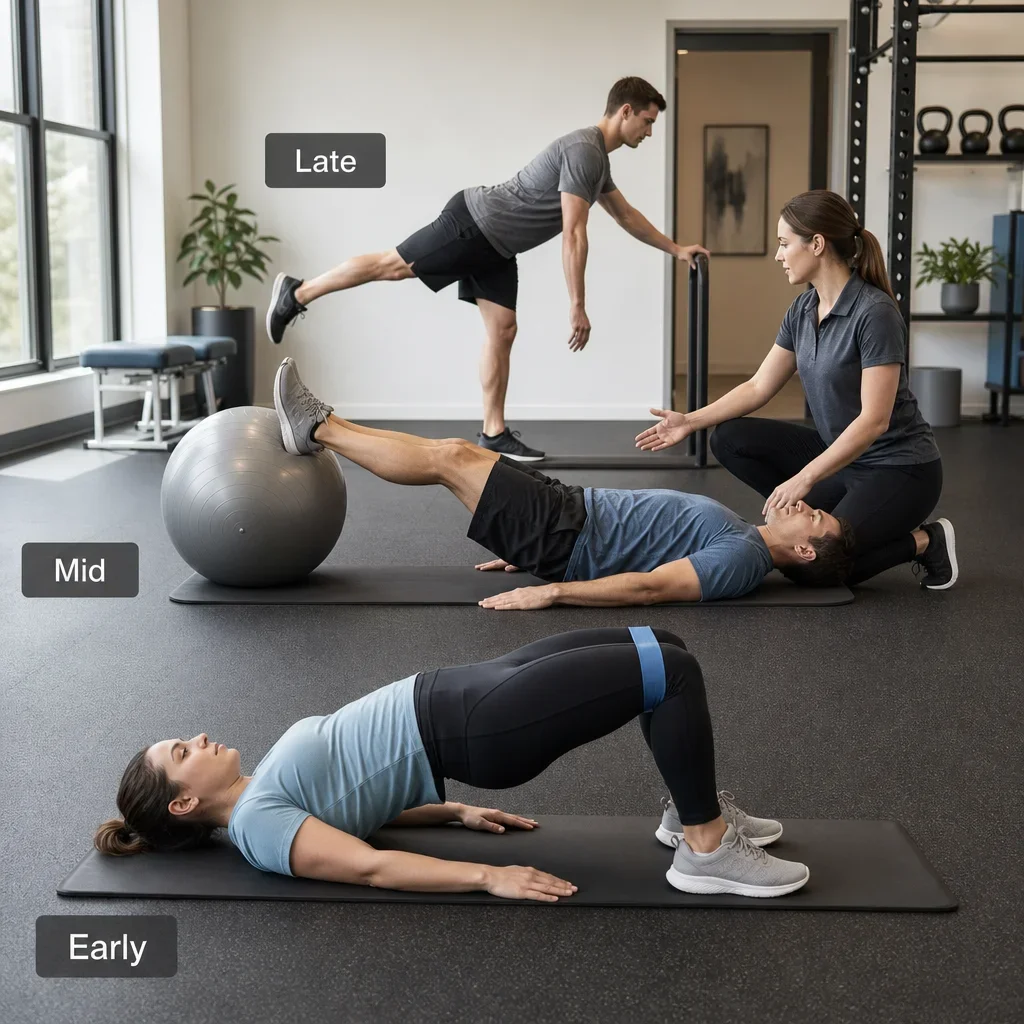
Hamstring rehabilitation should progress from tolerable movement toward controlled strength, lengthened loading, and sport-specific speed. The exact exercise selection depends on injury location, irritability, training history, and the goal you need to return to.
Early rehabilitation commonly emphasizes comfortable movement and low-irritability activation. The purpose is to restore confidence in using the leg without repeatedly provoking symptoms.
Mid-stage rehabilitation may include bridge variations, controlled hamstring curls, gradual hip-hinge work, and range-of-motion restoration where tolerated. These exercises begin rebuilding both knee-flexion and hip-extension capacity.
Later-stage rehabilitation may include hamstring slides, stability-ball curls, single-leg Romanian deadlift progressions, heavier hinging, and eccentric hamstring exercises. This phase prepares the hamstring for lengthened positions and faster loading.
Nordic hamstring curls are valuable for prevention and later-stage strength development, but they are not automatically the first or best exercise after every injury. A physiotherapist can decide when the exercise fits your current capacity.
| Rehabilitation goal | Examples | What it develops | Modify when |
|---|---|---|---|
| Restore comfortable movement | Walking and low-irritability activation | Confidence and basic tolerance | Limping or sharp pain appears |
| Build basic strength | Bridges, controlled curls, supported hinges | Knee-flexion and hip-extension capacity | Symptoms escalate after training |
| Build lengthened capacity | Hinge progressions, slides, stability-ball curls | Strength in longer hamstring positions | Range or load provokes pulling pain |
| Prepare for sport | Eccentric work, running drills, acceleration progressions | Speed and sport-specific tolerance | Movement quality deteriorates |
Runners need gradual reintroduction to longer strides and faster running. Football and soccer players need progressive kicking, acceleration, deceleration, and change-of-direction exposure. Gym-goers need a planned return to hinges, deadlifts, curls, and unilateral loading.
Older adults may benefit from supported bridges, chair-based hip hinges, step-ups, and controlled knee-flexion work selected for balance and tolerance. Sedentary workers may benefit from regular movement breaks and gradual leg-strength training rather than prolonged stretching sessions alone.
Best Exercises to Prevent Hamstring Injuries
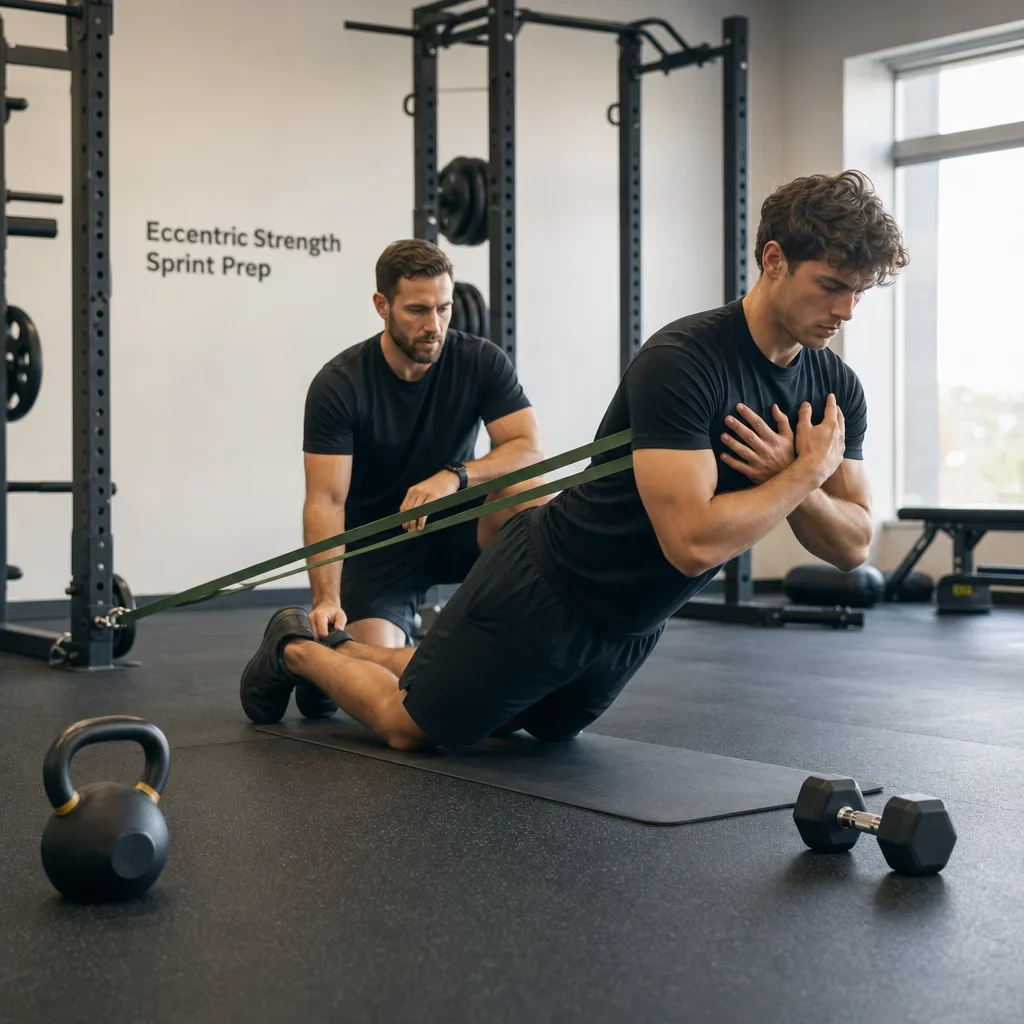
The best exercises to prevent hamstring injuries are not the same for every person. Prevention depends on sport demands, prior injury, strength, tolerance to sprinting, fatigue, and whether your program includes both knee-flexion and hip-hinge loading.
Progressive eccentric hamstring strengthening is a useful prevention tool because sprinting requires the hamstring to produce force while lengthening. Nordic hamstring curls are one example, but they may need regressions for people new to eccentric training or returning from injury.
Romanian deadlifts develop hip-hinge strength and hamstring capacity in a lengthened position. Hamstring curls develop knee-flexion strength, while bridges and hip-extension work can build a foundation for more demanding exercises.
Single-leg control, trunk strength, hip capacity, calf strength, and gradual sprint exposure support hamstring pull prevention. These qualities do not replace hamstring strengthening, but they help prepare the body for running, cutting, and fatigue-heavy sport demands.
Warm-ups prepare the body for training but do not guarantee injury prevention. A useful warm-up gradually exposes you to the movement speed, range, and coordination required by the session.
| Prevention focus | Exercise examples | Main purpose |
|---|---|---|
| Eccentric hamstring capacity | Nordic curl progression, sliders | Tolerance to lengthening under load |
| Hip-hinge strength | Romanian deadlift progression, hinge variations | Strength in longer hamstring positions |
| Knee-flexion strength | Hamstring curl variations | Direct hamstring capacity |
| Single-leg control | Split-stance work, step-ups, single-leg hinges | Control under running-like loading |
| Sprint preparation | Progressive drills and faster running exposure | Readiness for speed demands |
Stretches to prevent hamstring injury have a limited role when used alone. Comfortable mobility can support movement quality, but stretching does not replace progressive strength work and sensible training-load progression.
Why Hamstrings Keep Getting Pulled
Previous hamstring injury is a major reason recurrent symptoms need a more complete plan. Returning to sport before restoring strength, running capacity, and confidence can leave the hamstring underprepared for high-speed demands.
Sudden increases in sprint volume, training intensity, total workload, or fatigue-heavy sessions can exceed current tissue capacity. The problem is not always one workout; it can be a mismatch between recent training exposure and the demands of the next session.
Poor tolerance to lengthened positions can contribute to recurrent strains. This is why prevention and rehabilitation of hamstring injuries usually includes a gradual return to hip-hinge work, eccentric loading, and sport-specific speed rather than flexibility alone.
Movement mechanics can matter, but no single posture, pelvic position, foot pattern, or tight hip flexor explanation accounts for every hamstring injury. A biomechanics assessment is most useful when it looks at the whole picture: running demands, strength, fatigue, training history, and symptom behaviour.
Cramps and soreness should not automatically be treated as a strain. Hydration, fatigue, nutrition, medication, conditioning, nerve sensitivity, and training load can all influence cramping or posterior-thigh discomfort.
Return to Running and Sport: Progress by Readiness, Not Just Time

Walking without pain is not proof that you are ready to sprint, cut, kick, or compete. High-speed sport places greater force on the hamstring than daily activity.
Return to running should move from comfortable walking or jogging, when appropriate, toward controlled running, faster running, acceleration, deceleration, and sport-specific drills. Each stage should be tolerated without a meaningful symptom flare or loss of movement quality.
Return to sport requires more than reduced pain. Useful readiness domains include normal daily movement, appropriate range and strength for the individual, tolerance of progressive running, control during acceleration and deceleration, and confidence with sport-specific actions.
Full-speed running exposure matters for runners and field-sport athletes. Avoid returning to maximal sprinting or competition simply because the pain has settled at rest.
Return-to-sport checklist:
- Daily walking and stairs are comfortable and normal.
- Strength work is tolerated without a later flare.
- Running progression is tolerated without limping or guarding.
- Faster running, braking, cutting, or kicking have been rebuilt as needed.
- Sport-specific drills feel controlled rather than protective or hesitant.
- Recurrent symptoms, uncertainty, or competitive demands have been assessed clinically.
Hamstring Injury Recovery Time and the Myth of a Quick Fix
A true hamstring strain or tear cannot reliably heal in a few days. Recovery depends on the tissue involved, severity, location, previous injury, daily activity demands, sport demands, and the quality of progressive rehabilitation.
The fastest responsible approach is not aggressive stretching or complete rest. It is appropriate assessment when needed, temporary reduction of aggravating load, maintenance of tolerable movement, progressive strengthening, and criteria-based return to running or sport.
A hamstring tear can recover well, but suspected significant tears need medical assessment. Persistent weakness, bruising, a visible deformity, or inability to walk normally should not be managed with home exercises alone.
Online timelines cannot predict your recovery. A regulated physiotherapist can assess whether the pattern fits a muscle strain, tendon-related high hamstring pain, referred symptoms, or another issue requiring different management.
FAQ: Common Hamstring Injury Questions
What exercises should I avoid with a hamstring injury?
Avoid or modify exercises that reproduce sharp pain, marked pulling, limping, or worse symptoms after activity. Sprinting, jumping, kicking, aggressive stretching, heavy Romanian deadlifts, Nordic curls, and deep loaded hinges are commonly reduced early after a strain.
Are squats OK with a hamstring injury?
Squats may be tolerated when the depth, load, trunk position, and range do not aggravate symptoms. Reduce depth or load, use support, or choose another variation if the squat recreates hamstring pain.
Is walking good for a hamstring injury?
Walking can be useful when it is comfortable and does not create limping or a later symptom flare. Reduce walking and seek assessment if pain is sharp, gait changes, or symptoms worsen.
Should I stretch a strained hamstring?
Avoid forceful stretching into pain after a fresh strain. Later flexibility work can be useful when it is matched to your symptoms and rehabilitation stage rather than forced because the hamstring feels tight.
Can I still work out with a hamstring strain?
You may be able to train around a hamstring strain using non-provocative upper-body work and selected conditioning. Do not use training to repeatedly test painful sprinting, stretching, or heavy hinging.
How do I tell if my hamstring is strained or torn?
A pop, major bruising, marked weakness, visible contour change, or inability to walk normally increases concern for a significant injury. Symptoms alone cannot confirm a tear, so seek timely assessment when those signs are present.
What is the fastest way to heal a hamstring strain?
The fastest responsible path is to reduce aggravating load, maintain tolerable movement, rebuild strength progressively, and return to faster activity by function rather than by a fixed timeline. Pushing through sharp pain can delay progress.
How long does a pulled hamstring take to heal?
Recovery time cannot be predicted reliably from an online description. Tissue location, injury severity, prior injury, sport demands, and rehabilitation response all affect the timeline.
What is the best exercise to prevent hamstring pulls?
No single exercise prevents every hamstring injury. Progressive eccentric hamstring work, Romanian deadlift progressions, hamstring curls, single-leg control, and gradual speed exposure can all contribute to hamstring strain prevention.
Does stretching prevent hamstring injuries?
Stretching alone does not provide complete hamstring prevention. Comfortable mobility can be part of training, but progressive strength and appropriate exposure to running or sport demands are more complete prevention strategies.
Why does my hamstring keep getting pulled?
Repeated strains can be linked to previous injury, incomplete return to high-speed activity, abrupt training changes, fatigue, insufficient lengthened-strength capacity, or a mismatch between current conditioning and sport demands. A tailored assessment can identify which factors matter most.
What exercises should I avoid with proximal hamstring tendinopathy?
Exercises to avoid with hamstring tendinopathy commonly include deep toe-touching, prolonged seated stretching, deep forward folds, heavy deep RDLs, long-lever bridges, and uphill running when they reproduce high hamstring or sit-bone pain. Modify depth, lever length, resistance, and sitting exposure instead of assuming all hamstring exercise is harmful.
When a Hamstring Assessment Can Help
A physiotherapy or sports-medicine assessment can identify the movement and loading patterns that keep symptoms active. Assessment may include walking or running mechanics, hip and trunk movement, strength, range, training load, and the demands of your sport or work.
Studio Athletica supports downtown Toronto athletes, runners, gym-goers, active adults, and post-injury patients with biomechanics-led physiotherapy, chiropractic care, sports medicine, and massage therapy. A personalized plan can help you reduce aggravating movements, rebuild hamstring capacity, and progress toward running or sport without relying on generic online timelines.
Book a hamstring assessment when symptoms are recurrent, severe, unclear, or preventing a confident return to activity.
References
- Heiderscheit BC, Sherry MA, Silder A, Chumanov ES, Thelen DG. Hamstring strain injuries: recommendations for diagnosis, rehabilitation, and injury prevention. Journal of Orthopaedic & Sports Physical Therapy.
- JOSPT Clinical Practice Guidelines and rehabilitation literature on hamstring strain management and return to sport.
- Physiotherapy and sports-medicine literature on proximal hamstring tendinopathy, tendon loading, and exercise modification.
- Canadian Physiotherapy Association resources on physiotherapy assessment and rehabilitation.