

Medical note: This return to running after injury guide is general education, not medical clearance. Do not use it after surgery, suspected fracture or bone stress injury, tendon rupture, major trauma, or neurological symptoms without guidance from your surgeon, physician, or physiotherapist.
Returning to running after injury works best when you rebuild impact tolerance gradually. A hard first run is a fitness test. A controlled run-walk session is useful information about how your body responds.
The calendar matters less than your diagnosis, healing stage, movement control, strength, and symptom response. Runners returning after a minor settled overload problem may use a gradual plan. Runners returning after surgery, a fracture, a tendon tear, or persistent nerve symptoms need an individualized rehabilitation plan.
Return to Running After Injury: Start With Readiness, Not a Calendar
Healing and running readiness are related, but they are not the same thing. Tissue healing may be progressing while your calf, hip, knee, foot, or trunk still lacks the capacity to absorb repeated impact.
A safe return to running after injury starts when daily activity, walking, and basic movement no longer create a meaningful flare. A runner who can walk comfortably but limps, avoids one side, or develops increasing pain with impact is not ready to test running.
Your previous training also changes the starting point. A runner returning after two weeks away has a different baseline than someone coming back from injury running after several months of rehabilitation.
Studio Athletica physiotherapists assess movement, strength, load tolerance, and running goals for active adults in downtown Toronto. An assessment is useful when symptoms keep returning, the diagnosis is uncertain, or a race deadline is influencing decisions.
Do Not Start Running Yet If You Have These Red Flags
Stop using a generic return to run program after injury and seek timely medical assessment if you cannot bear weight, have severe or worsening pain, marked swelling, deformity, or a suspected fracture. Focal bone pain that worsens with hopping or easy activity needs assessment before impact training.
Seek urgent medical help for calf swelling with unexplained warmth, chest pain, shortness of breath, fever with a painful swollen joint, or new bowel or bladder changes. These symptoms can indicate conditions that need medical evaluation rather than exercise progression.
Numbness, progressive weakness, pain travelling down the leg, or back pain with neurological symptoms also require assessment. Running with an injured back or an L4/L5 imaging finding cannot be cleared from an online guide because symptoms, neurological signs, and function matter more than an imaging label alone.
Post-operative runners should follow their surgeon’s restrictions and rehabilitation criteria. Suspected bone stress injury, acute tendon tears, complete ligament injuries, exertional compartment-like symptoms, and tendon rupture are assessment-first situations.
Return-to-Running Readiness Checklist

Use this checklist before your first easy run-walk session. It is not diagnostic clearance, and it does not replace post-surgical or injury-specific testing.
☐ Daily activities are comfortable and do not cause increasing symptoms.
☐ You can briskly walk for 30 minutes without a limp or meaningful symptom increase.
☐ Your injured area has functional range of motion for walking, stairs, and basic exercise.
☐ You can stand on the affected leg for 30 seconds with controlled balance.
☐ You can complete 15 to 20 controlled single-leg squats or step-downs without obvious collapse, compensation, or increasing pain.
☐ You can complete 20 to 30 controlled single-leg calf raises when calf, ankle, Achilles, or foot capacity is relevant.
☐ You can perform low-level hopping only if impact is already comfortable and your clinician has not restricted it.
☐ You feel able to stop, walk, or repeat a level without treating the session as a failure.
Compare sides, but do not force a repetition target simply to pass a test. Control matters. A knee that dives inward, a pelvis that drops, or a foot that collapses may show a strength or coordination deficit worth addressing before increasing running load.
Do not use hopping as a self-clearance test after suspected bone injury, surgery, major trauma, or painful impact. Continue prescribed rehabilitation and seek a physiotherapy assessment instead of repeatedly test-running.
Pain Rules: Continue, Modify, Stop, or Get Help

Pain during a return from injury running plan must be judged by behaviour and recovery, not by one number alone. Mild symptoms that stay stable, do not change your gait, and settle promptly may be managed differently from sharp, escalating, focal, or next-day symptoms.
| Response | What it looks like | What to do |
|---|---|---|
| Green: continue cautiously | Mild symptoms stay stable, movement remains normal, and next-day function is unchanged. | Repeat the same level before progressing. |
| Yellow: modify | Symptoms increase slightly, stiffness lasts longer than expected, or confidence drops. | Reduce total running time, slow down, add walk breaks, or use flatter terrain. Change one variable only. |
| Red: stop and regress | Sharp pain, limping, swelling, altered mechanics, focal bone pain, or symptoms that build through the run. | Stop running, return to walking if comfortable, and reassess before the next session. |
| Assessment needed | Symptoms persist or worsen over 24 to 48 hours, return with every progression, or include neurological signs. | Book a clinician assessment before increasing impact. |
A commonly used general guide is to modify activity when pain rises above 3/10 or lasts beyond the next day. This is not a universal rule. Suspected bone stress injuries, acute tendon injuries, post-operative restrictions, and neurological symptoms should not be managed with a generic pain threshold.
Monitor symptoms during the run, later that day, the next morning, and through the following 24 to 48 hours. Delayed soreness can reveal that the session exceeded current load tolerance.
A 4-Week Run-Walk Return to Running Plan

This 4-week return to running after injury plan is for runners who have passed basic readiness checks, have been cleared for impact where needed, and are returning from a relatively uncomplicated injury or time away. It is not an ACL reconstruction, fracture, tendon rupture, or post-surgical protocol.
Use a five- to 10-minute easy walk before each session and a short walk afterward. Run at a conversational effort on level, predictable terrain. The first session is data gathering, not a test of pace or fitness.
| Week | Run-walk session | Rounds | Total running time | Session cue |
|---|---|---|---|---|
| 1 | Run 2 minutes, walk 1 minute | 5 | 10 minutes | Easy and controlled |
| 1 or 2 | Run 2 minutes, walk 1 minute | 7 | 14 minutes | Repeat only if symptoms settle well |
| 2 | Run 3 minutes, walk 1 minute | 5 | 15 minutes | Keep pace conversational |
| 3 | Run 4 minutes, walk 1 minute | 5 | 20 minutes | Maintain normal mechanics |
| 4 | Run 8 minutes, walk 1 minute | 3 | 24 minutes | Build confidence before continuous running |
Repeat a level when symptoms are uncertain. Reduce a level when symptoms worsen. Advance only after the previous session and next-day response remain settled.
A runner with a very short baseline can start below this table. One minute of easy running followed by two minutes of walking is a valid post injury running program starting point when it matches current tolerance.
Choose a 2-, 3-, or 4-Run Weekly Calendar

Early return-to-run sessions usually need recovery days between them. A conservative starting pattern uses at least 48 hours between impact sessions. Some runners need more spacing when symptoms are unpredictable or the injury is recent.
Two-run calendar
A two-run week suits lower confidence, a lower baseline, or a runner whose symptoms need more observation.
| Day | Plan |
|---|---|
| Monday | Run-walk session |
| Tuesday | Rehabilitation or rest |
| Wednesday | Low-impact cross-training if comfortable |
| Thursday | Strength or rest |
| Friday | Run-walk session |
| Weekend | Recovery walking, rehab, or rest |
Three-run calendar
A three-run week is a common structure once two sessions are tolerated without a flare.
| Day | Plan |
|---|---|
| Monday | Run-walk session |
| Tuesday | Strength or rehabilitation |
| Wednesday | Rest or low-impact conditioning |
| Thursday | Run-walk session |
| Friday | Rest |
| Saturday | Run-walk session |
| Sunday | Recovery day |
Four-run calendar
A four-run week is not the default for getting back into running after injury. Add a fourth run only after current frequency, duration, and recovery are consistently tolerated.
| Day | Plan |
|---|---|
| Monday | Easy run-walk |
| Tuesday | Strength or rehabilitation |
| Wednesday | Easy run-walk |
| Thursday | Rest or low-impact conditioning |
| Friday | Easy run-walk |
| Saturday | Rest |
| Sunday | Short easy run-walk |
Do not increase frequency, total time, pace, hills, and interval length in the same week. One changed load variable gives you clearer information about what your body can handle.
How to Progress Without Reinjury: Time, Effort, Terrain, and Load

Build time and consistency before you build speed. Total running time is usually easier to control than distance because it prevents runners from chasing their old pace too early.
Use conversational effort for the early phase. Rate of perceived exertion, or RPE, is useful because pace can be misleading while you are rebuilding capacity. An easy effort should feel controlled enough that you can speak in short sentences.
The 10% rule suggests increasing weekly volume by about 10%, but it is only a planning heuristic. It does not guarantee safety because injury risk also changes with sleep, work stress, terrain, strength fatigue, prior training, and the specific condition being rehabilitated.
The so-called 80% rule also lacks one universal clinical definition. Some runners use it to mean keeping most training easy, while others use it to mean stopping before a session feels maximal. Neither version replaces symptom monitoring or a diagnosis-specific rehabilitation plan.
The 10-10-10 rule is not a standardized medical return-to-run rule. Different coaches use the term for different combinations of gradual weekly progressions. A better principle is to change one loading factor at a time and assess your 24- to 48-hour response.
A sensible progression hierarchy is simple: tolerate easy run-walk sessions, build continuous easy running, increase duration or frequency, introduce gentle terrain changes, and add controlled intensity last. Hills, tempo running, track work, and speed sessions create different mechanical demands than flat easy running.
Strength, Rehab, Cross-Training, and Running Mechanics
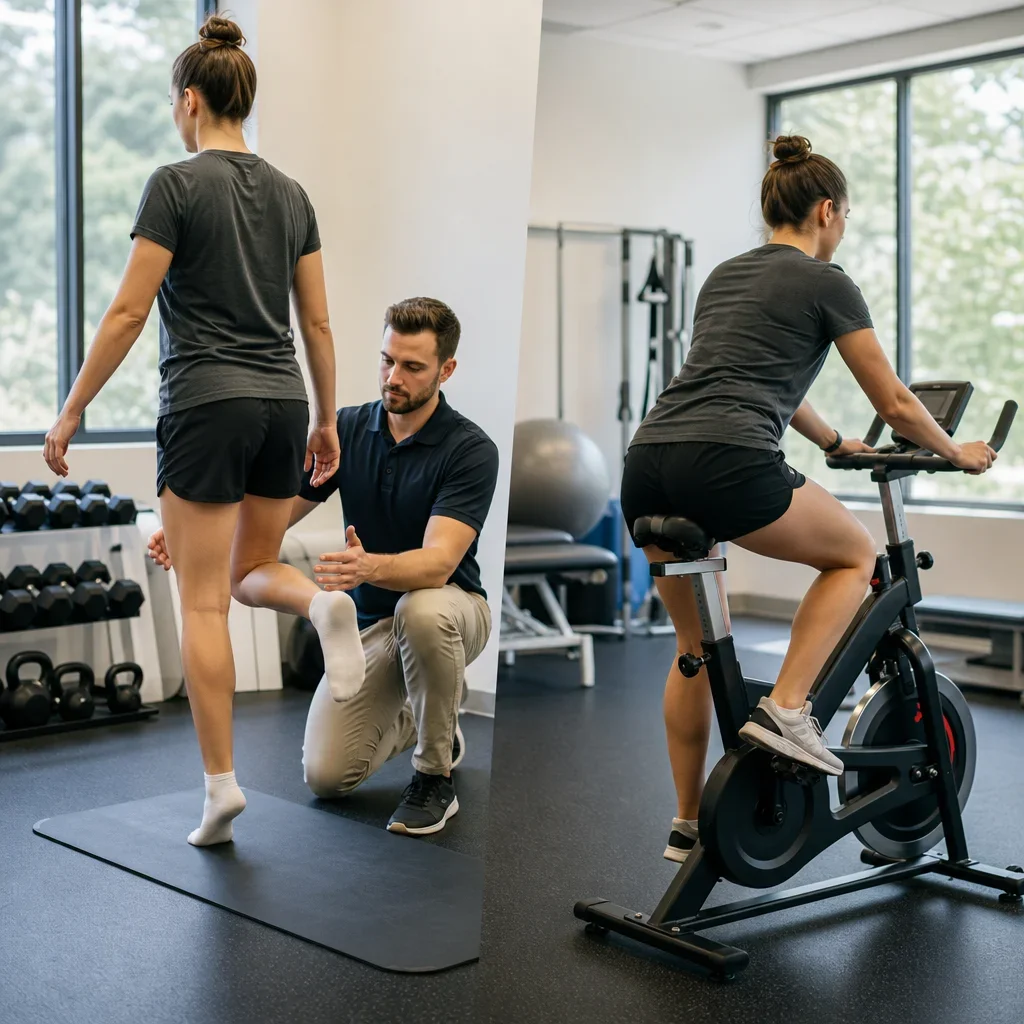
Rehabilitation should target the limiting factor found in your assessment. That may be calf capacity, hip and knee control, foot and ankle strength, trunk control, mobility, or tolerance to repeated loading.
Useful general exercise categories include calf raises, squat or step-down patterns, hip-dominant strengthening, single-leg balance and control, and trunk stability. Exercise selection and dosage should match the injury because running after tendon injury needs different loading decisions than returning after an ankle sprain or knee pain.
Low-impact cross-training can maintain fitness when it does not aggravate symptoms and suits the diagnosis. Cycling, pool running, elliptical training, or swimming are not automatically appropriate for every injury, so use the activity that remains symptom-tolerable.
Running mechanics may matter, but there is no universal “correct” stride. Cadence, stride length, trunk position, footwear, and surface should be assessed in context with strength, mobility, training load, and symptoms.
Comfortable, appropriate shoes can support a return, but new shoes alone do not prevent injury. Avoid making a major footwear change on the same week that you increase running time.
Adapt the Plan for Specific Injuries
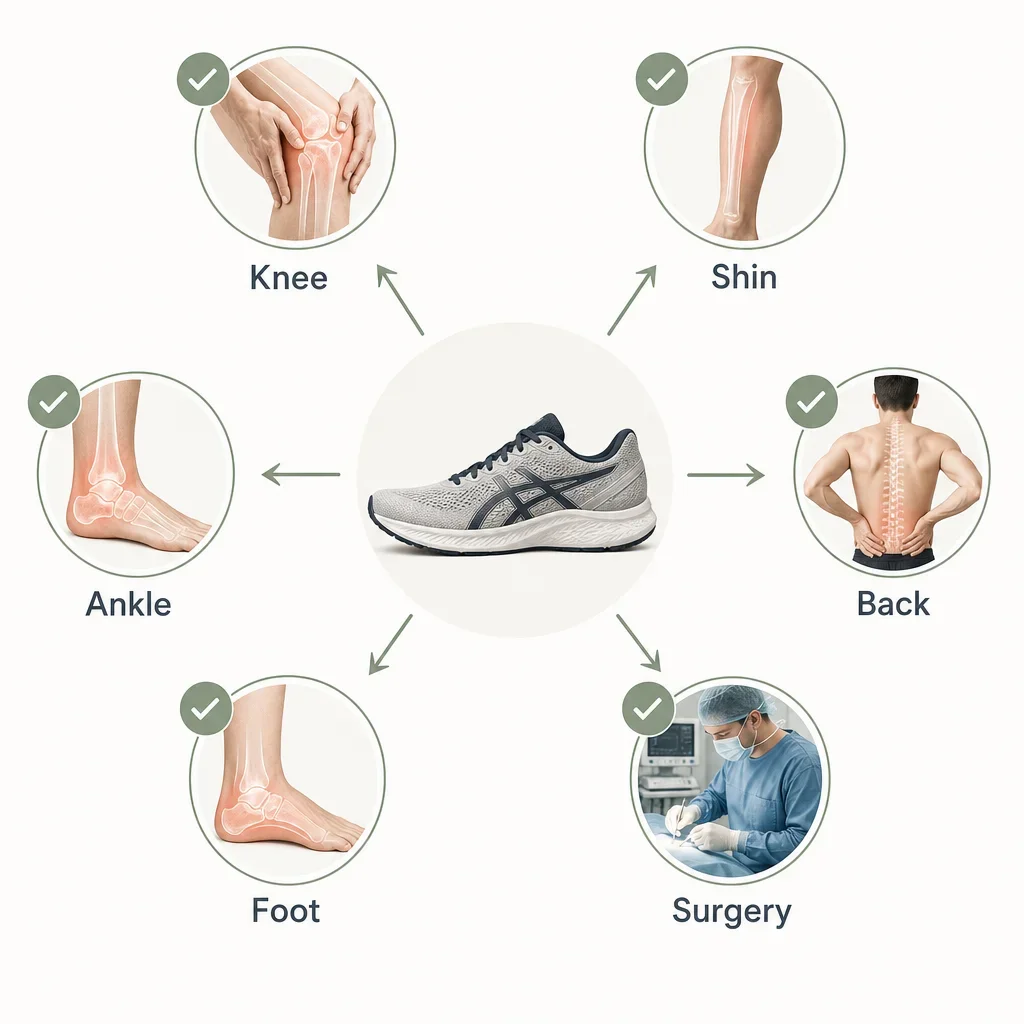
Different diagnoses need different precautions. A generic return to running program after ankle sprain should not be treated like a program for suspected bone stress injury or post-operative ACL rehabilitation.
| Presentation | General focus before progression | When a generic plan is not appropriate |
|---|---|---|
| Patellofemoral or front-of-knee pain | Knee and hip control, gradual impact tolerance, symptom response to stairs and running | Swelling, locking, giving way, major trauma, or persistent worsening pain |
| Lateral knee or IT band-related pain | Load management, hip control, avoiding abrupt hill or distance increases | Significant swelling, instability, or an unclear diagnosis |
| Ankle sprain | Walking, balance, calf strength, ankle control, and confidence on uneven ground | Persistent instability, marked swelling, inability to hop comfortably, or suspected fracture |
| Plantar heel pain | Gradual foot and calf loading, controlled running volume, symptom monitoring after rest | Severe focal heel pain, numbness, or symptoms worsening with each run |
| Achilles or other tendinopathy | Progressive tendon loading and careful changes to hills, speed, and total load | Sudden pop, bruising, major weakness, or suspected tear or rupture |
| Shin pain | Careful assessment of location, impact tolerance, footwear, and training change | Focal bone tenderness, pain at rest, or pain with hopping suggesting possible bone stress injury |
| Low back pain | Symptom-guided movement, trunk and hip capacity, and load management | Radiating pain, numbness, weakness, saddle symptoms, or bowel/bladder changes |
| ACL or other post-operative recovery | Surgeon and rehabilitation-team criteria, strength testing, and staged sport exposure | Any stage before clinician clearance or protocol milestones |
Returning to running after knee injury should focus on controlled function, not simply the absence of swelling on one day. Returning after plantar fasciitis or Achilles symptoms should also account for morning stiffness and delayed tendon response.
Treadmill, Trail, Track, Hills, and Race Return
Flat, predictable routes are easier to control early because they reduce unexpected terrain changes. A treadmill can help manage pace and grade, although it still creates running impact and should not be treated as injury-free.
| Surface or demand | Early return modification |
|---|---|
| Treadmill | Use a comfortable pace and predictable grade; avoid changing speed and incline together. |
| Road or path | Choose a flat, familiar route with an easy exit option. |
| Track | Use caution with repetitive turns, especially when ankle, hip, or knee symptoms remain. |
| Trail | Delay uneven terrain until balance, ankle control, and confidence are restored. |
| Hills | Reintroduce after level running is stable because uphill and downhill running change calf, knee, and tendon demand. |
Race registration is not a readiness test. Earn race-specific training after you can tolerate easy running consistently, recover normally, and complete the strength or rehabilitation work your condition requires.
Common Return-to-Running Mistakes
The biggest mistake is restarting at your old pace or distance. Fitness memory can make an early run feel manageable while the injured tissue and supporting muscles are not yet ready for repeated loading.
Use this short check before each session:
- Check current symptoms and your response to the previous run.
- Choose one planned session goal, such as total run time or interval length.
- Keep the terrain predictable.
- Skip hills, speed, and race-pace testing early.
- Do not use pain medication to mask worsening symptoms and push through a session.
- Keep rehabilitation and recovery days in the week.
- Be willing to stop or walk if mechanics change.
Overconfidence and fear can both interfere with recovery. Overconfidence pushes load too quickly. Fear can lead to avoiding all impact for too long. Graded exposure gives you manageable evidence that movement can be safe when the plan matches your current capacity.
When to See a Sports Physiotherapist for a Return-to-Run Assessment
Book an assessment when pain returns with each progression, your diagnosis is uncertain, you notice side-to-side weakness, or you are returning after surgery, suspected stress injury, or a significant tendon problem. Recurring injuries and a major race goal also justify an individualized plan.
A return-to-running assessment can review injury history, current symptoms, walking and running tolerance, strength, movement control, training load, footwear context, and goals. Physiotherapy is usually the primary service for a graded return-to-run plan, while sports medicine, chiropractic care, or massage therapy may be relevant depending on the condition and care plan.
Studio Athletica provides physiotherapy and sports medicine support for active adults in downtown Toronto. A clinician can help determine whether a standard walk-run program fits your presentation or whether you need a more specific rehabilitation pathway.
Frequently Asked Questions About Returning to Running After Injury
How long should I wait to run after an injury?
There is no universal waiting period. Return depends on the diagnosis, tissue healing, walking tolerance, strength, impact tolerance, symptom response, and any surgeon or physician restrictions. A minor settled overload problem and a stress fracture, tendon rupture, or surgery do not follow the same timeline.
Can I return to running before I am completely pain-free?
Some runners can begin graded activity with mild, stable symptoms that do not alter gait or worsen afterward. That approach does not apply to every condition. Sharp pain, focal bone pain, limping, swelling, neurological symptoms, or worsening next-day function are reasons to stop and seek assessment.
What pain level is acceptable when returning to running?
A general guide is that symptoms should remain mild, stable, and settle promptly without changing your movement. Pain above 3/10 or symptoms lasting beyond the next day are commonly used reasons to reduce load. This is not a clearance rule for bone, tendon, surgical, or neurological conditions.
Should I run on consecutive days when coming back from injury?
Consecutive running days are usually not the starting point. Early programs commonly leave at least 48 hours between impact sessions so you can assess delayed symptom response. The best spacing depends on your diagnosis, prior running history, rehabilitation status, and recovery response.
What should my first return-to-run session look like?
Start with a short easy walk, then use controlled run-walk intervals on flat terrain. A sample first session is two minutes of easy running and one minute of walking repeated five times, for 10 minutes of running. Reduce the interval if that baseline feels too demanding.
How do I return to running after a knee injury?
Return after a knee injury when walking, stairs, single-leg control, and low-level impact are improving without a flare. Build flat easy run-walk sessions before hills or speed. Swelling, locking, giving way, major trauma, or persistent pain should be assessed before using a generic plan.
Can I run with an injured back?
Back pain requires symptom-based assessment rather than a decision based only on L4 or L5 imaging language. Running may be appropriate for some people once movement and impact are tolerated, but radiating pain, numbness, weakness, or bowel and bladder changes require medical assessment before running.
What is the 80% rule for running?
The 80% rule is used inconsistently. It may mean keeping most training easy or stopping before maximal effort. It is not a validated universal return-to-running formula. Use symptom response, controlled progression, and rehabilitation criteria instead of relying on one percentage.
What is the 10-10-10 rule for running?
There is no single standardized 10-10-10 return-to-running rule. Some programs use it as a shorthand for small training increases, but it does not account for diagnosis, terrain, intensity, or delayed symptoms. Change one load variable at a time and reassess over 24 to 48 hours.
Do I need a physio for a return-to-running plan?
Physiotherapy is useful when pain persists, recurs with progression, follows surgery, involves suspected bone or tendon injury, or creates uncertainty about movement and strength deficits. A physiotherapist can assess your specific capacity and build a plan around your sport, schedule, and goals.
Can I download a return to running after injury PDF?
This page can be printed or saved as a PDF for personal reference. It is not a medical clearance form. A downloadable worksheet should only be used alongside the readiness checklist, symptom rules, and individualized advice when your injury requires professional guidance.
—
Clinical review: Studio Athletica physiotherapy team. Review date: March 2025. This guide supports informed discussion with a regulated health professional and does not replace medical assessment, surgical protocols, or individualized rehabilitation.