
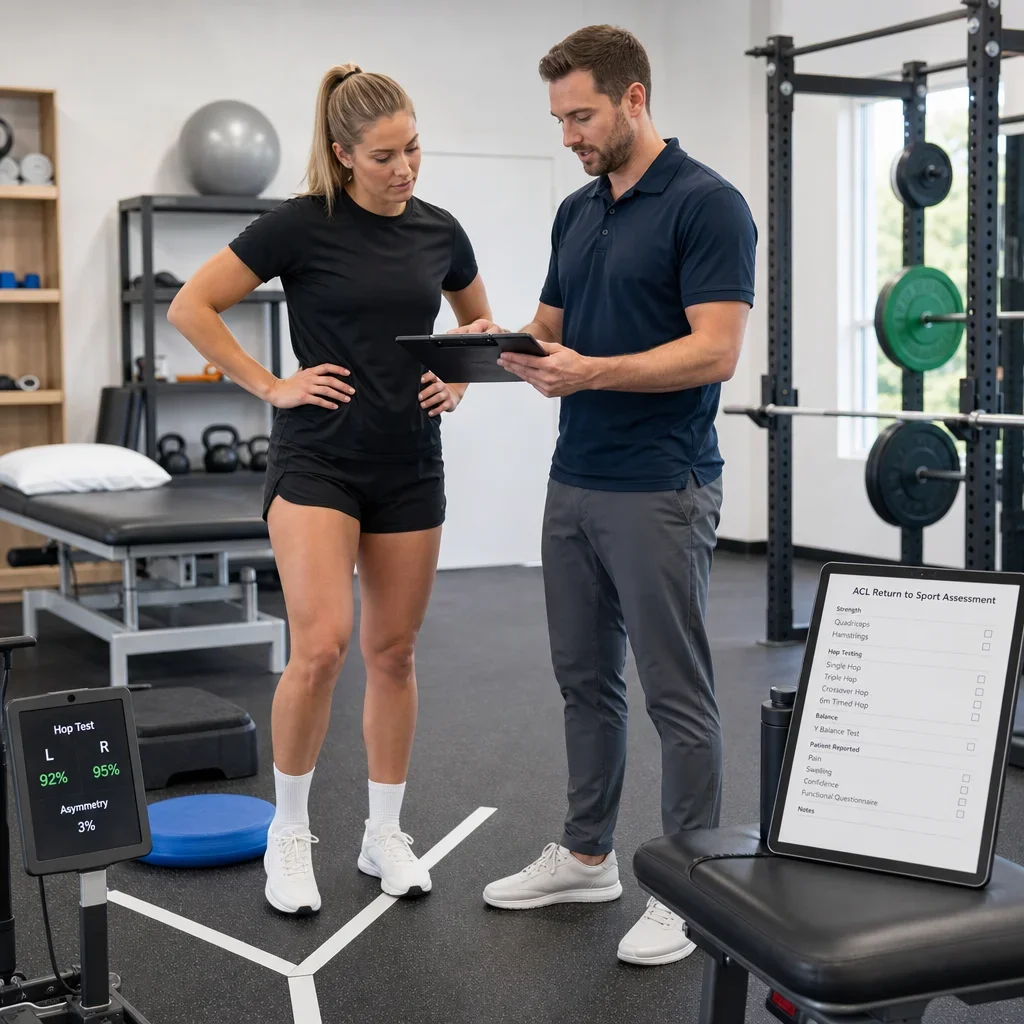
Can a calendar date clear you for sport after ACL surgery? Return to sport testing says no: readiness depends on symptoms, strength, movement control, sport demands and confidence, not the surgery date alone.
Medical guidance: This guide is educational and does not provide self-clearance for running, cutting, jumping, contact sport or competition. ACL rehabilitation plans must account for your surgery, graft, associated meniscus or cartilage procedures, symptoms and surgeon guidance. Speak with your treating clinician before attempting maximal hop, agility or fatigue testing.
ACL Return-to-Sport Testing: What It Is and What It Can Tell You
ACL return-to-sport testing is a structured assessment of knee recovery and sport capacity after ACL injury or reconstruction. A comprehensive functional return to sport test looks at symptoms, range of motion, strength, hopping, landing mechanics, change of direction, sport-specific capacity and psychological readiness.
No single score, hop distance or date can prove that a knee is ready for unrestricted sport. Testing supports shared decisions between the athlete, treating clinician, surgeon and, where relevant, parents and coaches.
An ACL screening or diagnostic examination answers a different question from a return-to-sport ACL test. Clinical tests such as Lachman assessment examine possible ligament laxity or injury, while return-to-play testing examines how the athlete performs after rehabilitation.
| Test-battery component | What it assesses | Why it matters |
|---|---|---|
| Symptoms and clinical review | Pain, swelling, instability, range of motion | A reactive knee can make higher-level testing misleading or unsafe |
| Strength testing | Quadriceps, hamstrings and hip capacity | Strength supports deceleration, landing and force absorption |
| Hop and jump testing | Single-leg force production and control | Hopping reveals function that walking and gym exercises may miss |
| Movement-quality review | Knee, trunk, hip and foot control | A good distance score can hide poor landing strategy |
| Agility and reactive tasks | Cutting, braking and decision-making | Pivoting sports require more than straight-line hopping |
| Psychological readiness | Confidence, fear and trust in the knee | Fear or hesitation can change movement and training exposure |
| Sport-specific exposure | Demands of the athlete’s actual sport | A runner, skier and basketball player need different final-stage tasks |
When Can You Start ACL Return-to-Sport Testing?
Formal higher-level testing starts after foundational rehabilitation milestones are in place, not simply when a certain number of months has passed. Time from surgery matters because healing, graft recovery and progressive loading take time, but it is only one part of the decision.
Later-stage assessment is commonly discussed around the six-to-nine-month period after ACL reconstruction, but this is not a universal clearance window. Your surgeon’s restrictions, graft type, additional procedures, symptoms, training history and sport all affect when testing is appropriate.
Advanced hop, cutting and reactive tests should be deferred when the knee has concerning pain, new swelling, giving-way episodes, locking, loss of motion or poor single-leg control. These findings call for reassessment and targeted rehabilitation rather than a harder test.
A useful prerequisite for an ACL test for return to sport is tolerance of progressively demanding strength and running work without a concerning next-day knee response. Clinicians also review gait, knee motion, single-leg squat control and confidence before adding maximal tasks.
The ACL Return-to-Sport Testing Sequence
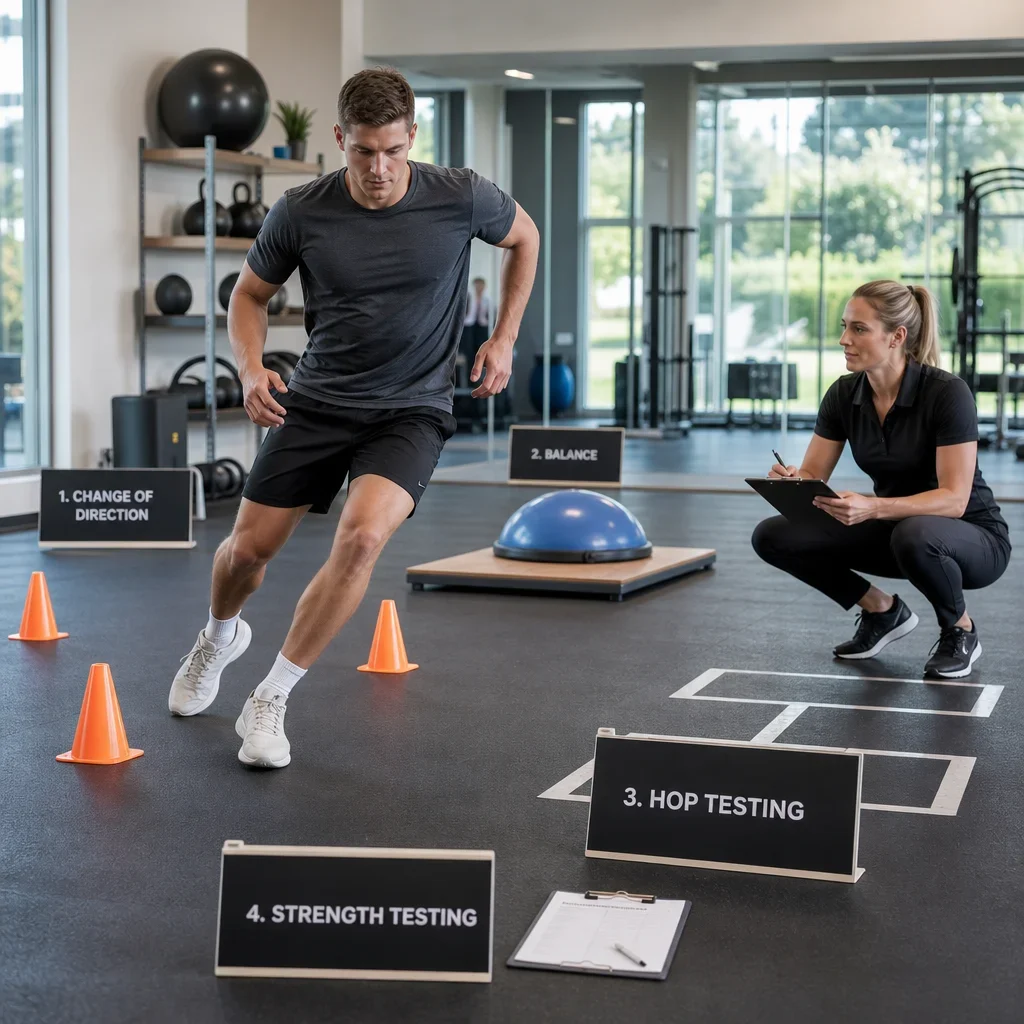
A staged ACL testing protocol moves from basic control to unpredictable sport demands. Passing one stage supports progression to the next stage; it does not automatically mean full competition clearance.
- Symptom and clinical readiness: Review pain, swelling, instability, gait and daily function.
- Range of motion and basic control: Check knee motion, squat pattern, balance and single-leg control.
- Strength testing: Assess quadriceps, hamstrings, hips and overall lower-limb capacity.
- Jump and hop capacity: Use supervised single-leg hop or jump tasks when appropriate.
- Landing and movement quality: Observe alignment, balance, force absorption and trunk control.
- Change of direction and reactive tasks: Progress from planned drills to decision-based movement.
- Sport-specific and fatigue-state exposure: Match drills to the athlete’s actual sport demands.
- Confidence and staged return plan: Combine physical findings with goals, fear level and training tolerance.
A soccer midfielder may need sprinting, braking, cutting and reactive passing drills before competition exposure. A runner may need a different sequence focused on impact tolerance, cadence, hills, pace changes and distance progression.
Step One: Clinical Readiness Before Functional ACL Testing
The knee should be calm and functioning reliably before advanced ACL clearance testing begins. Pain, effusion, instability, loss of motion and altered walking can all change how an athlete performs on strength or hop testing.
A positive Lachman’s test can indicate increased forward movement of the tibia relative to the femur and may suggest ACL insufficiency in the right clinical context. It is not a return-to-sport test, and it should not be used as a do-it-yourself diagnosis.
A clinician may use ligament-stability tests as part of a broader knee examination, but these tests do not measure whether you can cut, land, sprint or tolerate fatigue. Return-to-play testing adds functional performance and movement assessment to the clinical picture.
New swelling, a giving-way event, locking, escalating pain, a fresh injury or loss of previously gained motion are reasons to pause progression. Contact your treating clinician or surgeon for reassessment instead of testing through those symptoms.
Step Two: Strength Testing After ACL Surgery
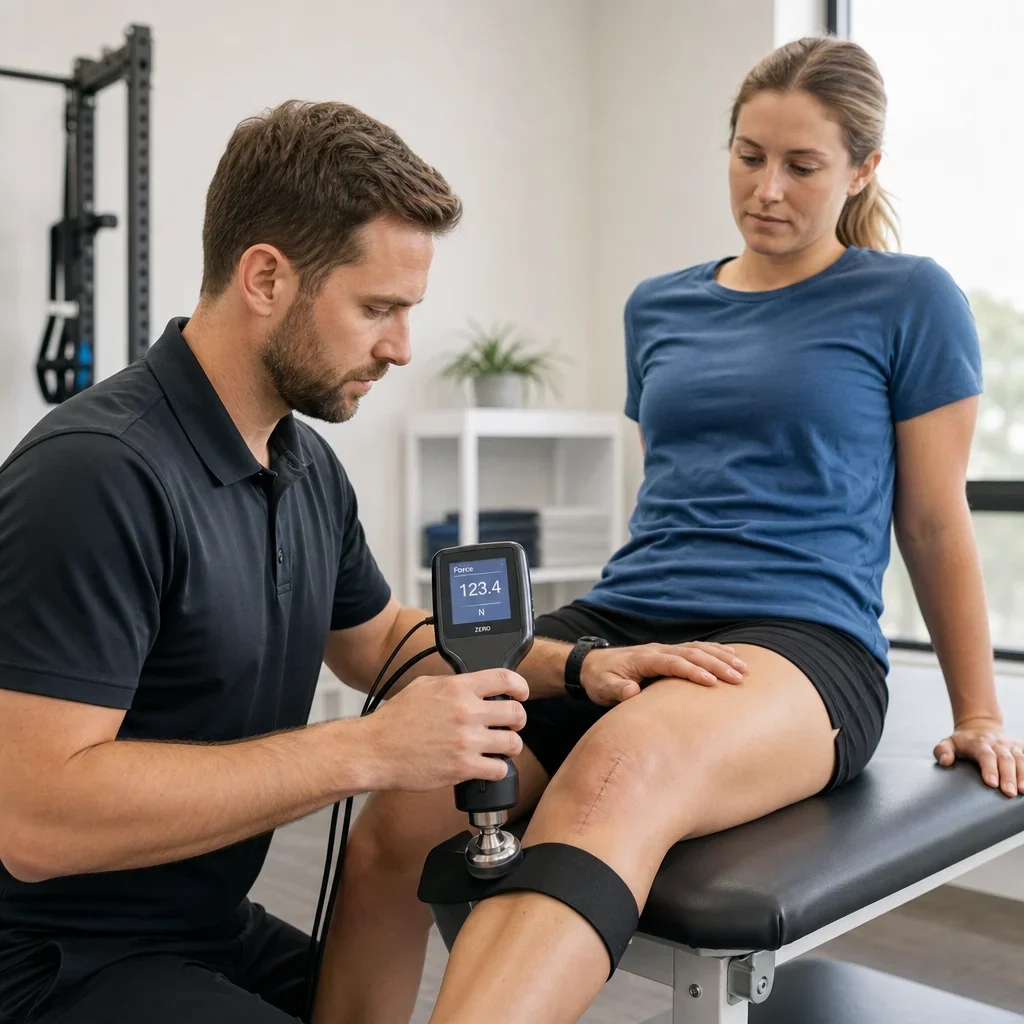
Quadriceps strength is central to ACL recovery because the quadriceps help control knee bending, absorb landing forces, manage stairs and support deceleration. A persistent strength deficit can show up as a stiff landing, poor braking or avoidance of the surgical side.
Hamstring and posterior-chain strength also matter for sprinting, deceleration and lower-limb control. This may be especially relevant when rehabilitation must rebuild hamstring capacity after a hamstring tendon graft, although testing still needs individual interpretation.
Strength testing can use isokinetic dynamometry, fixed dynamometry, handheld dynamometry and functional strength tasks. Results from different devices and test positions are not automatically interchangeable because each method measures force under different conditions.
Limb symmetry index, or LSI, compares the involved limb with the uninvolved limb. The basic calculation is involved-side result divided by uninvolved-side result, multiplied by 100.
An LSI of 90% or greater is a commonly cited benchmark for some later-stage strength and hop tests, but it is not a universal clearance threshold. A high symmetry score can occur when the uninvolved leg has also become weaker during rehabilitation.
| Strength measure | What it shows | Limitation to consider |
|---|---|---|
| Limb symmetry index | Difference between involved and uninvolved limbs | Both limbs may be deconditioned |
| Absolute strength | Total force relative to body size and sport demand | Requires context, equipment and comparison data |
| Isokinetic dynamometry | Controlled strength across a set speed | Access and protocol vary between settings |
| Handheld or fixed dynamometry | Practical comparison of muscle force | Tester setup and position affect results |
| Functional strength tasks | Control during squats, step-downs or split squats | They do not replace direct strength measurement |
Step Three: ACL Hop Tests and How They Are Scored
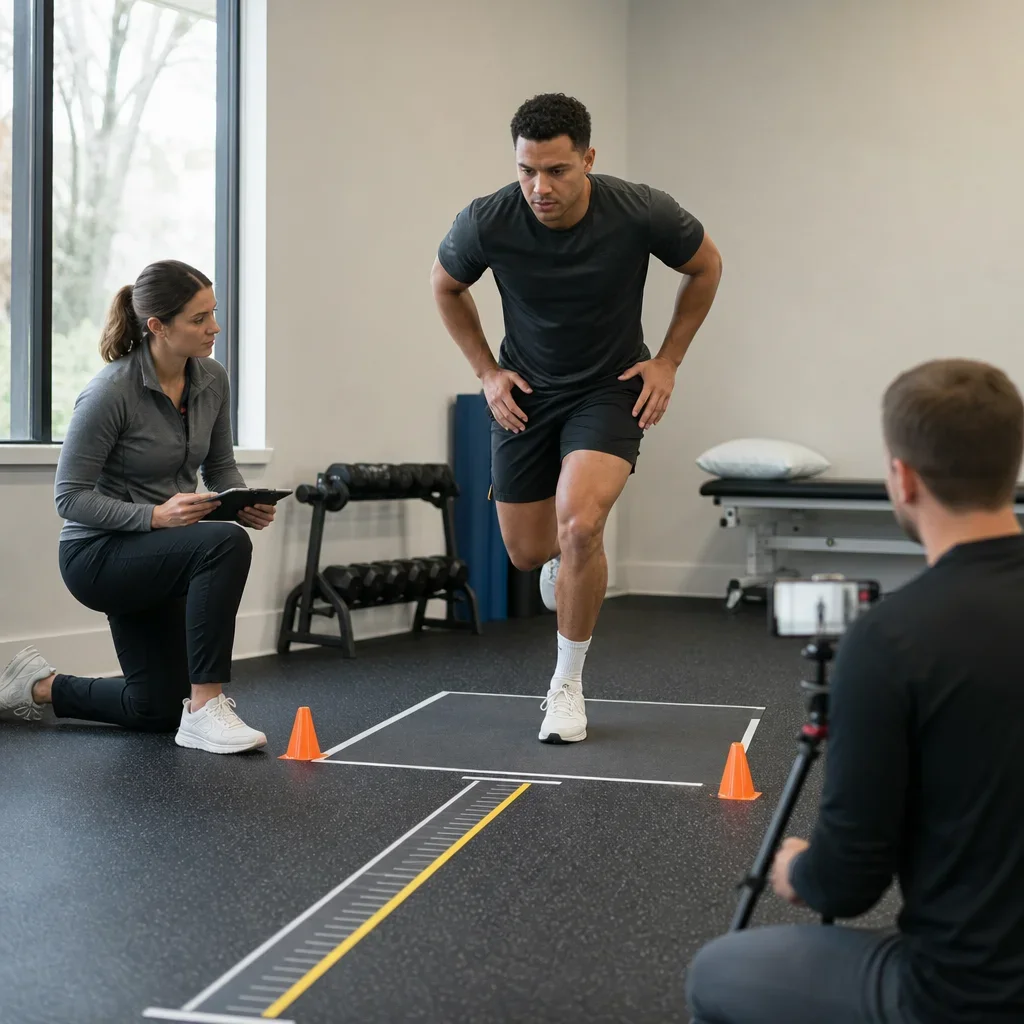
ACL hop tests assess how well an athlete can generate, absorb and control force on one leg. They are supervised tasks, not downloadable self-clearance exercises for pivoting or contact sport.
The ACL hop test battery commonly includes distance-based and timed hopping tasks. Clinicians observe the result, but also watch knee alignment, trunk position, balance, landing noise, hesitation, pain and the ability to stabilize each landing.
| Hop test | Basic task | Typical score | What the clinician also observes | When it may be deferred |
|---|---|---|---|---|
| Single-leg hop for distance | One controlled forward hop on one leg | Distance reached | Stable landing, knee control and confidence | Pain, swelling, poor single-leg control or inability to land safely |
| Triple hop for distance | Three consecutive forward hops | Total distance | Rhythm, force absorption and control across repeated landings | Loss of balance, apprehension or symptom increase |
| Crossover hop for distance | Repeated hops crossing a centre line | Total distance | Lateral control, trunk position and directional confidence | Poor frontal-plane control or pain with lateral loading |
| Six-metre timed hop | Hop across a six-metre distance as fast as safely possible | Time to complete the task | Efficiency, stability and compensations | Inability to tolerate repeated hopping or unstable landings |
For distance hops, the involved-side result is commonly compared with the uninvolved side using LSI. For the six-metre timed hop, lower time is better, so the calculation must account for the direction of scoring.
A good hop distance does not erase poor movement quality. An athlete can travel far while landing stiffly, shifting away from the surgical side or allowing the knee and trunk to lose control.
Step Four: Movement Quality, Landing Mechanics and Change of Direction
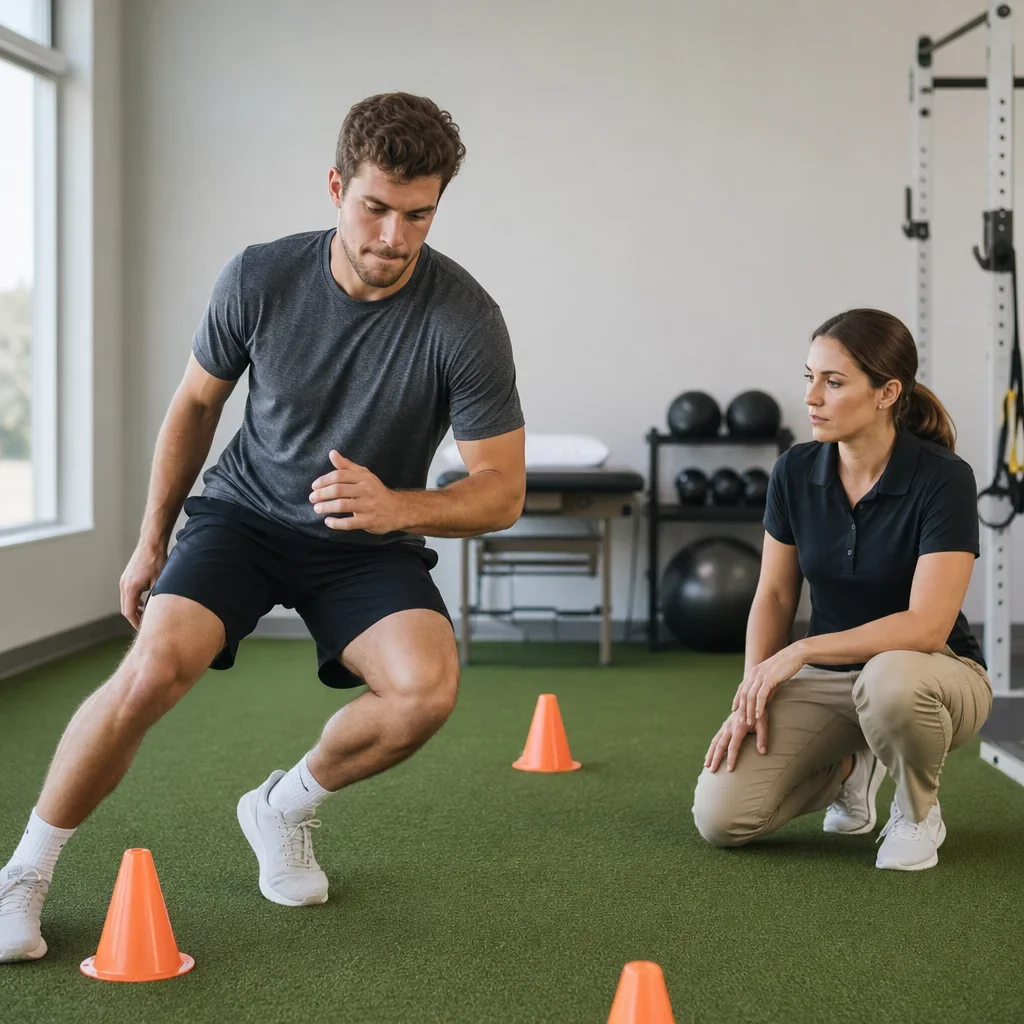
Movement-quality testing looks for how an athlete completes a task, not only whether they complete it. A strong hop score can coexist with reduced knee bend, unequal loading, loss of trunk control, poor balance or hesitation on landing.
Clinicians may observe single-leg squats, step-downs, jump landings, drop jumps, deceleration and planned change-of-direction tasks. No one movement screen is a complete answer, so results must be considered with strength, symptoms and sport demands.
Reactive tasks add decision-making because sport rarely happens in a straight line. A basketball player responding to a defender or a soccer player braking to change direction faces a different demand than a planned cone drill.
Fatigue can reveal changes in landing control or confidence that are not visible early in a session. Fatigue-state testing should be chosen and supervised carefully because it increases task demand.
Passing hop distance but showing poor landing mechanics usually means targeted rehabilitation and retesting are needed before progression. The useful result is not “failure”; it is a clear description of the gap to address.
Step Five: Confidence, Fear of Reinjury and ACL-RSI
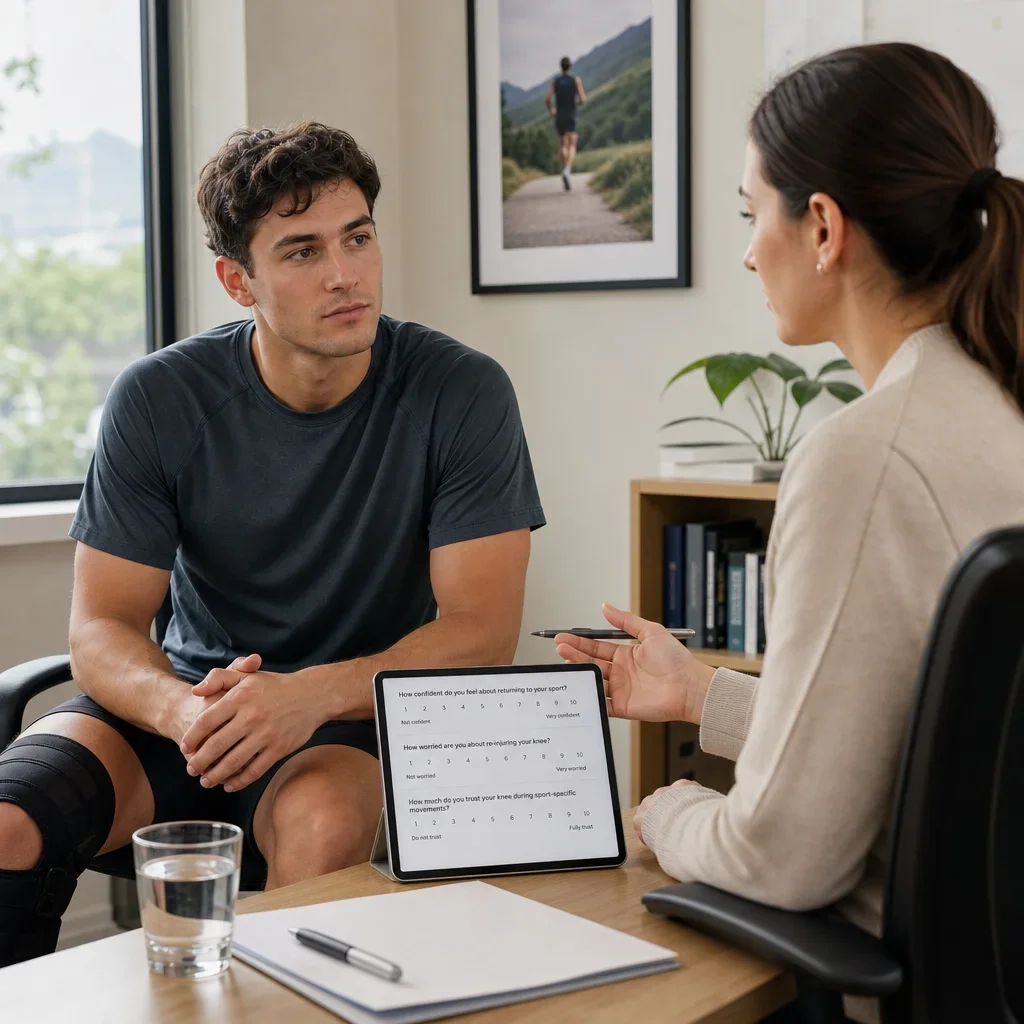
Psychological readiness belongs in return-to-play decisions because confidence, fear of reinjury and trust in the knee can affect movement and training exposure. An athlete may have physical capacity but still hesitate during cutting, landing or contact situations.
The ACL-RSI is a patient-reported questionnaire designed to assess psychological readiness after ACL injury or reconstruction. It should be interpreted alongside physical testing, symptoms, sport context and the athlete’s goals.
Low confidence can be addressed through graded exposure to the feared task, successful repetitions at manageable intensity, improved physical capacity and clear communication with the rehabilitation team. Mental-performance or mental-health support may also be appropriate when fear is persistent or affecting daily life.
Confidence alone does not establish readiness, and fear is not a personal weakness. Both are useful clinical information that can guide the next rehabilitation step.
How to Interpret ACL Return-to-Sport Test Results
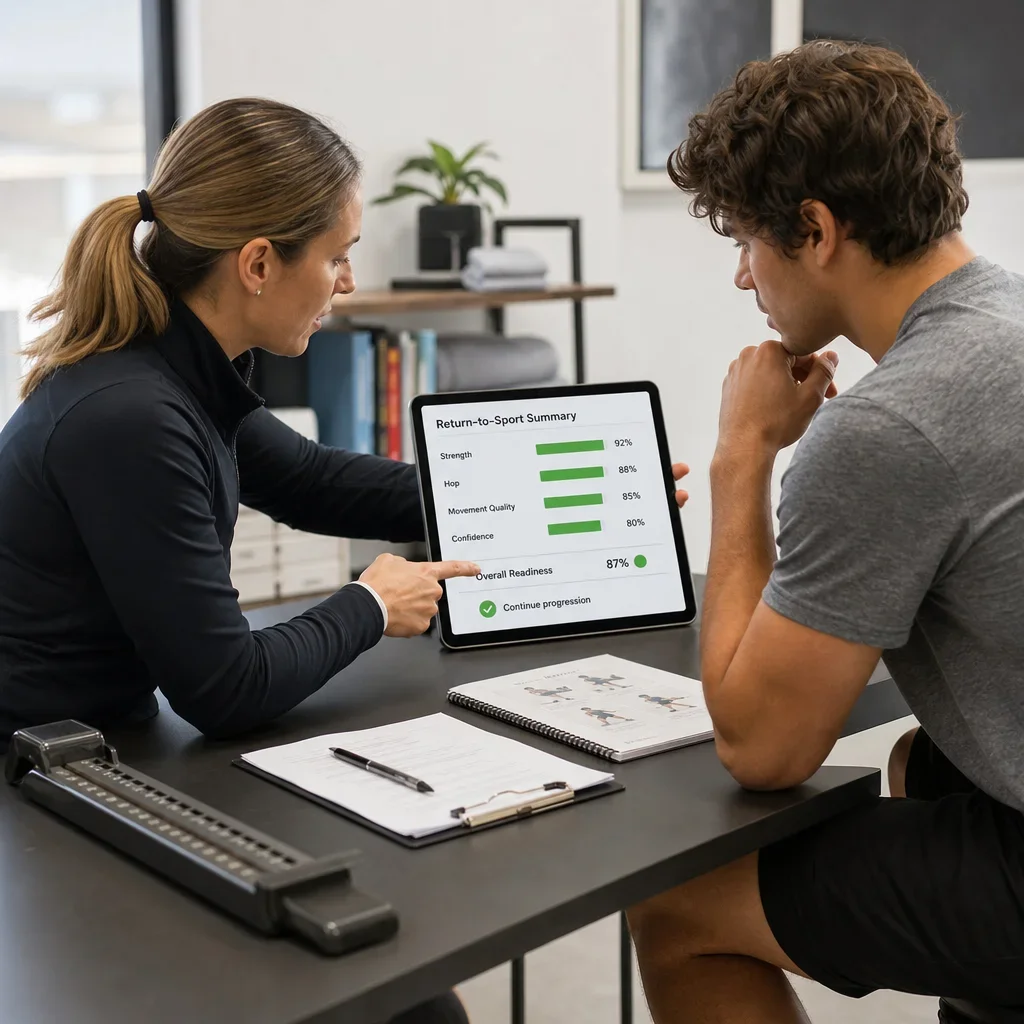
ACL return-to-sport criteria work best as a profile, not a single pass-or-fail score. A test battery helps identify modifiable gaps and guides the next block of rehabilitation.
| Result pattern | What it can mean | Typical next step |
|---|---|---|
| Objective scores and movement quality are strong | Physical capacity supports progression to more specific training | Build controlled sport exposure and monitor symptoms |
| Hop score is strong but landing quality is poor | Distance may be masking a control deficit | Train landing, deceleration and single-leg control, then retest |
| Strength is good but confidence is low | Fear or uncertainty may limit sport movement | Use graded sport exposure and address the feared context |
| Confidence is high but strength remains limited | Motivation exceeds current physical capacity | Resume targeted strengthening and reassess capacity |
| Symptoms occur during testing | Load tolerance may be insufficient or the knee needs reassessment | Stop advanced testing and review symptoms with the treating clinician |
| A task cannot be completed safely | The test is currently above the athlete’s capacity | Use lower-level rehabilitation tasks before retesting |
The uninvolved leg should not be treated as a perfect baseline without context. Both limbs can lose strength, power and conditioning after surgery, reduced sport exposure or a long rehabilitation period.
Surgical history, meniscus or cartilage procedures, previous ACL injury, age, sport, position and competition level all change how results are interpreted. This is why a generic ACL return-to-sport testing PDF cannot replace an individualized assessment.
Return to Training, Return to Competition and Return to Performance
Return to training means controlled participation in practice, drills or modified sessions. Volume, intensity, contact and movement complexity may still be adjusted.
Return to competition means participating in a game, race or event after appropriate progression and decision-making with the athlete’s care and coaching team. Competition is a higher demand because it adds fatigue, pressure and unpredictable movement.
Return to performance means rebuilding pre-injury sport capacity, confidence and consistency. It can take longer than returning to competition because performance depends on fitness, timing, decision-making and full training exposure.
A soccer athlete may progress from straight-line running to technical drills, controlled cutting, practice minutes and then match exposure. A runner may progress from impact tolerance to distance, pace, terrain and race-specific demands.
Symptoms, next-day knee response, swelling, soreness, movement quality and training tolerance should guide load progression. A quiet knee after one session does not automatically confirm tolerance for a larger or more complex session.
How ACL Testing Changes by Sport and Athlete
The final return to sport ACL test should match the sport the athlete is returning to. Running, cutting, jumping, skiing and rotational sports place different demands on the knee and nervous system.
| Sport category | Priority demands | Useful assessment emphasis |
|---|---|---|
| Running and endurance sport | Impact tolerance, repetitive loading, pace and terrain control | Strength, gait, single-leg control and progressive running exposure |
| Field and court cutting sports | Braking, cutting, lateral control and reactive decisions | Hop tests, deceleration, change of direction and reactive drills |
| Jumping sports | Vertical force production, landing control and repeated jumping | Jump-landing quality, single-leg force absorption and fatigue tolerance |
| Skiing and rotational sports | Dynamic balance, rotation, terrain response and confidence | Single-leg control, lateral stability, rotational demands and graded sport exposure |
A recreational jogger, competitive midfielder and basketball guard can all have an ACL reconstruction but need different end-stage testing. Position, level of competition, training environment and actual sport goals matter.
Young athletes need individualized progression, appropriate family involvement and continued attention to movement quality and neuromuscular training. Pediatric and adolescent decisions should be made with the treating clinician and surgeon rather than a copied adult checklist.
Printable ACL Return-to-Sport Testing Checklist
Use this checklist as a discussion tool with your treating clinician, not as proof of clearance. A clinician-reviewed ACL return-to-sport testing PDF can be created from this checklist before it is used as a downloadable patient resource.
Athlete details
- Sport and position: ______
- Surgery date: ______
- Graft type, if known: ______
- Other procedures, if known: ______
- Current rehabilitation phase: ______
- Treating clinician and surgeon guidance reviewed: ______
Symptoms and clinical readiness
☐ Assessed
☐ Meets current progression criteria
☐ Needs further rehabilitation or reassessment
☐ Not yet tested
Pain, swelling, instability, locking and range of motion reviewed
Daily activity and rehabilitation loading tolerance reviewed
Strength and functional testing
☐ Quadriceps strength assessed
☐ Hamstring and posterior-chain capacity assessed
☐ Limb symmetry interpreted with absolute strength and sport demands
☐ Single-leg squat or step-down control reviewed
Hop, jump and movement quality
☐ Single-leg hop assessed when appropriate
☐ Triple hop assessed when appropriate
☐ Crossover hop assessed when appropriate
☐ Six-metre timed hop assessed when appropriate
☐ Landing mechanics and stabilization reviewed
☐ Pain, swelling and confidence during testing documented
Sport progression
☐ Running or impact tolerance assessed where relevant
☐ Cutting, deceleration or reactive drills assessed where relevant
☐ Sport-specific exposure plan created
☐ Confidence and ACL-RSI discussion completed where relevant
☐ Return-to-training plan documented
Retest date or next review: ______
Clinician notes and next goals: ______
ACL Return-to-Sport Testing in Downtown Toronto
A biomechanics-led assessment can identify whether the next priority is strength, landing control, running tolerance, cutting mechanics, confidence or sport-specific exposure. The goal is to turn test findings into a focused rehabilitation plan rather than reduce recovery to one score.
For a downtown Toronto physiotherapy or sports medicine assessment, bring surgical and rehabilitation information if available, surgeon guidance, current training details and questions about your sport goals. Existing strength or hop results can also be useful for interpretation.
Studio Athletica supports athletes and active adults with individualized physiotherapy, chiropractic care, massage therapy and sports medicine services. A clinician can assess current movement capacity and help plan the next rehabilitation stage without promising a clearance date or injury-free return.
FAQ
What is ACL return-to-sport testing?
ACL return-to-sport testing is a clinician-guided assessment of symptoms, strength, hopping, movement quality, sport demands and psychological readiness after ACL injury or reconstruction. It helps guide progressive training decisions rather than providing automatic clearance.
Is nine months the sweet spot for ACL return to sport?
Nine months is not a universal clearance date. It is a later-stage point commonly discussed in ACL rehabilitation, but readiness still depends on healing restrictions, symptoms, strength, movement control, training exposure and surgeon guidance.
What does a 90% limb symmetry index mean?
A 90% LSI means the involved limb produced 90% of the measured result of the uninvolved limb. It can be useful for comparison, but it does not show whether both limbs have enough absolute strength for the athlete’s sport.
What is the single-leg hop test?
The single-leg hop test asks an athlete to hop forward on one leg and land with control. Clinicians measure distance and observe balance, knee alignment, trunk control, pain and landing stability.
What does a positive Lachman’s test mean?
A positive Lachman’s finding may indicate increased forward tibial movement and possible ACL insufficiency in clinical context. It requires assessment by an appropriately trained clinician and does not measure return-to-sport readiness.
Can I return to sport if I pass hop tests but my landing mechanics are poor?
Poor landing mechanics are a meaningful result even when hop distance is strong. The usual next step is targeted rehabilitation for force absorption, alignment, balance or deceleration, followed by reassessment.
What if I am not ready to hop on one leg after ACL surgery?
You should not force maximal hopping before you can control lower-level single-leg tasks safely. Rehabilitation can focus first on range of motion, strength, balance, gait, squatting and graded impact tolerance.
Will I ever be 100% after ACL surgery?
Recovery is individual, and “100%” is not a single test result. Many athletes work toward restoring meaningful strength, confidence and sport capacity, but your treating team should help define realistic goals based on your knee, sport and history.
Can I run a 5K with a torn ACL?
Whether running is appropriate depends on knee stability, symptoms, associated injuries, training history and medical guidance. A torn ACL can occur with other injuries that change the safety of running, so discuss this with a qualified clinician before starting.
Do young athletes need different ACL return-to-sport criteria?
Young athletes need individualized assessment because growth, sport demands, confidence and family support can affect rehabilitation. Decisions should include the treating clinician, surgeon, athlete and parent or guardian where appropriate.
Before you return to running, training or pivoting sport, compare the full picture: symptoms, strength, movement quality, sport exposure and confidence. If you are preparing for the next stage after ACL injury or reconstruction, book a downtown Toronto physiotherapy or sports medicine assessment for individualized testing and a targeted rehabilitation plan.