Clinically reviewed by Studio Athletica’s physiotherapy team. Medical review date: March 2025.
Calf soreness vs strain usually comes down to timing, location, and function. Diffuse tenderness that starts after an unfamiliar workout is more consistent with delayed-onset muscle soreness, while sudden focal pain during push-off, sprinting, jumping, or cutting is more concerning for a calf strain.
This guide cannot diagnose calf pain online or rule out a blood clot, pulmonary embolism, Achilles rupture, infection, or another serious condition. Seek urgent medical assessment for red flags rather than trying to confirm the cause with stretching, massage, or home tests.
Calf Soreness vs. Strain: the Quick Answer
Ordinary calf soreness usually develops after activity and feels broad, tender, stiff, or heavy. Delayed-onset muscle soreness, commonly called DOMS calf pain, tends to follow a new workout, hill running, more walking, a return to the gym, or a sudden training increase.
A calf strain means muscle or muscle-tendon tissue has been overstretched or torn. A pulled calf muscle more commonly causes a sudden, sharper, one-sided pain during an activity. Some people describe a snap, grab, stab, or sudden pulling feeling.
A tight calf can feel uncomfortable without being torn. Tightness may improve as you warm up, while a strain can remain focal, weak, painful with push-off, or worse after activity. Feeling better during a warm-up does not rule out an injury or make sharp pain safe to push through.
People sometimes say they have “sprained” their calf. A sprain affects a ligament, while a calf muscle injury is usually called a strain. Symptoms overlap with other conditions, so no single sign can confirm the diagnosis.
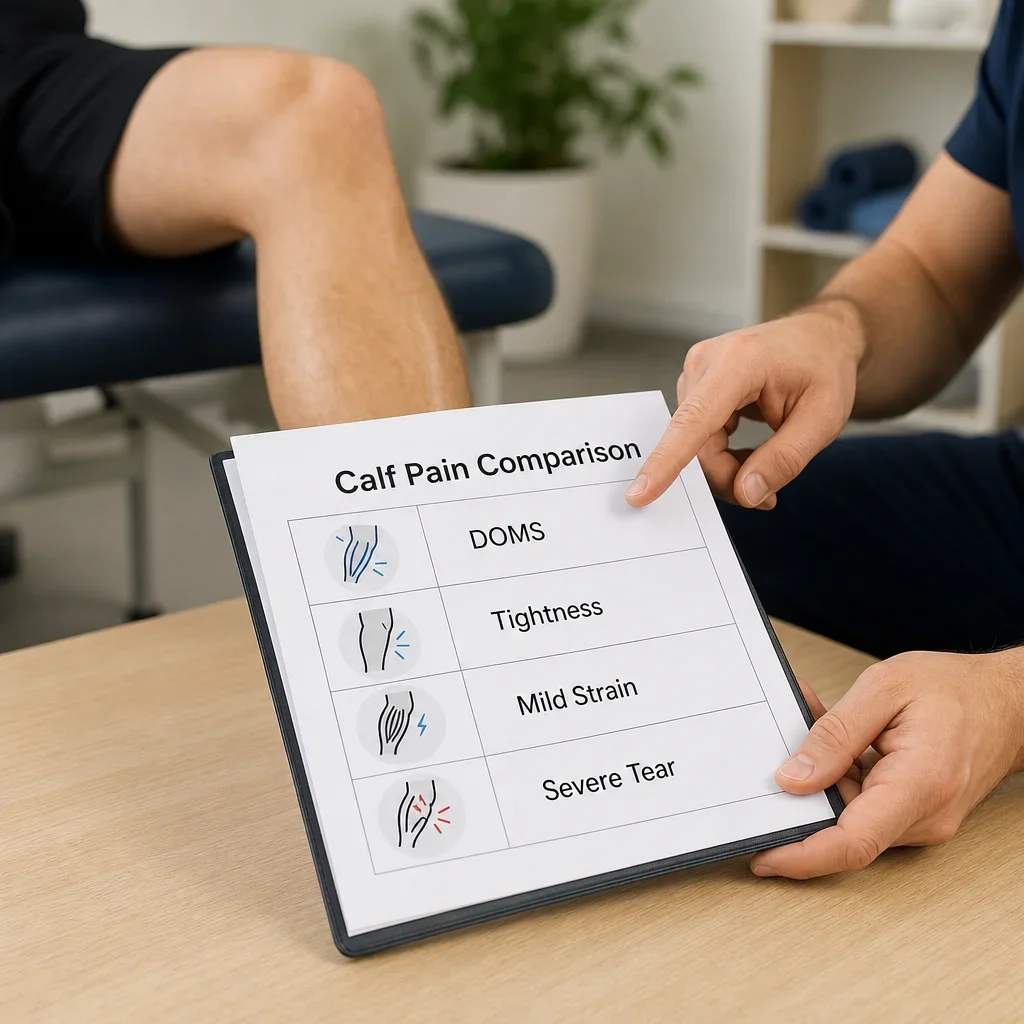
Calf Soreness, Tightness, Strain, or Tear? Use This Comparison
| Pattern | Usual onset and feeling | Common functional clues | Appearance | Sensible next step |
|---|---|---|---|---|
| DOMS or post-exercise soreness | Gradual tenderness and stiffness after unfamiliar or harder activity | Walking is usually possible, though stairs or calf raises may feel generally sore | Usually no major swelling or bruising | Reduce load briefly, keep comfortable movement, and monitor |
| Tightness or cramp | Tight, knotted, cramping, or restricted feeling | Symptoms may ease with gentle movement or a change in position | Usually no bruising; a cramp may visibly tighten the muscle | Avoid forcing a stretch if pain becomes sharp or focal |
| Mild calf strain | Sudden or clearly activity-linked focal pain, often during push-off | Walking, stairs, or a controlled calf raise may hurt or feel weak | Mild swelling may occur; bruising can appear later | Stop painful impact activity and arrange assessment if symptoms persist or limit function |
| More significant calf muscle tear | Sharp pain, pop, marked weakness, or inability to push off normally | Weight-bearing, stairs, or calf loading may be severely limited | Swelling, bruising, a contour change, or marked tenderness may develop | Seek same-day assessment; urgent care is needed for severe symptoms or red flags |
A controlled heel raise, stair climb, or short walk can provide a functional clue only when weight-bearing is comfortable. These are not diagnostic tests, and you should stop immediately if pain is sharp, escalating, causes limping, or occurs with swelling, weakness, or a red flag.
When Calf Pain Needs Urgent Care, Same-Day Assessment, or Self-Care
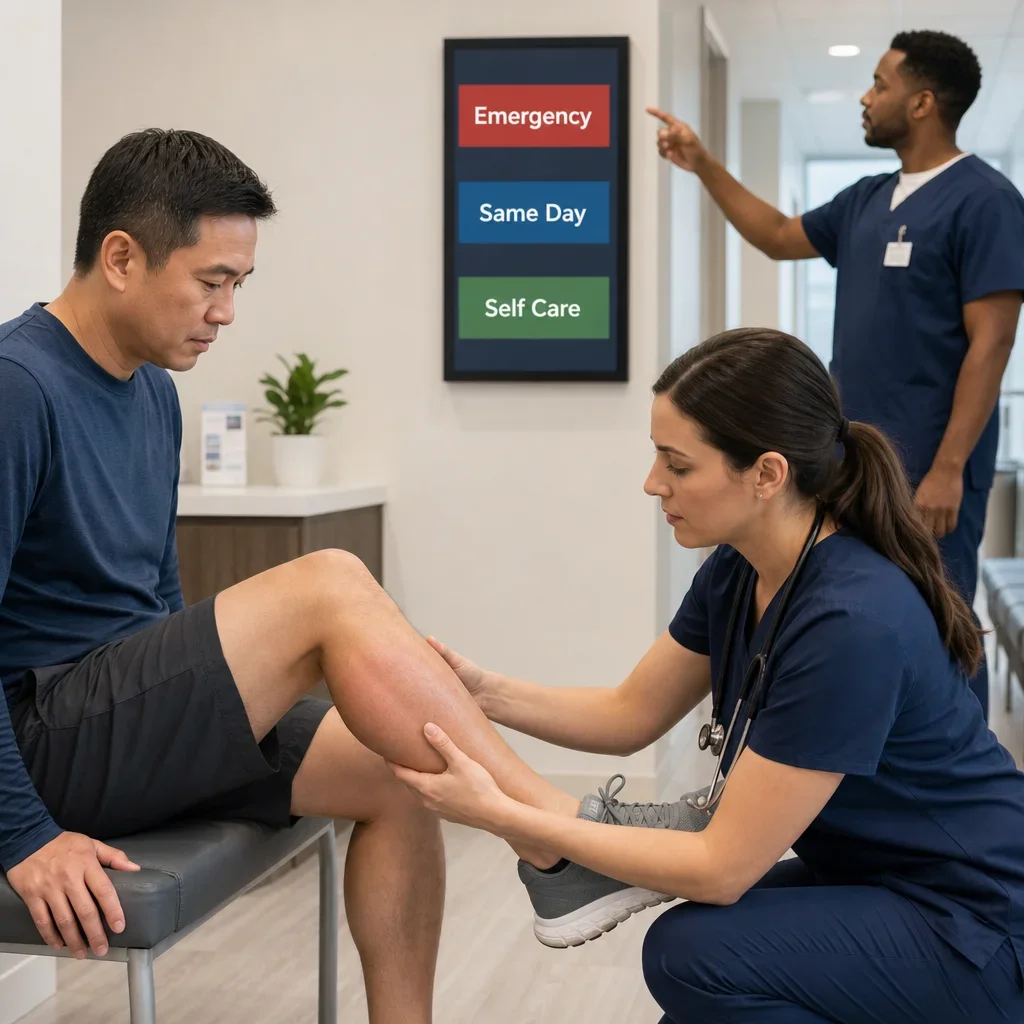
Go to emergency care now
Call 911 or go to the emergency department if calf pain occurs with chest pain, shortness of breath, coughing blood, fainting, severe dizziness, or sudden collapse. These symptoms can occur with a pulmonary embolism and require emergency assessment.
Emergency care is also appropriate for severe trauma, an open wound, a cold or pale foot, severe pain that rapidly escalates, or new loss of sensation or movement. These symptoms are not typical of simple post-workout soreness.
Seek same-day medical assessment
Same-day assessment is appropriate for unexplained one-sided calf swelling, warmth, redness, colour change, severe pain, rapidly increasing swelling, fever, inability to bear weight, or a pop followed by major weakness. DVT calf pain and an Achilles tendon injury cannot be confirmed or excluded by an online checklist or a home squeeze test.
Prompt assessment is also sensible after recent surgery, immobilization, long-distance travel, pregnancy or the postpartum period, a known clotting condition, or a personal history of blood clots. These factors can raise concern when new calf symptoms appear.
Consider cautious self-care and monitoring
Mild symptoms without swelling, colour change, severe weakness, chest symptoms, or walking difficulty can usually be managed by stopping the painful activity and monitoring the response. Book an assessment if pain worsens, returns repeatedly, does not improve, or prevents normal walking or training.
For downtown Toronto athletes with persistent or performance-limiting calf pain, a physiotherapy or sports medicine assessment can help distinguish load-related symptoms from a suspected muscle injury after urgent causes have been ruled out.
What a Calf Strain Feels Like and Why It Happens
A calf strain commonly feels like a focal pull, grab, sharp pain, or sudden loss of confidence during push-off. The pain may occur in the upper calf, middle calf, or lower calf near the muscle-tendon junction.
The calf contains two main muscles: the gastrocnemius and the soleus. Both connect through the Achilles tendon to the heel, helping you push off while walking, running, jumping, climbing stairs, and changing direction.
A gastrocnemius strain may feel higher in the calf and can occur during sprinting, jumping, or a forceful straight-knee push-off. A soleus strain may feel deeper or lower in the calf and can develop with sustained running, hills, or repetitive loading. Location alone cannot confirm which structure is injured.
A pulled calf muscle often follows acceleration, a sudden stop, a jump, a cut, hill running, or an abrupt increase in training demand. New footwear, prolonged standing, extra stairs, a return to sport, fatigue, previous calf injury, reduced ankle mobility, and reduced calf strength can also contribute to overload.
Grade 1, Grade 2, and Grade 3 Calf Strains
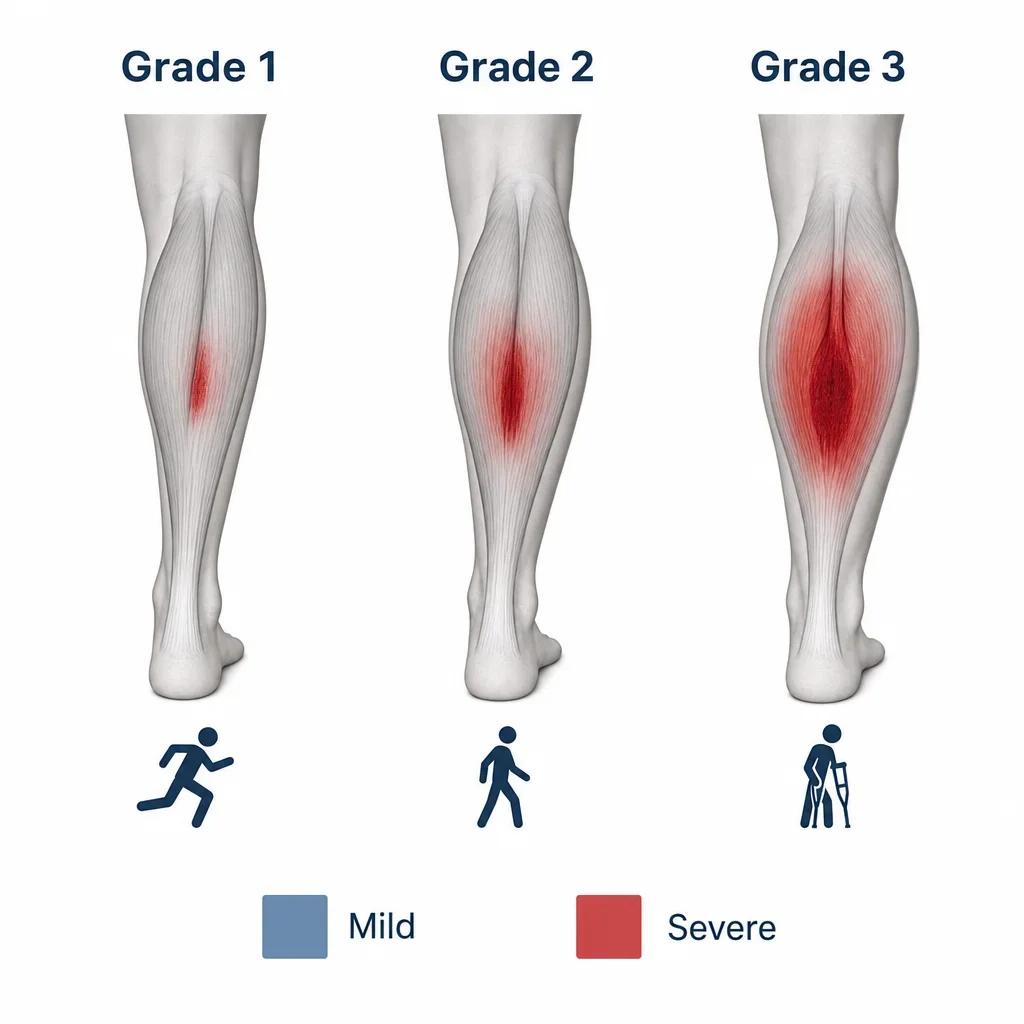
Calf strain grades describe the suspected extent of tissue injury, but a clinician may need an examination and sometimes imaging to determine severity. Pain level, bruising, walking ability, or one home test cannot confirm a grade.
| Grade | Typical pattern | Functional impact | Usual management need |
|---|---|---|---|
| Grade 1 calf strain | Mild focal pain, tightness, or tenderness with relatively preserved function | Walking may be possible, but running or forceful push-off hurts | Activity modification and progressive rehabilitation are commonly used |
| Grade 2 calf strain | More substantial pain, weakness, swelling, or bruising | Running, stairs, and calf loading may be clearly limited | Clinical assessment helps guide loading and return to activity |
| Grade 3 calf strain | Severe or complete tear with marked pain, weakness, or loss of function | Normal push-off or weight-bearing may be difficult or impossible | Urgent medical assessment is needed; imaging or specialist referral may be considered |
Bruising can appear after the initial injury rather than immediately. A calf that looks normal at first can still need assessment if weakness, swelling, or focal pain develops.
First 48–72 Hours: What to Do for a Suspected Calf Strain
The first 48–72 hours should focus on protecting the calf from painful loading while keeping comfortable movement. Complete inactivity is not automatically necessary, but running, jumping, sprinting, cutting, and heavy calf work should stop if they reproduce sharp pain or limp-inducing symptoms.
Use comfortable walking and gentle ankle movement only within tolerance. Compression and elevation may help manage swelling for some people, but compression should not be used if it causes numbness, colour change, increasing pain, or circulation concerns.
Cold or heat can be used for symptom relief if it feels comfortable, but neither treatment confirms the diagnosis or repairs a tear. Avoid direct skin injury from ice or heat packs, and avoid sleeping with them in place.
Avoid aggressive stretching, deep massage, intense foam rolling, repeated calf testing, or forceful exercise in an acute suspected tear. These approaches can aggravate a fresh muscle injury and are not appropriate when DVT is possible.
Do not massage a swollen, warm, red, unexplained one-sided calf. Seek urgent medical assessment instead, because a blood clot must be considered before treating it as a routine muscle problem.
Medication decisions depend on medical history, allergies, other medications, kidney and stomach conditions, pregnancy status, and other factors. A pharmacist or physician can advise on what is appropriate for you.
Is It Safe to Stretch or Keep Exercising?
Gentle mobility may be tolerable with ordinary post-workout soreness, but sharp, focal, sudden, worsening, or swelling-associated calf pain should not be stretched through. Stretching a sore calf should feel mild and controllable, not sharp or protective.
Continue only daily movement that does not worsen symptoms during activity or later that day. Modify training when discomfort is mild and stable, but stop impact and push-off activities when a suspected strain causes sharp pain, limping, weakness, or loss of normal movement.
A gentle walk, controlled stair ascent, or easy calf raise can show whether the calf tolerates basic loading when there are no red flags. Stop if pain escalates, becomes sharp, or changes your gait. Hopping and more provocative strength tests belong later in rehabilitation, not during the acute phase.
Suspected Achilles rupture needs urgent assessment rather than self-testing. Sudden pain near the back of the ankle or heel, a pop, bruising, swelling, or major push-off weakness should not be managed by repeatedly stretching or testing the tendon.
Calf Strain Rehabilitation: Restore Mobility, Strength, and Running Capacity
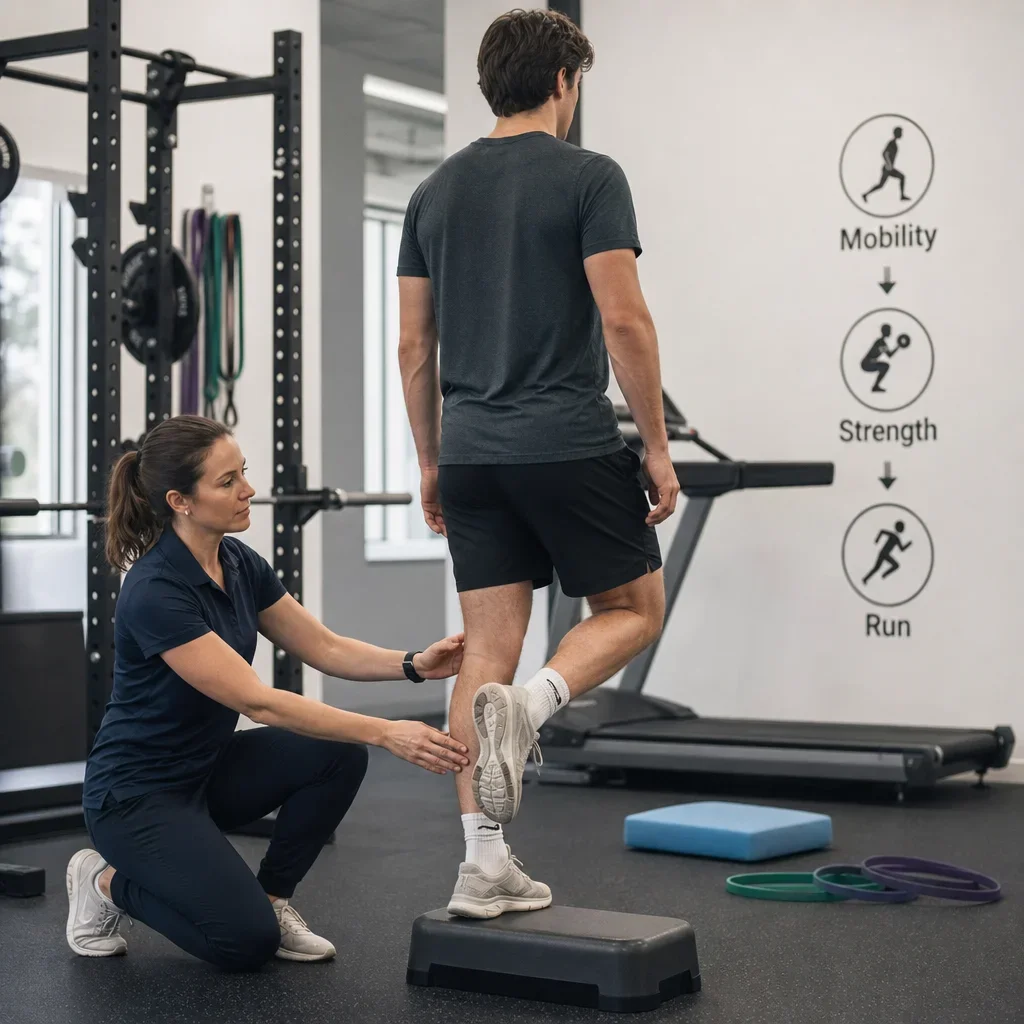
Rehabilitation should progress by function, not by a fixed calendar. The first goal is comfortable walking and normal daily movement without symptom escalation.
The next phase rebuilds calf capacity with progressively loaded calf raises, ankle movement, balance work, and other tolerated lower-limb exercises. Straight-knee calf loading places more demand on the gastrocnemius, while bent-knee loading places more demand on the soleus. Neither position fully isolates one muscle.
Low-impact options such as cycling, swimming, or walking may be useful when they do not increase symptoms. The right option depends on pain behaviour, walking tolerance, swelling, and the suspected diagnosis.
Return to running after calf strain should begin only when walking and stairs are comfortable, ankle movement is restored, calf loading is tolerated, and symptoms do not worsen during or after activity. Speed work, hills, jumping, cutting, and sport-specific drills should return after basic running capacity is established.
Recurrent strains, persistent weakness, or a competitive return-to-sport goal warrant individualized calf strain rehab. A physiotherapist can assess movement, calf and ankle strength, mobility, running demands, and training load before building a progression.
How Long Does a Calf Strain Take to Heal?
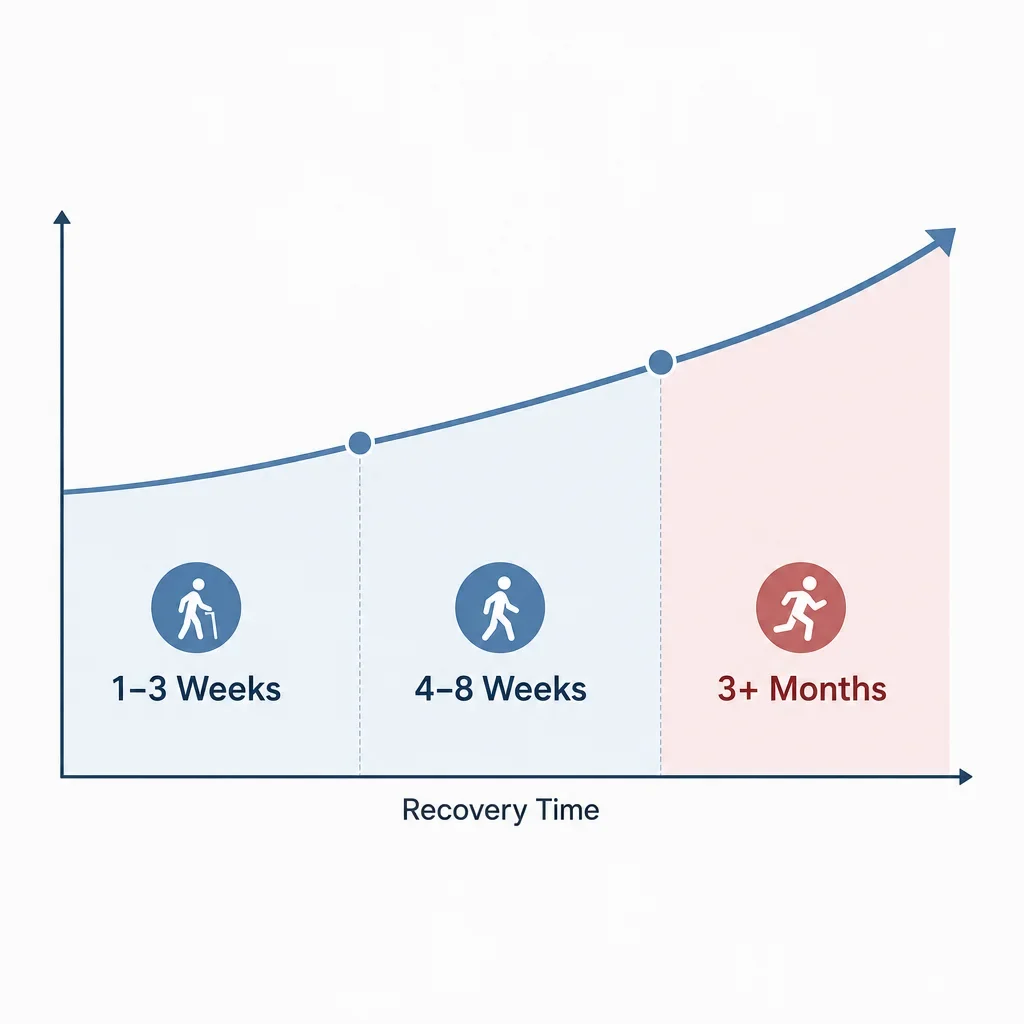
Calf strain recovery time depends on tissue involvement, severity, injury location, previous injury, training demands, age, and whether the diagnosis is actually a strain. Comfortable walking usually returns before sprinting, hill running, cutting, and repeated jumping are ready.
| Injury severity | Broad recovery planning range | Important limitation |
|---|---|---|
| Mild strain | About 1–3 weeks | Symptoms and function must continue improving before return to running |
| Moderate strain | About 4–8 weeks | Bruising, weakness, and sport demands can extend recovery |
| Severe tear | 3 months or longer | Severe tears need medical assessment and may require specialist input |
These are broad planning ranges, not return-to-sport promises. A calf can feel acceptable in day-to-day life but still lack the endurance and force capacity needed for hills, sprinting, court sports, or dance.
Recurring pain after a fast return can reflect incomplete load tolerance rather than a simple lack of stretching. A progressive return to calf loading usually matters more than forcing flexibility.
Conditions That Can Be Mistaken for a Calf Strain
Calf pain has more than one cause, and the safest next step changes with the pattern. A physiotherapy assessment can help with movement-related causes, but urgent medical symptoms need urgent medical care first.
| Condition | Common pattern | Recommended action |
|---|---|---|
| DOMS | Diffuse tenderness after unfamiliar exercise or increased volume | Modify activity and monitor improvement |
| Cramp or tightness | Sudden tightening or knotted feeling, sometimes linked to fatigue or prolonged position | Gentle movement may help if there are no red flags |
| Achilles tendinopathy | Pain or tenderness closer to the back of the ankle or heel, often linked to tendon loading | Seek assessment if persistent or activity-limiting |
| Achilles rupture | Pop, sudden pain, swelling, bruising, or major push-off weakness | Seek urgent assessment |
| DVT | Unexplained one-sided swelling, warmth, redness, pain, or colour change | Seek same-day medical assessment |
| Baker’s cyst | Fullness or swelling behind the knee that can refer into the calf | Seek medical assessment, especially if swelling is new |
| Nerve-related pain or sciatica | Radiating pain, numbness, tingling, or symptoms travelling from the back or buttock | Arrange assessment, especially with weakness or worsening symptoms |
| Contusion | Pain after a direct blow with local bruising | Monitor or seek assessment depending on severity |
| Exertional compartment syndrome | Reproducible tightness, pain, numbness, or weakness during exertion | Seek sports medicine assessment |
Achilles tendinopathy and calf strain can overlap because the calf muscles connect into the Achilles tendon. Pain near the heel or tendon does not prove Achilles involvement, and pain in the muscle belly does not rule it out.
Calf pain when walking can come from muscle injury, tendon irritation, nerve symptoms, circulation problems, joint issues, or a blood clot. New one-sided swelling, warmth, redness, or shortness of breath should never be assumed to be a sports injury.
Preventing Another Calf Strain or Overuse Flare-Up
The best prevention strategy is gradual capacity-building rather than relying on stretching alone. Calf strength, ankle mobility, recovery, previous injury, training load, footwear changes, hills, speed work, and fatigue can all influence how the calf handles demand.
Runners should introduce hills, faster running, and longer distances progressively instead of increasing all three at once. Court and field athletes should build jumping, acceleration, deceleration, and cutting volume before returning to full-intensity sessions.
Consistent calf strengthening can improve tolerance for running and push-off demands. Both straight-knee and bent-knee calf work may have a role because the gastrocnemius and soleus contribute differently across knee positions.
A sport-specific warm-up can prepare the calf for the movement demands ahead, but no warm-up guarantees injury prevention. The goal is to match training demands to current capacity and avoid sudden jumps after time off.
Repeated running calf pain deserves a biomechanics and movement assessment. Studio Athletica can assess lower-limb movement, ankle mobility, calf strength, training demands, and return-to-running factors for active adults in downtown Toronto.
When to Book Calf Pain Physiotherapy in Toronto
Book a physiotherapy or sports medicine assessment when calf pain persists, recurs, limits walking, changes your running form, prevents training, or leaves you unsure whether you are dealing with soreness or a strain. This applies after urgent causes such as DVT, pulmonary embolism, severe trauma, or suspected Achilles rupture have been ruled out.
A calf pain assessment commonly includes a detailed history, movement and loading review, calf and ankle strength assessment, mobility testing, and a plan for progressive rehabilitation. The aim is to restore comfortable function first, then rebuild the capacity needed for your sport or activity.
Studio Athletica provides physiotherapy, chiropractic, sports medicine, and massage therapy services for active adults in downtown Toronto. Massage therapy may be appropriate later in recovery for selected movement-related symptoms, but it is not a substitute for urgent assessment when a blood clot or acute tear is possible.
FAQ
Did I pull my calf muscle or is it just sore?
Delayed, diffuse tenderness after a new or harder workout is more consistent with soreness or DOMS. Sudden focal pain during a movement, especially with weakness, limping, swelling, or bruising, is more concerning for a pulled calf muscle and should be assessed if it limits function.
How do you tell if your calf is tight or strained?
Tightness usually feels broad, restricted, or cramp-like and may ease with gentle movement. A strained calf is more likely to feel focal, sharp, pulled, weak, or painful during push-off, although symptoms can overlap.
What does a grade 1 calf strain look like?
A grade 1 calf strain may cause mild focal pain, tightness, or tenderness with relatively preserved walking ability. Running, jumping, stairs, or forceful calf loading can still be painful, and a clinician may be needed to confirm the severity.
How do I tell if my calf is strained or torn?
A more significant tear can involve a pop, marked weakness, swelling, bruising, or difficulty bearing weight. A home test cannot reliably confirm the difference, so severe symptoms need same-day medical assessment.
What is a red flag for calf pain?
Red flags include chest pain, shortness of breath, coughing blood, fainting, unexplained one-sided swelling, warmth, redness, severe pain, fever, colour change, or inability to bear weight. Chest symptoms require emergency care, while new one-sided swelling or major weakness needs same-day assessment.
Will a calf strain heal itself?
Milder strains can improve with appropriate protection, gradual loading, and time. Persistent pain, recurrent symptoms, weakness, altered walking, or difficulty returning to sport can indicate that guided rehabilitation is needed.
Is it safe to stretch a sore calf?
Gentle stretching may be tolerable for ordinary soreness when it does not cause sharp pain. Do not force a stretch through focal pain, swelling, bruising, weakness, or suspected acute strain.
How long does a calf strain take to heal?
Mild strains can take about 1–3 weeks, moderate strains about 4–8 weeks, and severe tears 3 months or longer. Return to sport should be based on symptoms, strength, endurance, and sport-specific tolerance rather than the calendar alone.
What can be mistaken for a calf strain?
DOMS, cramp, Achilles tendinopathy, Achilles rupture, DVT, Baker’s cyst, nerve-related pain, contusion, and exertional compartment syndrome can all cause calf symptoms. The right next step depends on the onset, location, swelling, neurological symptoms, and functional impact.
How do I know if my calf pain could be a blood clot?
A blood clot cannot be ruled out at home. New unexplained one-sided swelling, warmth, redness, colour change, tenderness, or calf pain with clotting risk factors should be assessed the same day, while chest pain or shortness of breath requires emergency care.