
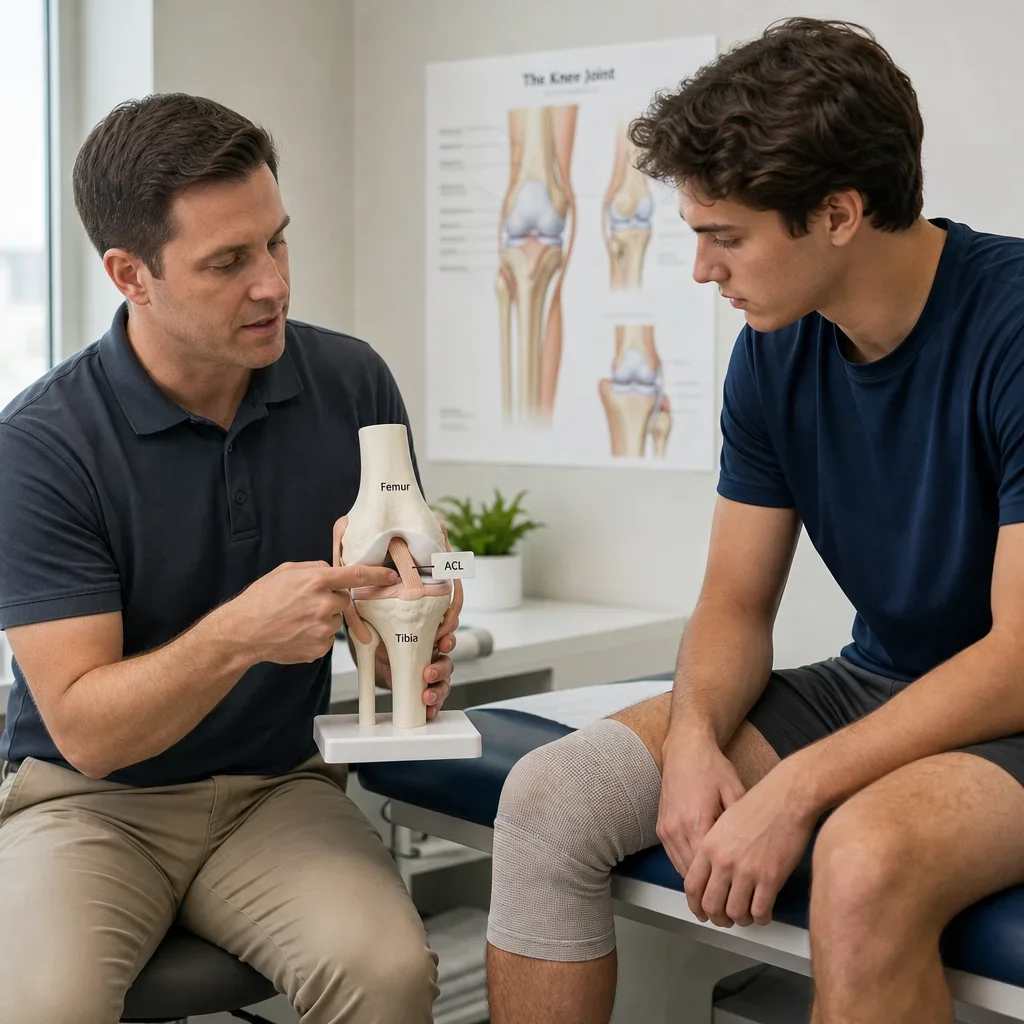
If you tear your ACL, can you still play sports? Some people can walk, cycle, swim, or perform controlled straight-line activity, but being able to move does not mean the knee is ready for sport.
A torn ACL can leave the knee unstable during cutting, pivoting, sudden stops, landing, uneven terrain, and contact. Pain and swelling may settle before stability returns. That is why a return to sport after ACL tear should be based on an individual assessment, not on whether you can push through a workout.
Quick answer: Do not test a suspected ACL tear by returning to sport. Stop play and arrange an assessment if your knee buckles, swells, locks, loses motion, or feels unreliable. A clinician needs to assess the ligament, the meniscus, cartilage, movement control, and your sport demands before advising progression.
This guide is general education, not a diagnosis or clearance for your knee. A downtown Toronto sports medicine or physiotherapy assessment can help determine the safest next step for your specific injury.
Quick Answer: Can You Still Play Sports With a Torn ACL?
Some people can still participate in low-impact, straight-line activities after an ACL injury, but pivoting and contact sports place greater demand on knee rotation and control. The ACL, or anterior cruciate ligament, helps control forward movement and rotational stability between the thigh bone and shin bone. A tear can make the knee give way during movements that are not required for ordinary walking.
You should not self-clear for sport based on pain alone. A knee can feel less painful while swelling, weakness, poor landing control, or rotational instability remain present. Repeated giving-way episodes are a clinical concern because they can occur alongside meniscus or cartilage injury.
The safest activity depends on the tear pattern, knee stability, associated injury, swelling response, strength, movement quality, rehabilitation progress, and the demands of your sport. Soccer, basketball, football, skiing, racquet sports, and combat sports generally involve cutting, landing, deceleration, contact, or unpredictable surfaces.
When a Knee Injury Needs Urgent Care vs. a Sports Medicine Assessment
A knee injury needs urgent medical attention when there is obvious deformity, a cold or pale foot, numbness, weakness, severe escalating pain, rapidly increasing swelling, a locked knee, fever, or concern for fracture or dislocation. These signs can indicate injuries beyond an isolated ACL tear and should not be managed by waiting for symptoms to settle.
A prompt sports medicine or physiotherapy assessment is appropriate after a pop at the time of injury, rapid swelling, knee buckling, pain with twisting, loss of motion, persistent limping, or inability to return to normal walking. ACL symptoms overlap with meniscus tears, collateral ligament injuries, patellar dislocation, bone bruising, and fractures, so the mechanism and examination matter.
Some people can tear their ACL without knowing immediately. Not every tear produces a loud pop, dramatic swelling, or instant inability to walk. Persistent instability, swelling after activity, or a knee that repeatedly feels unreliable still deserves assessment.
What the ACL Does and What a Tear Can Feel Like
The ACL helps the knee resist excessive forward movement of the tibia under the femur and contributes to rotational stability. It becomes especially relevant when you decelerate, change direction, land from a jump, or react to an unexpected force.
An ACL injury can cause a pop sensation, swelling, pain, stiffness, reduced range of motion, or a feeling that the knee is giving way. Walking soon after an injury does not rule out an ACL tear because daily walking usually creates less rotational demand than sport.
ACL tears commonly occur without contact during cutting, awkward landing, sudden stopping, or hyperextension. They can also occur through direct contact, including a collision that drives the knee into an unstable position.
A sports medicine clinician may use your injury history, knee examination, stability testing, and imaging where appropriate to clarify the diagnosis. Magnetic resonance imaging, or MRI, can help assess the ACL, meniscus, cartilage, and other internal knee structures when clinically indicated.
ACL Sprain, Partial Tear, Complete Tear, and Rupture: What the Terms Mean
An ACL sprain is a ligament injury that ranges from overstretching to partial or complete fibre disruption. The word “sprain” does not automatically mean the injury is minor.
A partial ACL tear means some ligament fibres remain intact, while a complete tear means the ligament fibres are fully disrupted. “Rupture” usually refers to a complete tear, but the diagnosis should combine imaging with a clinical examination of knee laxity and function.
Clinicians may describe ligament injuries as Grade I, Grade II, or Grade III. Grade I generally describes stretching without major instability, Grade II describes partial tearing, and Grade III commonly describes a complete tear. These labels do not decide treatment on their own because symptoms, associated injuries, functional stability, and sport goals also matter.
A complete ACL tear does not automatically require reconstruction. Some people pursue structured non-operative rehabilitation, while others need a surgical consultation because of repeated instability, combined injury, or high-demand pivoting and contact sport goals.
Which Activities May Be Possible, and Which Movements Carry More Risk?
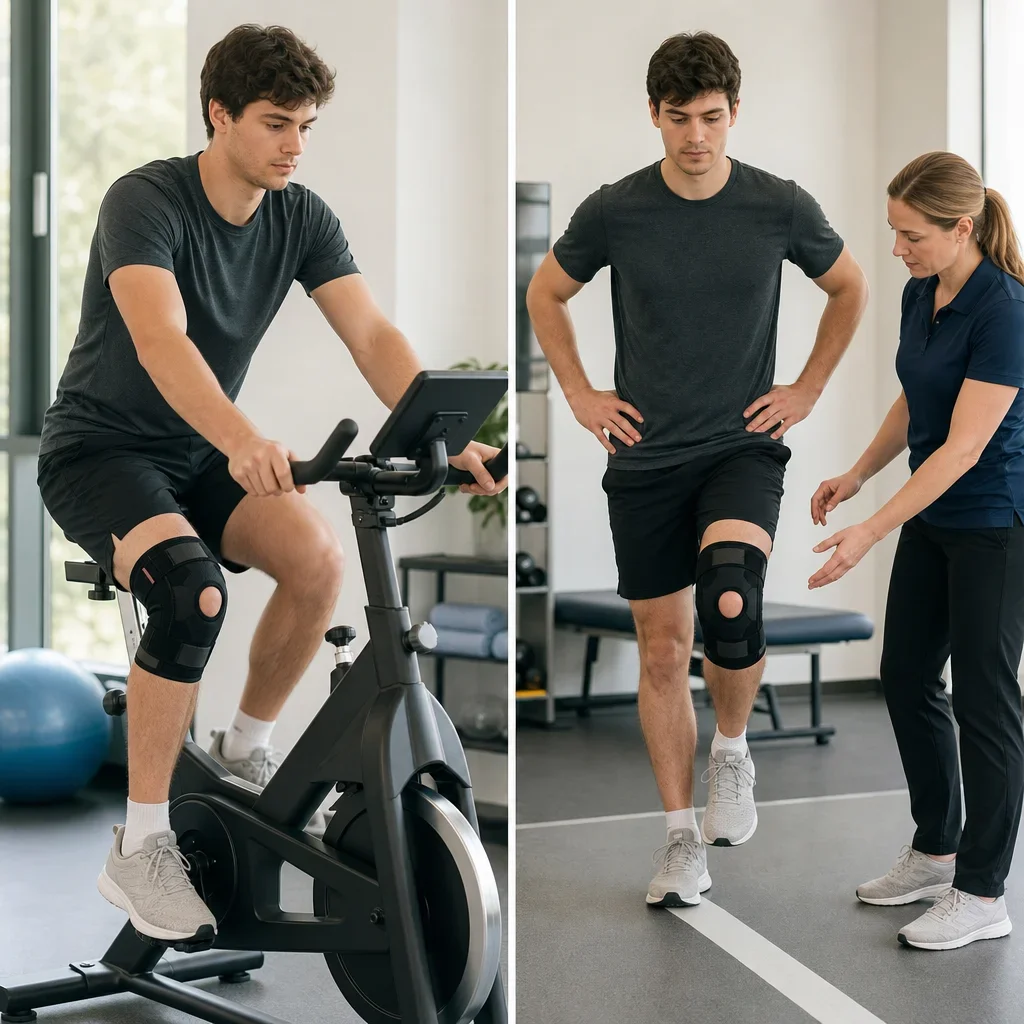
Walking, cycling, and swimming may be tolerable for some people with an ACL injury, but they are not automatic clearance activities. Swelling, limping, pain, loss of motion, buckling, and poor control are signs that the knee is not tolerating the current load.
| Activity or movement | ACL demand | Main concern after a suspected or confirmed tear | What needs assessment before progression |
|---|---|---|---|
| Walking on level ground | Lower rotational demand | Limping, swelling, pain, or giving way can indicate poor load tolerance | Gait, swelling, range of motion, and stability |
| Stairs and uneven ground | Greater single-leg control demand | Buckling and poor eccentric control can increase fall risk | Single-leg strength, balance, and knee control |
| Stationary cycling | Controlled, low-impact movement | Deep knee bending may irritate a swollen or stiff knee | Range of motion and symptom response |
| Swimming | Low-impact, but kicking can load the knee | Breaststroke kick may aggravate some knee injuries | Pain, swelling, and stroke-specific tolerance |
| Straight-line jogging | Moderate repetitive load | Limping, swelling, pain, or instability can worsen with repeated impact | Strength, gait mechanics, and landing control |
| Distance running or a 5K | Sustained repetitive load | Fatigue can expose poor knee control even without cutting | Running tolerance, symptom response, and training load |
| Strength training | Variable | Deep loaded positions or poor technique may irritate the knee | Exercise selection, alignment, and control |
| Soccer, basketball, tennis, pickleball | High pivoting and cutting demand | Rotational instability and giving-way episodes | Change-of-direction control and sport-specific testing |
| Football, rugby, combat sports | High pivoting and contact demand | Contact, twisting, and unpredictable force can stress an unstable knee | Full clinical assessment and staged return planning |
| Skiing | High rotational and uneven-surface demand | Falls, variable terrain, and rapid direction changes challenge stability | Strength, reaction control, and sport-specific preparation |
Can you walk on a torn ACL after a week? Some people can, but walking ability does not confirm that the ACL is intact or that the knee is ready for running or sport. Persistent swelling, a limp, reduced extension, or buckling should be assessed before activity increases.
Can you run with a torn ACL? Straight-line running may be possible later in rehabilitation for some people, but it is not appropriate when pain, swelling, limping, weakness, or instability remain. A return-to-running plan should assess how the knee responds during and after loading.
Can I run a 5K with a torn ACL? A 5K adds sustained impact and fatigue, which can expose movement deficits that are less obvious during short jogging. Do not use a race as a test of recovery; a clinician should assess running mechanics, strength, swelling response, and training tolerance first.
Can you play football with a torn ACL and meniscus injury? Football combines pivoting, contact, sudden deceleration, and unpredictable forces. A suspected ACL and meniscus injury, especially with locking or catching, needs assessment rather than a decision to play through it.
If you have a suspected ACL tear or a knee that gives way, Studio Athletica can provide a downtown Toronto sports physiotherapy or sports medicine assessment focused on biomechanics, movement control, and a progressive rehabilitation plan.
What Can Happen if You Keep Playing on a Torn ACL?
Continuing pivoting or contact sport with an unstable ACL-deficient knee can lead to repeated giving-way episodes. Those episodes may increase the risk of additional meniscus or cartilage injury because the joint can move in an uncontrolled pattern during rotation or landing.
Playing through pain is not the same as having a stable knee. Pain can fluctuate, while swelling after activity, reduced confidence, altered movement patterns, and loss of training tolerance can still signal that the knee is not handling sport demands.
The long-term effects of an ACL tear without surgery differ between people. Associated meniscus or cartilage injuries, repeated instability, rehabilitation quality, activity choices, overall knee health, and whether surgery is clinically appropriate all influence the outcome.
Arthritis is not inevitable after an ACL tear or ACL reconstruction. However, an ACL injury is a meaningful knee event, and protecting long-term joint health includes restoring strength, managing training load, monitoring symptoms, and avoiding repeated instability.
Do Braces, Taping, or Pain Medication Make It Safe to Keep Playing?
A brace, tape, or pain medication does not restore a torn ACL or independently make pivoting and contact sport safe. These tools may have a role in a clinician-guided care plan, but they do not replace stability, strength, movement control, or return-to-sport testing.
A brace or crutches may be used to protect the knee, manage symptoms, or support a staged rehabilitation plan. The benefit depends on the injury, the person’s movement pattern, the intended activity, and the treating clinician’s assessment.
Pain medication can reduce symptoms without correcting instability. It should not be used to push through knee buckling or unsafe sport participation, and medication questions should go to a pharmacist, physician, or prescriber.
Does Every Torn ACL Need Surgery?
Not every torn ACL needs reconstruction. Non-operative rehabilitation may be considered when a person has stable daily function, lower-demand activity goals, willingness to modify pivoting sport exposure, and the ability to progress through structured strength and movement training.
A surgical consultation may be appropriate when the knee repeatedly gives way, when there is a combined injury, when rehabilitation does not restore functional stability, or when a person’s goal is to return to high-demand pivoting or contact sport. An orthopaedic surgeon, sports medicine physician, and rehabilitation team can help assess these factors.
Prehabilitation means improving the knee before a surgical decision or procedure where appropriate. It commonly focuses on swelling control, full knee extension, usable range of motion, quadriceps function, gait, and movement quality.
| Pathway | What it focuses on | When it may be discussed |
|---|---|---|
| Non-operative ACL rehabilitation | Strength, neuromuscular control, movement retraining, and activity modification | Stable function, lower pivoting demands, or a preference to avoid surgery where clinically appropriate |
| Surgical consultation and possible reconstruction | Assessing whether reconstruction may support stability goals | Repeated giving way, combined injury, persistent functional instability, or high-demand sport goals |
| Prehabilitation | Reducing swelling and restoring movement before decisions or surgery | Before reconstruction when appropriate, or as an early rehabilitation foundation |
ACL Recovery Timeline: Why Return to Sport Is Criteria-Based
ACL injury recovery time is based on milestones, not a single calendar date. The first phase addresses swelling, pain, range of motion, gait, and protection of the injured knee.
The next phase restores strength and control through progressive quadriceps, hamstring, hip, calf, and trunk training. Better single-leg control matters because sport places repeated load through one leg during landing, deceleration, and direction changes.
Running, jumping, and plyometric work are introduced only when symptoms, strength, movement quality, and training response support progression. A knee that becomes swollen or unstable after a session has not met the same tolerance standard as a knee that remains controlled.
Return to sport after ACL reconstruction is frequently discussed in the range of approximately 9 to 12 months, but this is not a guaranteed clearance date. Some athletes take longer, and the calendar alone does not establish readiness for training, practice, or competition.
Torn ACL recovery time without surgery does not have one universal timeline. It depends on knee stability, associated injuries, rehabilitation progress, activity goals, and the demands of the intended sport.
| Recovery phase | Primary goal | Typical progression decision |
|---|---|---|
| Assessment and symptom control | Reduce swelling, protect the knee, and clarify injury needs | Knee can tolerate daily activity without escalating symptoms |
| Range of motion and gait | Restore extension, flexion, and normal walking mechanics | Walking and basic movement are controlled |
| Strength and neuromuscular training | Rebuild force production and single-leg control | Strength and movement quality improve under increasing load |
| Running and plyometric progression | Prepare for impact and landing | No significant swelling, instability, or poor mechanics with progression |
| Sport-specific preparation | Rehearse cutting, reaction, contact, or terrain demands | Testing and training tolerance support staged return |
| Return to training, practice, then competition | Build exposure gradually | Sport demands are tolerated without instability or symptom escalation |
What Return-to-Sport Testing Looks Like in Practice
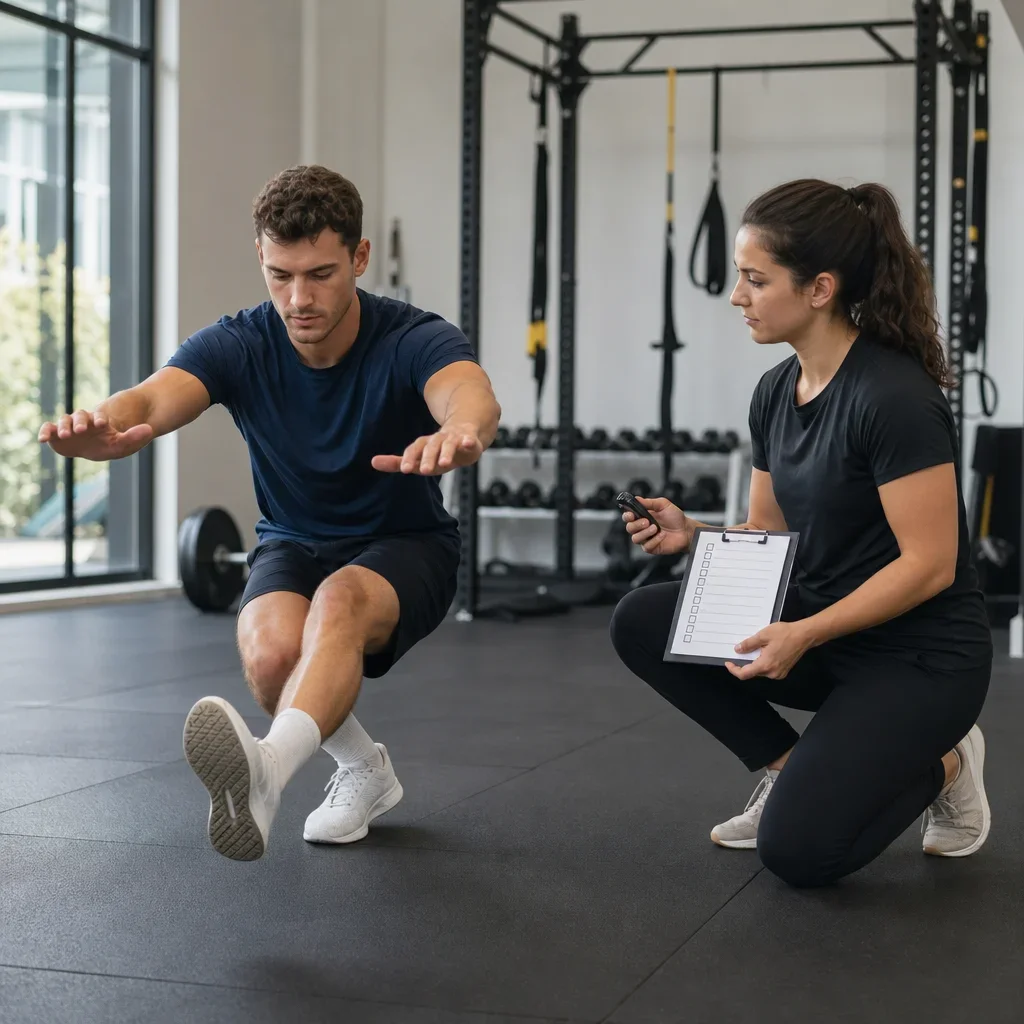
Return-to-sport testing combines symptoms, knee examination, range of motion, swelling response, strength, movement quality, functional testing, sport drills, training tolerance, and psychological readiness. No single hop test or strength number can guarantee that an athlete is ready for every sport.
Strength testing commonly compares quadriceps and hamstring performance between legs. Some ACL protocols use limb-symmetry targets of 90% or higher for selected strength and hop measures, but this is one input rather than a universal clearance rule.
Functional testing may include hop tests, single-leg squat control, landing mechanics, balance, deceleration, and change-of-direction tasks. These tasks help reveal whether the knee can control force and rotation when the athlete is fatigued or reacting to movement demands.
Sport-specific drills should reflect the actual demands of the athlete’s activity. A runner may need progressive mileage and downhill tolerance, while a soccer player may need cutting, reactive movement, kicking, acceleration, deceleration, and controlled contact progression.
Psychological readiness matters because fear of reinjury can change movement patterns and limit confidence. Confidence should be considered alongside objective performance, not used as a substitute for strength, stability, or symptom control.
Return-to-sport checklist:
- Full or functional knee range of motion for the intended activity.
- No persistent swelling or giving-way episodes with training.
- Restored quadriceps, hamstring, hip, calf, and trunk strength.
- Controlled single-leg landing, deceleration, and change-of-direction mechanics.
- Functional testing appropriate to the person’s sport.
- Progressive exposure to practice demands before competition.
- Confidence supported by demonstrated movement capacity.
Can You Get Back to 100% After an ACL Tear or ACL Surgery?
Many people return to meaningful activity after an ACL tear, and some return to their previous sport level. No clinician can guarantee an identical pre-injury outcome because recovery is influenced by the injury itself, rehabilitation, sport demands, and future knee events.
Associated meniscus or cartilage injury can affect symptoms and long-term planning. Strength restoration, movement mechanics, rehabilitation consistency, training load, psychological readiness, and repeat injury also shape the outcome after ACL surgery or non-operative management.
“100%” should mean more than being able to participate once. A stronger definition includes reliable knee function, confidence, no recurrent giving way, tolerance of training demands, and the ability to recover from sport without significant swelling or pain flare-ups.
What happens 20 years after ACL surgery cannot be predicted for one individual. Long-term knee health is influenced by meniscus and cartilage status, later injuries, body mechanics, strength, activity exposure, and ongoing conditioning.
Reducing the Risk of Another ACL Injury
ACL injury prevention focuses on improving the movement demands that challenge the knee. Progressive quadriceps, hamstring, hip, calf, and trunk strength can support force control during jumping, landing, cutting, and deceleration.
Landing and change-of-direction technique should address knee position, trunk control, single-leg balance, and braking mechanics. Good technique is not a guarantee against injury, but it can be trained as part of a broader performance and rehabilitation plan.
Training load should increase gradually because fatigue can reduce movement quality and expose weak links in control. Sleep, recovery, sport-specific conditioning, and adequate exposure to practice demands also affect how well an athlete handles competition.
A biomechanics-led assessment can identify relevant movement patterns for the individual athlete rather than applying one generic prevention plan. Sports physiotherapy Toronto programs should connect strength, movement quality, sport demands, and real training conditions.
Prevention checklist:
- Build lower-body and trunk strength progressively.
- Train single-leg balance and landing control.
- Practice deceleration before high-speed cutting.
- Reintroduce pivoting and contact in stages.
- Increase running, jumping, and practice volume gradually.
- Monitor swelling, instability, pain, and recovery after sessions.
- Keep prevention work in the program after returning to sport.
FAQ: Playing Sports With a Torn ACL
Can you walk on a torn ACL after a week?
Some people can walk after a week, but walking does not rule out an ACL tear or confirm sport readiness. A limp, swelling, locking, reduced extension, or buckling should be assessed because daily walking creates less demand than running, jumping, or pivoting.
Can you run with a torn ACL?
Some people progress to straight-line running during rehabilitation, but running is not appropriate when the knee remains swollen, painful, unstable, weak, or mechanically uncontrolled. Running progression should be based on movement assessment and the knee’s response to load.
Can I run a 5K with a torn ACL?
A 5K requires repeated impact and fatigue tolerance, so it should not be used as a self-test after an ACL injury. A clinician should assess gait, strength, symptoms, and training response before a return to distance running.
Can you play football with a torn ACL and meniscus?
Football combines contact, cutting, twisting, and sudden deceleration, which can stress an unstable knee. A suspected ACL and meniscus injury needs clinical assessment, particularly if the knee locks, catches, swells, or gives way.
Can you tear your ACL without knowing?
Yes, an ACL tear may not always feel dramatic at first. Some people continue walking or training before persistent swelling, instability, or difficulty with pivoting makes the injury more obvious.
Does a torn ACL always require surgery?
No. Some people manage an ACL tear with structured rehabilitation and activity modification, while others benefit from surgical consultation because of instability, combined injury, or high-demand sport goals.
Can an ACL tear heal on its own?
The ACL has limited healing capacity because of its location and blood supply, and a complete tear does not reliably reconnect in a way that restores normal stability. Treatment decisions should focus on functional stability, associated injury, symptoms, and activity goals rather than assuming healing will occur.
What are the long-term effects of an ACL tear without surgery?
Long-term outcomes can include stable function for some people and recurrent instability or additional knee damage for others. Meniscus and cartilage status, rehabilitation quality, sport exposure, repeated giving way, and overall knee health are major factors.
Can you get back to 100% after an ACL tear?
Many people regain strong function and return to meaningful activity, but no clinician can promise an identical pre-injury result. The best return plan is criteria-based and considers strength, movement quality, sport demands, confidence, and symptom response.
What happens 20 years after ACL surgery?
Outcomes decades later differ between people and depend on factors such as meniscus injury, cartilage health, repeat injury, activity history, strength, and body mechanics. Ongoing conditioning and symptom monitoring remain useful after return to sport.
The Practical Next Step After a Suspected ACL Injury
The first priority is not proving that you can still play. It is establishing whether the knee is stable, whether other structures may be involved, and what activity level the knee can currently tolerate.
A sports medicine assessment can evaluate your injury mechanism, swelling, range of motion, gait, strength, balance, and movement control. Studio Athletica’s downtown Toronto team can build a progressive ACL physiotherapy Toronto plan, coordinate appropriate referrals, and guide criterion-based return to training and sport without promising a fixed recovery date or remote clearance.