
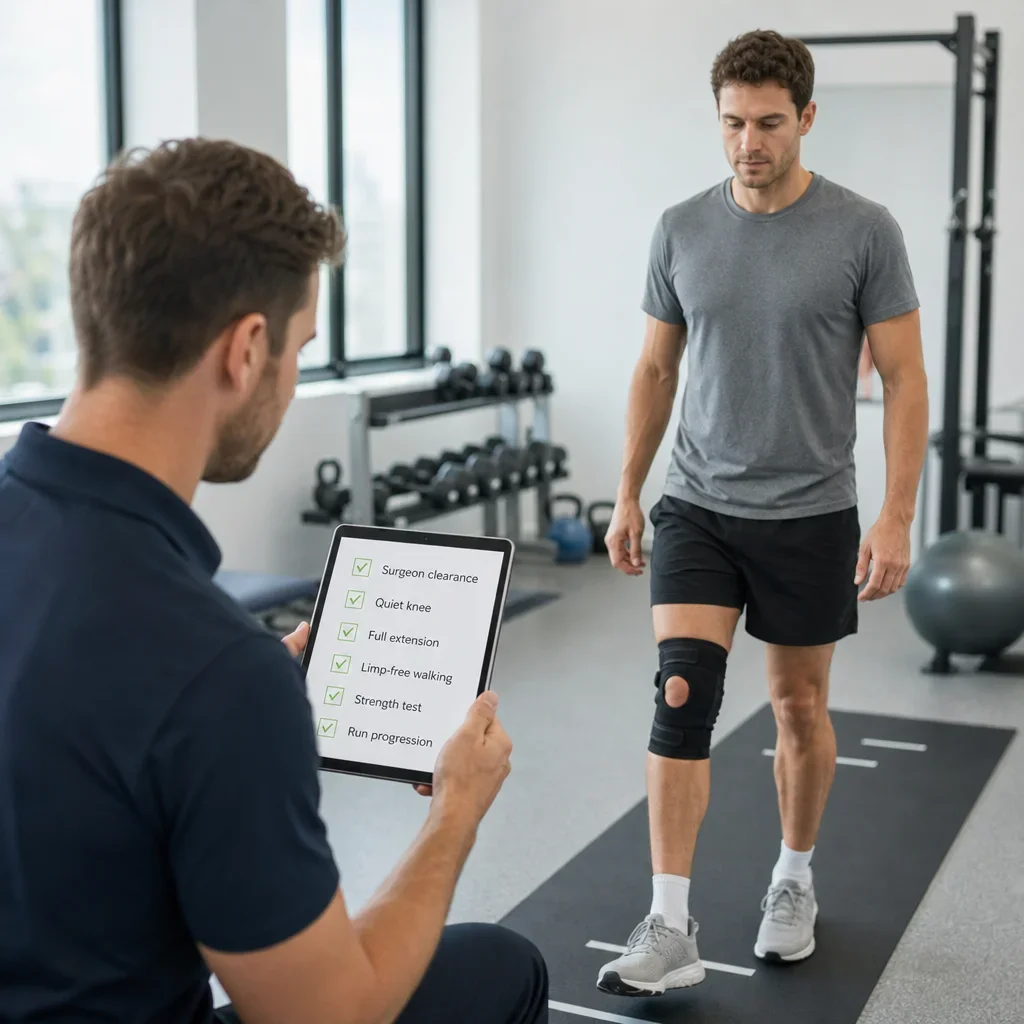
Jogging after ACL surgery is usually earned through recovery milestones, not cleared by the calendar alone. Many people begin a clinician-guided return to running after ACL reconstruction around 10–16+ weeks, but only when the knee is quiet, walking is normal, movement quality is controlled, and surgeon restrictions allow impact activity.
This guide is general education, not personal medical clearance. Follow your surgeon’s procedure-specific restrictions, especially after meniscus repair, cartilage work, or multi-ligament surgery.
The Short Answer: When Can You Start Jogging After ACL Surgery?
Light jogging may be introduced after your surgeon and physiotherapist confirm that your knee can tolerate impact. A common early return-to-running window after isolated ACL reconstruction is roughly 10–16+ weeks, or about 3–4 months, but this is not an automatic clearance date.
A combined procedure can change the plan substantially. Meniscus repair, cartilage restoration, bone work, or another ligament injury may require longer protection from impact because the surgical restrictions are based on more than the ACL graft.
Jogging is an early running milestone, not a return to unrestricted sport. A level, easy jog has lower demands than a 5K training block, hills, sprinting, jumping, cutting, or field and court sport.
Why Running Too Soon After ACL Surgery Can Set Rehab Back
Running too early can increase swelling, pain, stiffness, compensatory limping, and poor loading patterns. Each running step requires the quadriceps, calf, hip muscles, and knee joint to absorb repeated impact while controlling the leg through stance.
Cycling fitness does not automatically equal running readiness. A bike reduces impact and changes the demand on knee extension, shock absorption, balance, and single-leg control.
A knee that repeatedly swells after rehabilitation load is not yet tolerating that load well. Swelling, also called effusion, can inhibit quadriceps activation and make it harder to restore normal knee control.
Return-to-Running Readiness Checklist
Your first decision point is surgeon clearance for impact activity. If your surgeon has restricted jogging because of a meniscus, cartilage, or multi-ligament procedure, that restriction comes before any general ACL return to running program.
A quiet knee means no new or increasing swelling, no giving way, no persistent pain increase, and no loss of motion after usual rehabilitation activities. Full knee extension matching the other side is a common priority because even a small extension loss can alter walking and running mechanics.
Normal walking should come before jogging. You should be able to walk without a limp, manage daily activity and stairs with controlled movement, and avoid shifting your trunk away from the recovering leg.
Adequate knee bend also matters before impact. Some return-to-running frameworks use knee flexion near 95% of the uninvolved side as one clinical benchmark, but your physiotherapist must interpret this alongside swelling, surgical details, and movement quality.
Use this decision path with your rehabilitation clinician:
| Checkpoint | If the answer is yes | If the answer is no |
|---|---|---|
| Surgeon restrictions permit impact | Review movement and strength testing | Do not begin jogging yet |
| Knee remains quiet after daily rehab loads | Check walking and stair control | Reduce load and contact your care team if symptoms persist |
| Full extension and functional flexion are present | Assess strength and single-leg control | Continue mobility and strength rehabilitation |
| Walking is limp-free | Introduce impact preparation if appropriate | Address gait and strength deficits first |
| Strength and movement testing support impact | Begin a clinician-cleared walk-jog progression | Continue targeted ACL rehab |
Urgent symptoms need medical review rather than a running adjustment. Contact your surgeon or seek urgent care for calf pain or swelling, chest symptoms, fever, wound drainage, a locked knee, marked swelling, or a new episode of instability.
For an ACL rehab Toronto assessment, a sports physiotherapist can check swelling, knee motion, gait, strength, single-leg control, and impact tolerance before discussing a return-to-run plan.
Strength, Balance, and Movement Tests Before Jogging
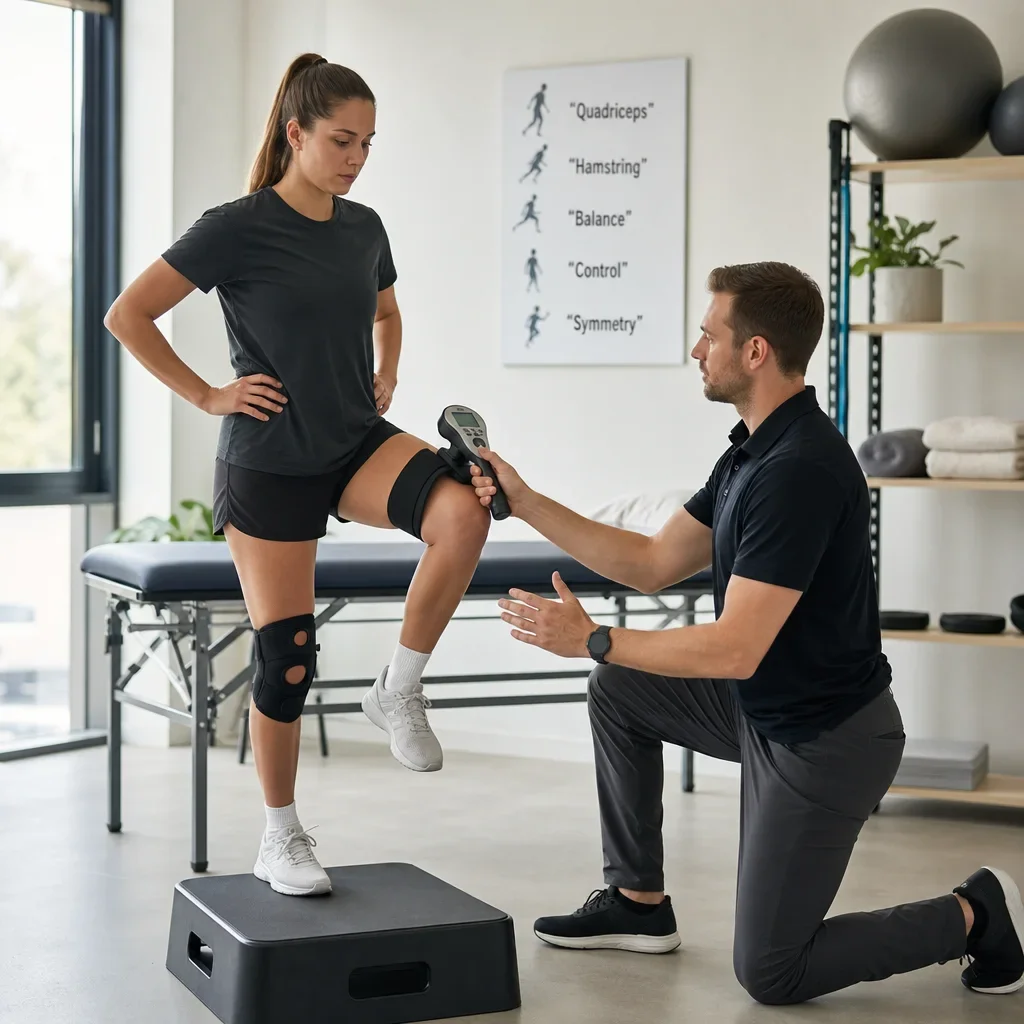
Strength testing helps identify whether the recovering leg can control repeated impact. Clinicians commonly compare the surgical and non-surgical legs using a limb symmetry index, which expresses one side’s test result as a percentage of the other.
Some clinical protocols use quadriceps and hamstring symmetry above 70% before an initial return to running, while other protocols use more demanding knee-extension benchmarks. These figures guide clinical decisions but do not replace an individualized assessment.
A dynamometer or isokinetic test gives more useful strength information than guessing from bodyweight exercises. The non-surgical leg can also lose strength after surgery, so a symmetry score must be interpreted with your overall training history and baseline capacity.
| Domain | How it is assessed | Why it matters for running | Clinician testing needed? |
|---|---|---|---|
| Quadriceps strength | Dynamometer, isokinetic testing, or controlled functional testing | Controls knee position and absorbs landing force | Usually yes |
| Hamstring strength | Strength testing and movement review | Supports knee control and posterior-chain loading | Usually yes |
| Calf and hip capacity | Single-leg calf work, step-downs, and strength testing | Helps absorb impact and control the pelvis | Often useful |
| Single-leg control | Squat, step-down, and landing observation | Identifies knee collapse, trunk shift, and poor control | Yes for clearance decisions |
| Balance and proprioception | Single-leg balance and perturbation tasks | Supports control when the body moves over the foot | Often useful |
| Running gait | Walking and jogging observation | Identifies limping, asymmetry, and load avoidance | Yes |
At home, you can observe whether controlled single-leg tasks are pain-free and free from obvious knee collapse or major trunk shifting. These observations are useful warning signs, but they are not a self-clearance test for jogging after ACL surgery.
Exercises That Build Capacity Before You Run
Pre-running ACL rehabilitation builds the tissues and movement patterns needed for impact. The usual categories are quadriceps strength, hamstring strength, calf capacity, hip control, balance, single-leg control, and graded landing preparation.
Quadriceps-focused work may include clinician-selected squat variations, step-ups, split squats, and controlled step-downs. The goal is not simply to complete repetitions; it is to restore controlled knee loading without swelling or loss of motion afterward.
Posterior-chain and calf work can include hamstring exercises, hip-dominant strength work, and calf raises. Running repeatedly loads the calf and hamstring complex, particularly as pace, hills, and stride length increase.
Low-level jumping is not automatically safe at a particular week. When can you start jumping after ACL surgery depends on symptoms, strength, landing quality, surgeon restrictions, and the ability to absorb force without a limp or knee collapse.
A Sample Clinician-Cleared Walk-Jog Progression
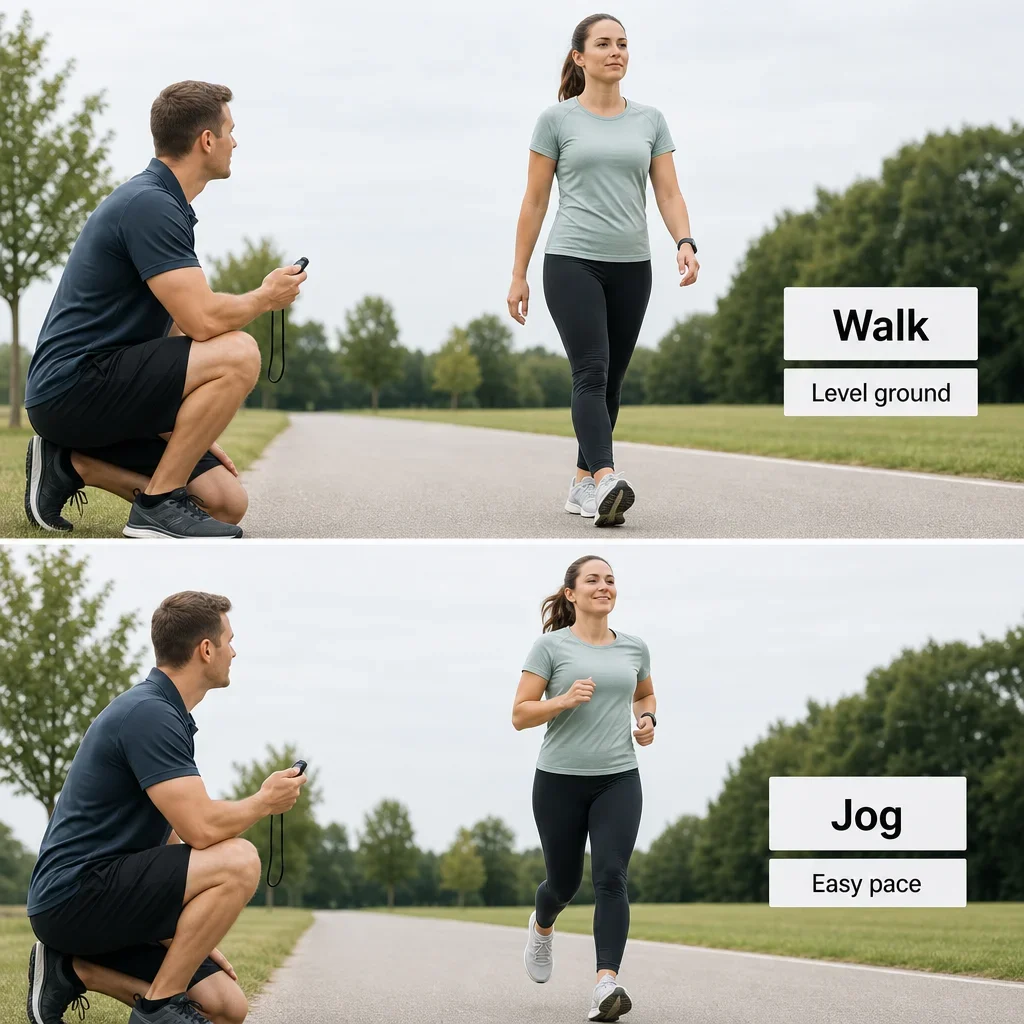
A walk-jog progression should start only after a surgeon and physiotherapist have cleared impact running. Begin on a level, predictable surface at an easy effort, then progress one variable at a time.
| Phase | Example focus | What must remain stable before advancing |
|---|---|---|
| 1 | Brisk walking and clinician-approved impact preparation | No swelling increase, limp, or next-day stiffness increase |
| 2 | Short easy jog intervals mixed with walking | Quiet knee during the session and the following day |
| 3 | Longer jog intervals with less walking | Controlled gait and stable symptoms |
| 4 | Easy continuous jogging on level ground | No reactive swelling or movement compensation |
| 5 | Outdoor flat running and gradual duration exposure | Stable response across more than one session |
| 6 | Gentle hills, varied surfaces, then controlled faster work | Strength, mechanics, and recovery remain appropriate |
The safest progression rule is to change one training factor at a time. Increase duration before adding hills, increase surface complexity before adding speed, and leave intervals or hard efforts until easy running is well tolerated.
A run log makes symptom patterns clearer. Record surface, total time, effort, swelling, pain, stiffness, limping, confidence, and your knee’s response the next day.
The commonly cited 10% weekly training increase is only a general training heuristic, not a universal ACL rule. Post-surgical progression should be based on your recovery response and clinician guidance rather than a fixed percentage.
What to Do If You Have Pain, Swelling, Stiffness, or Limping After a Run
New swelling, worsening pain, increasing stiffness, instability, or a limp means the current running load was not tolerated well. Stop or reduce the provoking run rather than trying to run through altered mechanics.
A useful response is to return to the last stage that kept the knee quiet. Continue the rehabilitation plan supplied by your care team, document the symptoms, and contact your physiotherapist if the change does not settle or keeps returning.
Limping while running after ACL surgery is not a normal progression strategy. A limp shifts load to other tissues and usually signals pain, weakness, stiffness, reduced confidence, poor control, or excessive training demand.
Same-day symptoms matter, but next-day symptoms matter too. A knee that becomes more swollen, stiff, painful, or difficult to fully straighten the next morning needs a lower load and clinical review before you advance running.
From Treadmill Jogging to Outdoor Runs, Hills, and Speed Work
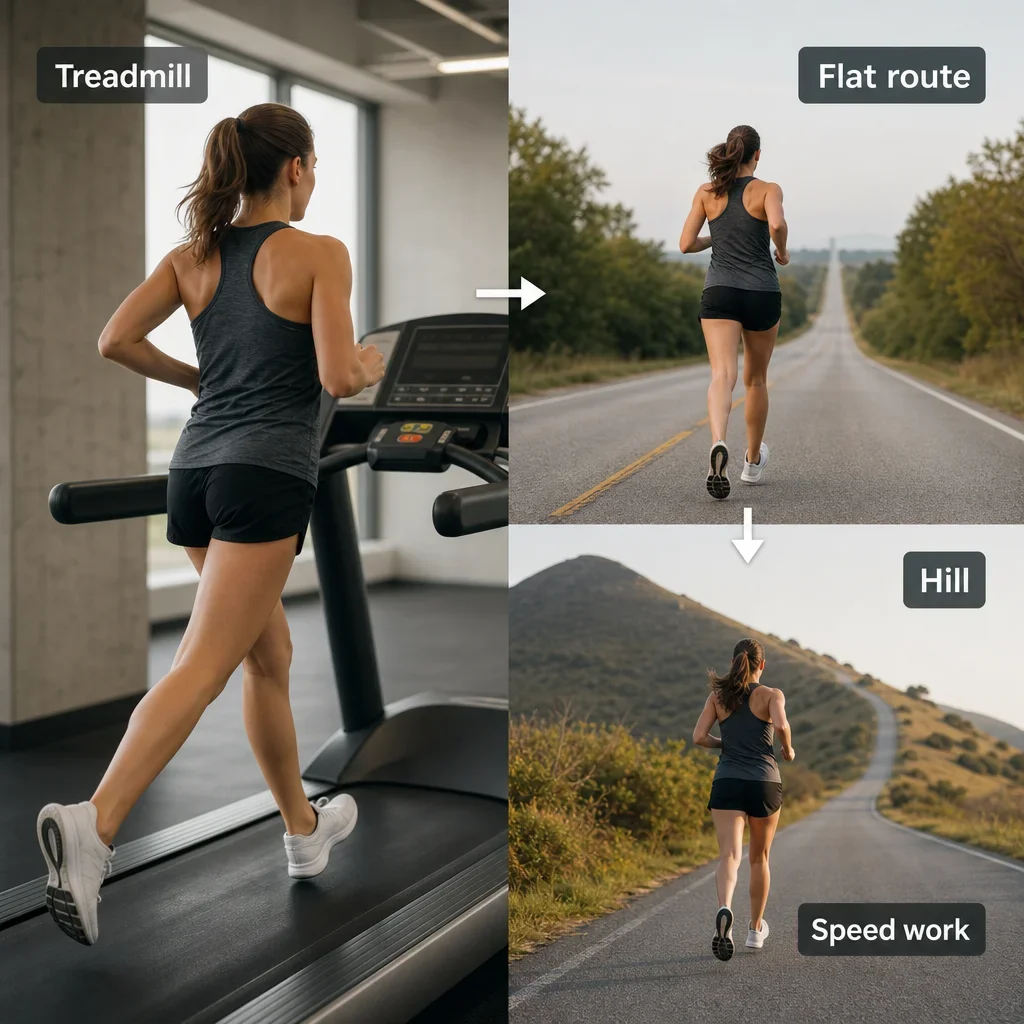
A treadmill can be useful for early jogging because it offers a predictable surface and controlled pace. It is not mandatory, but a level treadmill or flat route usually creates fewer variables than trails, hills, turns, or uneven pavement.
Outdoor running adds surface variation, visual distractions, weather, and route changes. Move from controlled level jogging to flat outdoor routes before adding uneven ground, hills, longer runs, intervals, or speed work.
Hills increase demand on the knee, calf, hip, and trunk. Uphill running changes propulsion demands, while downhill running can increase braking and quadriceps demand.
Footwear should fit comfortably and suit the running surface, but no shoe type can guarantee prevention of ACL reinjury. A physiotherapist may review footwear, cadence, stride length, trunk position, pelvic control, and side-to-side asymmetry when those factors affect your gait.
| Goal | Appropriate later-stage focus | Added requirements |
|---|---|---|
| Recreational 5K | Gradual duration and easy continuous running | Endurance progression and stable next-day symptoms |
| Faster road running | Intervals and pace changes | Running mechanics, calf capacity, and load tolerance |
| Field or court sport | Acceleration, deceleration, cutting, reactive drills | Strength, power, change-of-direction testing, and sport-specific exposure |
A 5K date cannot be set from surgery timing alone. Running a 5K requires return-to-run clearance plus enough gradual endurance training to tolerate the event distance without a symptom flare.
Does Your ACL Graft Type Change Your Return-to-Running Plan?
Graft type can shape rehabilitation priorities, but it does not independently clear or prohibit jogging. Your surgeon’s procedure notes, current symptoms, strength testing, associated procedures, and movement quality carry more weight than graft type alone.
| Graft type | Common rehabilitation consideration | What determines running readiness |
|---|---|---|
| Hamstring tendon graft | Hamstring donor-site symptoms or strength deficits may need attention | Knee status, gait, strength, control, and surgeon restrictions |
| Patellar tendon graft | Front-of-knee or kneeling symptoms may affect loading tolerance | Symptom response, quadriceps capacity, and movement quality |
| Quadriceps tendon graft | Quadriceps recovery can be a major rehabilitation focus | Knee-extension strength, swelling, motion, and running mechanics |
| Allograft | Surgical and biological considerations should be discussed with the surgeon | Procedure-specific restrictions and objective rehabilitation findings |
Follow the surgeon’s restrictions when graft details or associated procedures change the plan. General online timelines cannot account for your surgical findings, donor-site symptoms, or response to rehabilitation.
Running After an ACL Tear Without Surgery
Some people can return to straight-line jogging after an ACL tear without surgery, but suitability depends on knee stability, swelling, associated injuries, activity goals, and clinician assessment. A non-operative ACL plan should not use a post-surgical calendar as its guide.
Jogging may be tolerated without meaning pivoting sport is safe. Cutting, sudden turns, deceleration, jumping, and contact sport place different demands on an ACL-deficient knee than steady straight-line running.
A knee that gives way, locks, repeatedly swells, or feels unstable needs assessment before running progression. A sports medicine clinician can help determine whether the symptoms suggest a need for further imaging, surgical review, or a more structured rehabilitation plan.
Jogging Is Not the Same as Returning to Sport
Straight-line jogging is earlier in the ACL pathway than sprinting, jumping, cutting, contact, reactive drills, and competition. Return to sport requires more than a pain-free jog because sport adds speed, fatigue, decision-making, and unpredictable movement.
Some return-to-sport frameworks discuss approximately 9–12 months after ACL reconstruction, but this is not a universal clearance timeline. Athletes still need appropriate strength, power, hop testing, change-of-direction ability, sport exposure, confidence, and team-based medical clearance.
Many people return to valued activity after an ACL tear, but no clinician can guarantee a return to a specific performance level or a return to 100%. The useful target is a knee that meets the demands of your chosen activity with appropriate strength, movement quality, and symptom control.
Sports physiotherapy Toronto assessments can help separate return-to-running milestones from return-to-sport testing. A clinician can reassess readiness after changes in symptoms, training load, strength, or sport demands rather than relying on one test completed months earlier.
Frequently Asked Questions
Can I jog after ACL surgery?
You may be able to jog after ACL surgery once your surgeon and physiotherapist confirm that your restrictions, knee symptoms, range of motion, walking pattern, strength, and movement control support impact activity. A calendar date alone does not provide clearance.
When do you start jogging after ACL surgery?
Early jogging is commonly considered around 10–16+ weeks after isolated ACL reconstruction, but combined procedures and incomplete readiness criteria can extend that timeline.
How long after ACL surgery can I run a 5K?
A 5K requires more than initial jogging clearance because you need sufficient endurance and training-load tolerance. The right timeline depends on your quiet-knee response, running progression, strength, and capacity to build distance without swelling or limping.
What if my knee swells after jogging following ACL surgery?
Stop or reduce the running load and return to the last level that did not cause swelling. Contact your physiotherapist or surgeon if swelling is marked, recurrent, paired with instability, or accompanied by loss of motion.
Is limping while running after ACL surgery normal?
No. Limping while running after ACL surgery is a sign to stop and reassess because it can reflect pain, weakness, stiffness, poor control, or a progression that moved too quickly.
When can I start jumping after ACL surgery?
Jumping should be introduced when your surgeon permits it and when your knee can handle strength and landing preparation without swelling, pain, limp, or poor control. There is no universal week that makes jumping safe for every surgical presentation.
Can I run with a torn ACL without surgery?
Some people can run with a torn ACL without surgery after structured rehabilitation and assessment, particularly for straight-line activity. Recurrent giving way, swelling, locking, or instability should be assessed before you progress.
Does my ACL graft type affect when I can run?
Graft type can affect rehabilitation priorities through donor-site symptoms and strength deficits, but it does not set a guaranteed running date. Surgeon restrictions, knee symptoms, strength, and movement testing remain central.
Is running the same as being ready to return to sport?
No. Running is a straight-line activity, while sport can require sprinting, deceleration, cutting, jumping, contact, and reactive decisions. Return-to-sport decisions need later-stage testing and sport-specific exposure.
Can you get back to 100% after an ACL tear?
Recovery is individual, and no clinician can promise a specific outcome. A structured ACL rehab plan aims to restore strength, movement confidence, and capacity for the activities that matter to you.
A Practical Next Step
Before you test jogging on your own, have your knee reassessed if you have swelling, stiffness, weakness, a limp, instability, or uncertainty about your surgical restrictions. FocusPhysio in Toronto can provide an ACL return-to-running assessment focused on range of motion, gait, strength, single-leg control, impact tolerance, and a progression that fits your recovery.
Clinical review and references
Ontario physiotherapists are regulated health professionals under the College of Physiotherapists of Ontario, and post-operative ACL rehabilitation should be coordinated with your surgeon’s instructions.
Key clinical resources include the Aspetar Clinical Practice Guideline on Rehabilitation After ACL Reconstruction, the OPTIKNEE consensus recommendations, surgeon-specific post-operative protocols, and current peer-reviewed ACL rehabilitation research.