
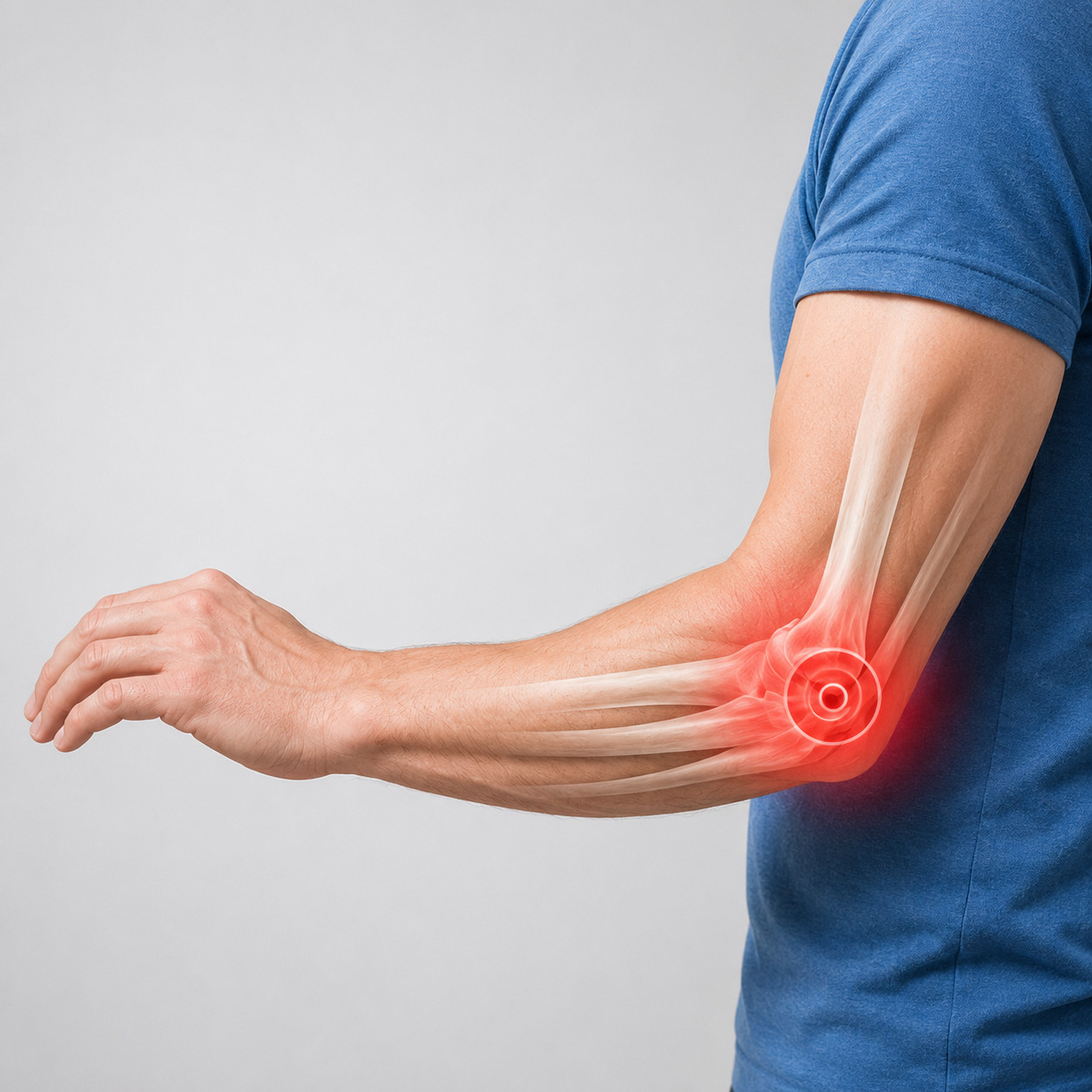
Good exercise for tennis elbow usually starts with the one your elbow can tolerate, not the hardest one online. For most irritable cases, that means an isometric wrist extensor hold first, then a gradual plan to strengthen the tendon, grip, and forearm for real-life loading.
What this page will help you do
The best plan usually follows 3 stages: calm pain, rebuild strength, then return to gripping, lifting, work, or sport . This guide gives you that order, plus pain rules, beginner options, no-equipment choices, and the signs that mean it is time to get assessed.
Tennis elbow exercises for beginners should feel controlled and repeatable, not aggressive. If an exercise causes sharp pain, increasing pain during the set, or a clear next-day flare that lasts, the load is too high and you should scale it back.
What tennis elbow is, where it hurts, and what it is commonly mistaken for
Tennis elbow is pain at the outer elbow linked to overload of the wrist and forearm extensor tendon, most often around the lateral epicondyle . You may also hear it called lateral epicondylitis or lateral elbow tendinopathy, but the practical takeaway is the same: the tissues that help extend your wrist, stabilize your grip, and control forearm loading have become irritated and load-intolerant.
Outer elbow pain exercises fit best when the pattern includes pain with gripping, lifting a kettle, carrying a bag, shaking hands, turning a doorknob, typing, mousing, or hitting a backhand. Pain is usually local to the outside of the elbow, but it can spread down the forearm.
What is commonly mistaken for tennis elbow is golfer’s elbow, neck-related arm pain, radial tunnel irritation, or elbow joint pain . Golfer’s elbow is felt on the inner elbow. Neck-related pain often comes with tingling, numbness, or pain traveling from the neck or shoulder. Radial tunnel symptoms can feel slightly lower in the forearm than classic tennis elbow. Joint irritation often feels stiffer deep in the elbow itself.
| Condition | Common pain location | Common triggers | Key difference |
|---|---|---|---|
| Tennis elbow | Outer elbow | Gripping, lifting, wrist extension | Tendon pain around lateral elbow |
| Golfer’s elbow | Inner elbow | Gripping, wrist flexion, pulling | Medial elbow rather than outer elbow |
| Neck-related pain | Neck, shoulder, arm | Posture, neck movement, sustained positions | May include numbness or tingling |
| Radial tunnel-type pain | Outer forearm, below elbow | Repetitive forearm use | Often more tender slightly below the elbow |
| Elbow joint irritation | Deep elbow | End-range bending or straightening | More joint stiffness and motion loss |
The best exercise order for tennis elbow: what to start with first
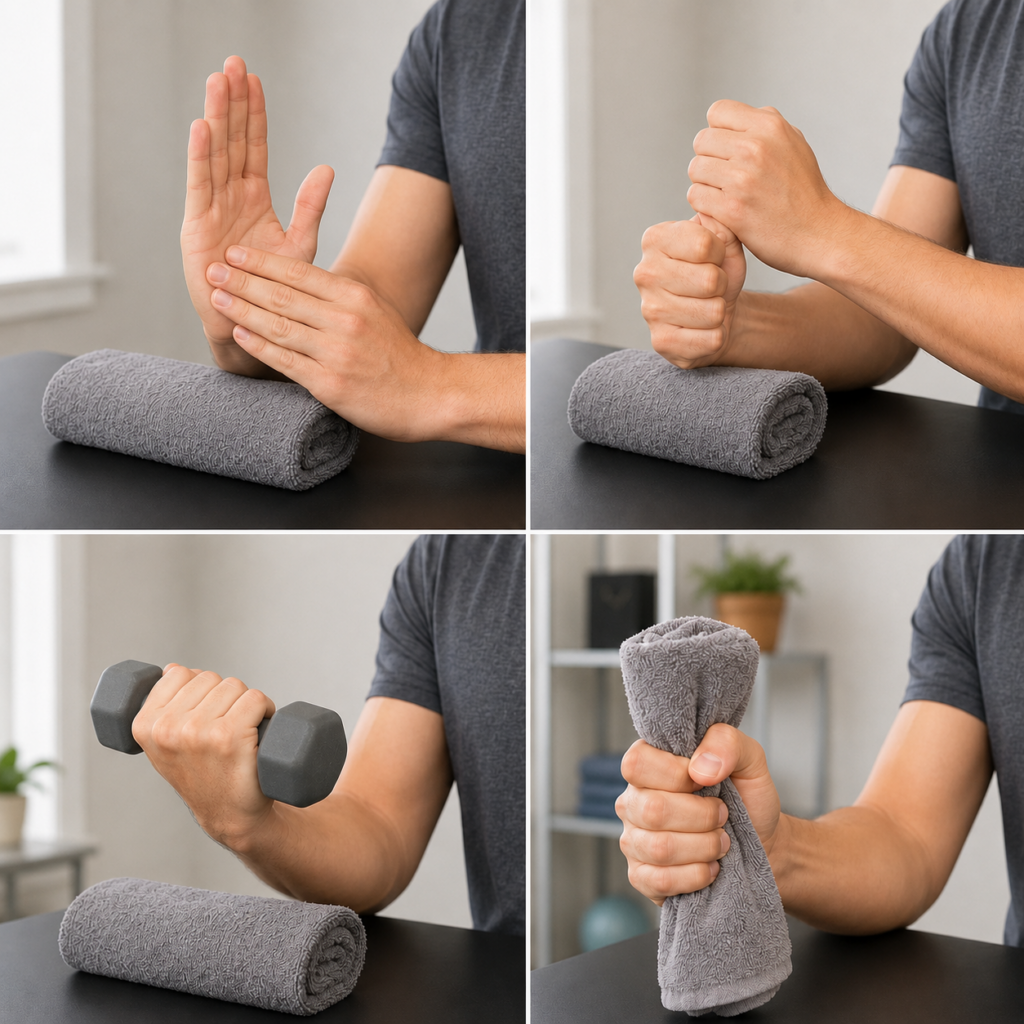
The best exercise order for tennis elbow is isometrics first if pain is irritable, then mobility if it feels relieving, then wrist extension strengthening, then forearm rotation and grip work, then return-to-function drills. That sequence matches how tendon rehab usually works: first improve load tolerance, then build capacity.
Should you stretch or strengthen first? Start with pain-tolerable loading, not aggressive stretching. Tennis elbow stretches can help some people, but stretching is supportive, not the main driver of recovery. If stretching clearly aggravates the elbow, skip it early and focus on controlled loading.
Progression should be based on symptom response more than the calendar. If pain during exercise stays mild, settles soon after, and is not clearly worse the next day, you can usually stay the course or make one small progression.
Pain rules: how much discomfort is acceptable?
Mild, tolerable discomfort can be acceptable during tennis elbow rehab exercises, but sharp pain, rising pain during the set, loss of grip strength after exercise, or next-day worsening means the load is too high. Tendons usually respond better to consistent loading than to a push-crash-rest cycle.
Change one variable at a time: reduce the range, resistance, speed, gripping effort, or number of sets. If even light loading flares the elbow, switch to a shorter isometric hold, lighter self-resistance, or a supported tabletop version.
Stop self-treatment and seek assessment if pain is severe, night pain is significant, there is marked weakness, swelling, numbness, tingling, major stiffness, or a history of trauma. Those patterns can point to something other than routine lateral epicondylitis exercises.
Stage 1: the first good exercise for tennis elbow when pain is irritable

The single best starting point for many painful cases is an isometric wrist extension hold. This is a good exercise for tennis elbow because it loads the irritated tendon without repeated movement, which can make early rehab easier to tolerate.
How to do the isometric wrist extension hold
Support your forearm on a table with your palm facing down and your wrist near neutral. Use your other hand to resist the back of the sore hand as you gently try to lift the wrist into extension without letting it move.
Hold the effort for 10 to 30 seconds and repeat 3 to 5 times, 1 to 3 times per day if symptoms stay settled . The effort should feel moderate, not maximal. You should feel work in the top of the forearm, not a sharp jab at the outer elbow.
Common mistakes are shrugging the shoulder, gripping too hard with the fingers, bending the elbow into an awkward position, or holding your breath. Keep the hand relaxed, the shoulder down, and the forearm supported.
A no-equipment option is to press the back of the hand gently into the underside of a desk or into your opposite palm. A very low-pain option is to use only 20 to 30 percent effort and shorten the hold.
Stage 2: stretches and mobility drills that may help
Tennis elbow stretches can help if they feel relieving, but they should feel gentle, not forced. Supportive mobility usually works better than aggressive pulling on an already irritable tendon.
Wrist extensor stretch
Straighten the elbow if that position is comfortable, then bend the wrist down with the other hand until you feel a light stretch along the top of the forearm. Hold 15 to 30 seconds for 2 to 4 repetitions once daily or near daily if it feels helpful .
If a straight elbow sharply increases symptoms, bend the elbow slightly. That answers the common straight-or-bent question: use the position that reduces tissue tension and lets you feel a mild stretch instead of pain.
Gentle forearm mobility
Slow wrist circles, opening and closing the hand, and light forearm rotation can maintain motion without overloading the tendon. Perform 5 to 10 controlled repetitions in each direction .
Stage 3: strengthening exercises for tennis elbow
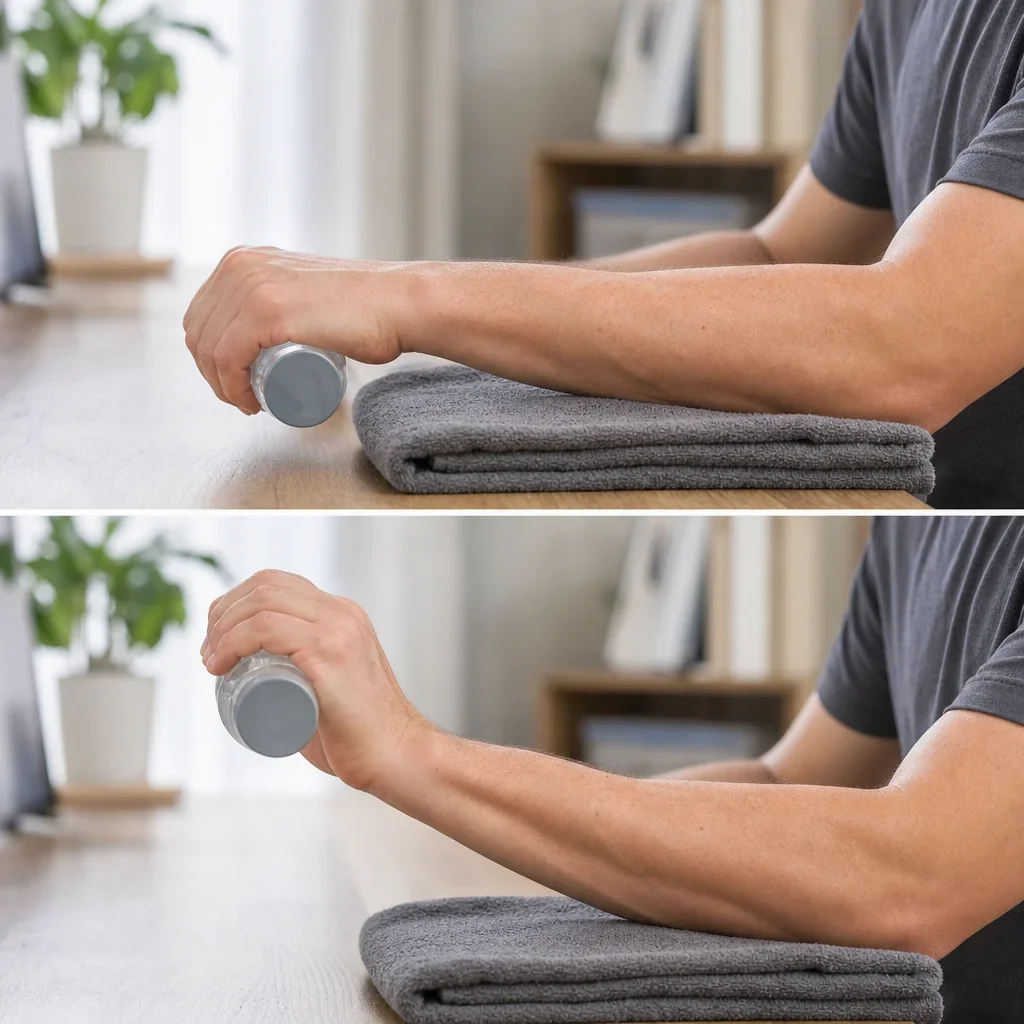
The main exercise to strengthen tennis elbow is wrist extension strengthening. That directly loads the wrist extensor tendon that commonly drives symptoms.
1) Wrist extension raise
Rest your forearm on a table, palm down, with your hand hanging off the edge. Hold a very light weight such as a small water bottle, then slowly lift the hand up and lower it with control.
Start with 8 to 12 repetitions for 2 to 3 sets every other day, using only a light load that keeps symptoms tolerable . The lowering phase should be slow. You should feel effort in the top of the forearm.
Make it easier by using the other hand to help lift, then lowering on the sore side. Make it harder by increasing the lever or the weight gradually.
2) Eccentric wrist extension
Use the opposite hand to help lift the sore wrist into extension, then slowly lower it down on the affected side alone. This is one of the most common lateral epicondylitis exercises because it gives the tendon controlled loading on the way down.
Use 6 to 10 slow repetitions for 2 to 3 sets . Keep the movement smooth. If the eccentric version is more painful than the regular raise, return to isometrics or lighter full-range lifting first.
3) Forearm rotation: supination and pronation
Hold a light hammer, dumbbell, or kitchen utensil vertically with the elbow tucked by your side. Rotate the forearm palm-up, then palm-down, through a comfortable range.
Start with 8 to 12 repetitions for 2 sets . This helps because forearm rotation is part of turning handles, using tools, and racquet control.
4) Wrist flexion as a supporting exercise
Wrist flexion can be added as a supporting exercise if it does not reproduce outer elbow pain. Rest the forearm palm-up and curl the wrist upward with a light load.
Use 8 to 12 repetitions for 2 sets . This is not usually the first priority for tennis elbow, but balanced forearm strength can help some cases.
5) Grip work and towel twists
Grip work can help rebuild tolerance, but it can also irritate a sensitive elbow if started too early or done too hard. Begin with a soft towel squeeze or light putty-style squeeze rather than maximal ball crushing.
Squeeze for 5 to 10 seconds for 5 to 8 repetitions . If even that provokes symptoms, delay grip strengthening and stay with wrist loading first.
A towel twist is another useful exercise to strengthen tennis elbow because it combines grip with forearm control. Twist a rolled towel gently in both directions for short, controlled efforts.
Tennis ball and resistance band options
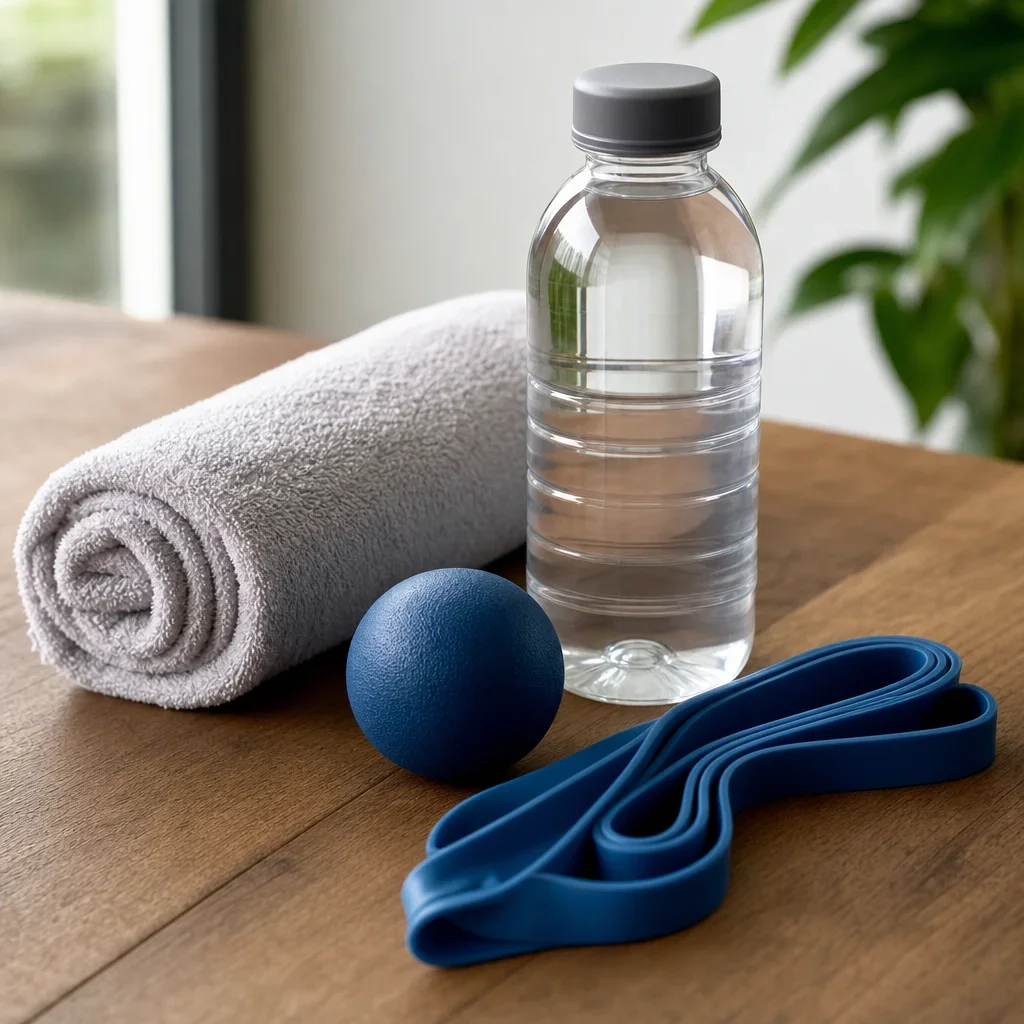
Tennis ball exercises for tennis elbow are not automatically better than other options. A soft ball or stress ball can help later-stage grip tolerance, but hard squeezing early can flare pain.
Resistance band exercises can work well because the load is easy to scale. Tennis elbow exercises with resistance band can include wrist extension, forearm rotation, and light pull-apart drills if they do not trigger outer elbow pain.
If you have no dumbbells, use your other hand, a water bottle, a soup can, a towel, a band, or tabletop resistance. No-equipment rehab is completely possible early on.
Isometric vs eccentric vs concentric: which is best?
Isometrics are static holds, eccentrics load the muscle while it lengthens, and concentrics load it while it shortens . Each has a role. No single mode is magic.
Isometric exercises are often the best place to start when pain is irritable because they can improve load tolerance without repeated movement. Eccentric exercises are useful when you can tolerate slow lowering. Concentric work matters too, because real-life grip and lifting demands use both directions.
A staged plan usually works better than committing to one method forever. Start with isometrics, build into slow strengthening, then combine movements for work, gym, and sport.
Beginner routine: a short plan you can actually follow
A practical beginner routine should take about 10 to 15 minutes . Keep it simple enough that you will actually repeat it.
Beginner order 1. Isometric wrist extension hold: 3 to 5 holds of 10 to 30 seconds 2. Gentle wrist extensor stretch if relieving: 2 to 4 holds of 15 to 30 seconds 3. Wrist extension raise or assisted lowering: 2 to 3 sets of 8 to 12 reps 4. Forearm rotation: 2 sets of 8 to 12 reps 5. Light towel or soft-ball squeeze if tolerated: 5 to 8 reps of 5 to 10 seconds
Do the isometric work daily or near daily if it settles symptoms. Do strengthening every other day at first . A full strengthening block often takes 6 to 12 weeks to build meaningful capacity, and stubborn cases can take longer .
Weekly progression plan
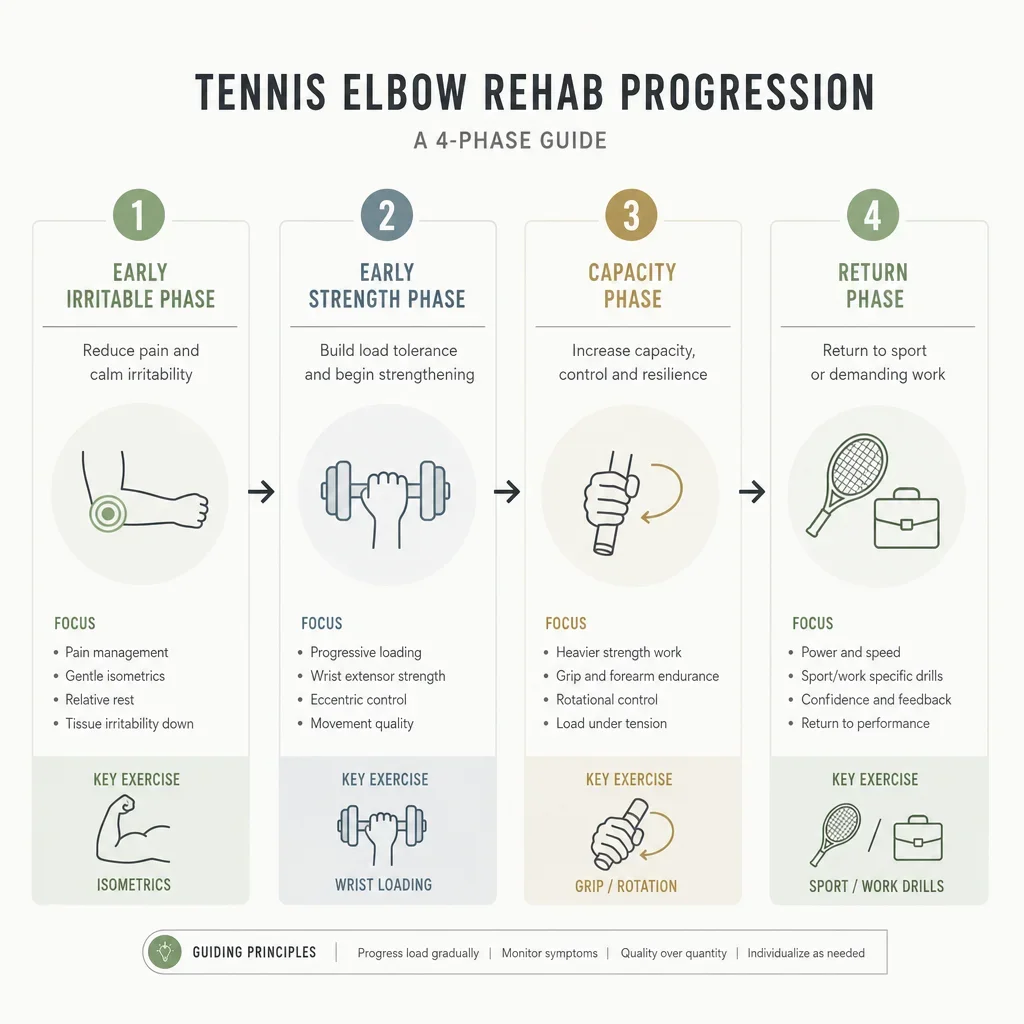
A safe weekly progression plan increases one thing at a time: hold time, repetitions, resistance, leverage, or functional demand. That keeps tendon loading predictable.
| Phase | Main focus | Example dosage | Advance when | Back off when |
|---|---|---|---|---|
| Early irritable phase | Isometrics, light mobility | Daily holds plus gentle motion | Pain during exercise stays mild and next day is stable | Pain spikes during or after sessions |
| Early strength phase | Wrist extension loading | 2 to 3 sets of 8 to 12 every other day | Daily tasks feel easier | Grip and carrying tolerance drop |
| Capacity phase | Rotation, grip, heavier control | Add one new variable at a time | You tolerate chores, gym, or work better | Symptoms linger into the next day |
| Return phase | Sport/work drills | Gradual exposure to real tasks | Warm-up helps and recovery stays stable | Specific tasks trigger repeated flare-ups |
If you cannot progress after several weeks of consistent effort, the diagnosis, exercise choice, technique, or total daily load may need to be checked by a physiotherapist.
What not to do with tennis elbow
What not to do with tennis elbow is keep hammering the exact movement that keeps flaring it. The usual problem is not movement itself. It is too much gripping, lifting, wrist extension, or twisting for your current tendon capacity.
Tennis elbow exercises to avoid are the ones that create sharp pain, obvious compensation, or a next-day flare. Common aggravators are repeated hard gripping, heavy carries with the wrist extended, forceful backhands, repetitive screwdriver-type motions, and sudden jumps in training or work volume.
Bicep curls can be okay if they are symptom-free and your wrist stays neutral, but they are not okay if you have to grip hard, cock the wrist back, or feel clear outer elbow pain. Use a lighter load, neutral grip, cable or machine variation, or reduce range if needed.
Avoid the all-or-nothing mistake. Temporary modification is usually better than complete shutdown followed by an abrupt return.
Can you still work out with tennis elbow?
Many people can keep training with tennis elbow by modifying load, grip, range, and exercise selection. Lower-body work, cardio, core training, and symptom-free pressing patterns are often easier to keep than heavy pulling or gripping.
Use neutral grips, lighter handles, slower tempo, and more recovery between upper-body sessions if the elbow is irritable. If rows, pull-ups, curls, carries, or racquet drills flare symptoms, reduce load, use machine support, shorten the range, or swap them out for a period.
The best rule is simple: if the workout leaves the elbow clearly worse later that day or the next morning, it was too much. Train around the irritation while you keep building tolerance.
Home care that may help alongside exercise
The quickest way to calm tennis elbow is usually not complete rest. Relative rest works better. That means reducing aggravating volume while keeping the elbow moving and loading it in a controlled way.
Ice can help with short-term symptom relief, especially after a flare, but it does not rebuild tendon capacity. Use short sessions of about 10 to 15 minutes if it feels soothing .
A counterforce brace or wrist support may reduce symptoms during provoking tasks by changing how load is felt at the tendon . It can be useful for short periods during work or sport, but it should not replace progressive strengthening.
If you are considering medication, get advice from a pharmacist or physician. Exercise, load management, and biomechanics are still the core plan.
How long tennis elbow takes to improve
Tennis elbow can improve, but true tendon capacity rarely rebuilds in a couple of days. Some people feel less pain within a few weeks, while strengthening and return to full loading often take several weeks to months .
Can tennis elbow heal in 2 weeks? Pain can calm in that time, especially if the issue is recent and you reduce the aggravating load, but longstanding cases usually take longer. Pain relief and tissue capacity are not the same thing.
Do tennis elbows ever go away? Yes, many do improve with good load management and progressive rehab, but recovery is rarely linear. Ongoing aggravation, poor sleep, high work demands, neck or shoulder contribution, and returning to heavy gripping too early can slow progress.
Return-to-work and return-to-sport checklist

Desk workers usually need to reduce sustained gripping and forearm tension. Keep the mouse close, support the forearm, avoid reaching, keep the wrist more neutral, and take short movement breaks through the day.
Manual workers usually need load distribution changes. Increase handle size where possible, reduce repetitive twisting, rotate tasks, pace heavy gripping jobs, and use two hands for heavier lifts when practical.
Racquet-sport players need a graded return, not a one-day comeback. Start with shadow swings, mini-hits, or shorter sessions before full serves and high-volume backhands. Grip setup, stroke volume, warm-up quality, and total weekly load all matter.
Readiness signs are practical: daily tasks are easier, light carries feel better, next-day pain is stable, and you can complete your rehab loading without a flare.
When to see a physiotherapist or sports medicine professional
See a clinician if pain is severe, worsening, linked to trauma, disturbing sleep, or associated with numbness, tingling, obvious weakness, swelling, or loss of motion. Those signs deserve a proper assessment.
You should also get checked if you are not improving after several weeks of load modification and consistent exercise. Not every outer elbow pain case is tennis elbow, and a biomechanics-led assessment can help separate tendon pain from neck referral, radial tunnel irritation, joint problems, or technique overload.
If you want a personalized return-to-training plan, Studio Athletica in downtown Toronto can assess movement, loading tolerance, and sport or work mechanics, then build a progressive plan around your actual triggers.
Equipment list and no-equipment alternatives
You do not need a full gym to start tennis elbow rehab. A table, a towel, a water bottle, a light dumbbell, a resistance band, or your opposite hand can cover most early and mid-stage drills.
If you have nothing at home, use self-resistance for isometrics, tabletop pressure for static holds, a rolled towel for twisting, and slow open-close hand drills for light grip exposure.
FAQ
What is the single best exercise for tennis elbow?
For many painful cases, the best starting exercise is an isometric wrist extension hold because it loads the irritated tendon in a controlled way. It is not the only exercise you will need, but it is often the safest first step.
What is the quickest way to heal a tennis elbow?
The quickest path is usually to reduce the movements that keep flaring it, start pain-tolerable loading, and build back gradually. Chasing complete rest or jumping into hard strengthening too early often slows things down.
Can you fix a tennis elbow with exercise?
Exercise can help many cases because it rebuilds load tolerance and strength. It is most effective when paired with activity modification and a plan that progresses based on symptoms.
Does squeezing a ball help tennis elbow?
Sometimes, but not always. Light squeezing can help later in rehab, while hard or repetitive squeezing early can aggravate symptoms.
Can I still workout if I have tennis elbow?
Usually yes, if you modify provoking lifts, reduce gripping demand, and respect next-day response. Train what is symptom-tolerable while you keep rehabbing the elbow.
Are bicep curls ok for tennis elbow?
They can be, but only if they do not reproduce outer elbow pain. Neutral grip, lighter load, and controlled wrist position are usually better tolerated.
What exercises should be avoided with tennis elbow?
Avoid exercises that cause sharp pain, forceful gripping, or a clear next-day flare. Heavy carries, hard curls with the wrist extended, repetitive backhand loading, and aggressive wrist work are common irritants.
How long does it take to strengthen tennis elbow?
A meaningful strengthening block often takes 6 to 12 weeks, and stubborn cases can take longer . Pain may improve earlier than full loading tolerance.
Can tennis elbow heal in 2 weeks?
Symptoms can settle in 2 weeks if the problem is mild and recent, but established cases usually need longer. Do not mistake short-term pain relief for full recovery.
What is commonly mistaken for tennis elbow?
Golfer’s elbow, neck-related arm pain, radial tunnel irritation, and elbow joint pain are common lookalikes. If the pattern is unclear, get assessed rather than guessing.
Final takeaway
The best beginner-to-advanced plan is simple: start with a tolerable isometric, add gentle mobility only if it helps, progress to wrist extension strength, then rebuild grip, rotation, and your real-life tasks. If symptoms are not settling, if you are unsure whether it is really tennis elbow, or if you want a clear return-to-sport or return-to-work plan, book a physiotherapy assessment in downtown Toronto.