

Preventing ACL injuries is possible in the sense that you can lower risk, but no program can eliminate ACL tears entirely. The athletes who do best usually stack the basics: a good ACL warm-up, strength work, landing and cutting practice, and smart workload management.
What preventing ACL injuries really means
Reducing ACL injury risk starts with understanding what the ligament does. The ACL, or anterior cruciate ligament, helps control forward movement and rotation of the shin bone under the thigh bone, especially during cutting, pivoting, landing, and deceleration .
Prevention is different from treatment after a tear. Prevention focuses on movement quality, strength, balance, and training habits before injury happens, while treatment deals with swelling, instability, rehab, and sometimes surgery after the ligament is damaged .
The most useful ACL injury prevention program is not one drill or one brace. It combines dynamic warm-up, lower-body and trunk strength, neuromuscular control, landing mechanics, cutting mechanics, and recovery habits over time .
What an ACL injury is and how it happens
An ACL injury is a sprain or tear of the ligament inside the knee. It often happens without direct contact when an athlete lands awkwardly, decelerates hard, or pivots on a planted foot while the knee collapses inward and the trunk loses control .
The ACL sits inside the knee joint between the femur and tibia. It helps resist excessive forward glide and rotation of the tibia, which is why fast changes of direction challenge it so much .
Many ACL tears happen in sports with repeated jumping, cutting, and stopping. Soccer, basketball, football, volleyball, skiing, lacrosse, tennis, and gymnastics all create those demands .
ACL prevention also helps with broader knee protection because the same bad mechanics that stress the ACL can also load the meniscus and other structures around the knee. A quieter landing, better hip control, and cleaner deceleration usually protect more than one tissue at once .
Who is at higher risk for ACL tears
Higher risk usually comes from the mix of sport demands and the athlete in front of you. The biggest patterns are cutting and jumping sports, prior ACL or knee injury, poor movement mechanics, rapid growth phases in youth athletes, deconditioning, fatigue, and year-round single-sport exposure .
Some risk factors are modifiable and some are not. You cannot change your injury history or the basic demands of your sport, but you can improve strength, landing control, cutting mechanics, conditioning, and recovery habits .
Female athletes are often discussed because higher ACL tear rates have been observed in some sports, but sex alone is not the whole explanation. The useful clinical question is not male versus female; it is whether the athlete shows deficits in hip strength, trunk control, landing strategy, deceleration, or fatigue resistance .
Recreational athletes are not exempt. We see non-contact knee injuries in adults who play weekend basketball, soccer, skiing, or racket sports with little preparation for jumping, cutting, or stopping demands .
Why female athletes may need tailored ACL prevention
Female athletes often benefit from more targeted prevention because the common deficits can cluster around single-leg control, trunk position, deceleration, and hamstring-glute contribution during landing and cutting. That does not mean every female athlete moves poorly, and it does not mean every male athlete is low risk .
The practical answer to how to prevent ACL injuries in females is to coach what the athlete actually needs. That usually means better hip and hamstring strength, cleaner landing mechanics, stronger trunk control, and practice absorbing force before progressing to reactive sport drills .
Individual assessment matters more than broad assumptions. Two athletes in the same sport can need very different plans based on growth stage, training age, previous injury, confidence, and movement quality .
The main pillars of ACL injury prevention
The core pillars are dynamic warm-up, strength training, plyometrics, balance and proprioception, landing mechanics, cutting mechanics, and workload management. If one piece is missing, the program usually gets weaker .
Strength alone is not enough because strong athletes can still land stiffly or let the knee drift inward. Movement coaching teaches them how to use that strength during sport .
Warm-up alone is not enough because a 10 to 20 minute prep block helps prime the body, but it does not replace regular strength and neuromuscular work done through the week. Prevention works best when it is repeated, not when it shows up only on game day .
How to warm up to reduce ACL injury risk
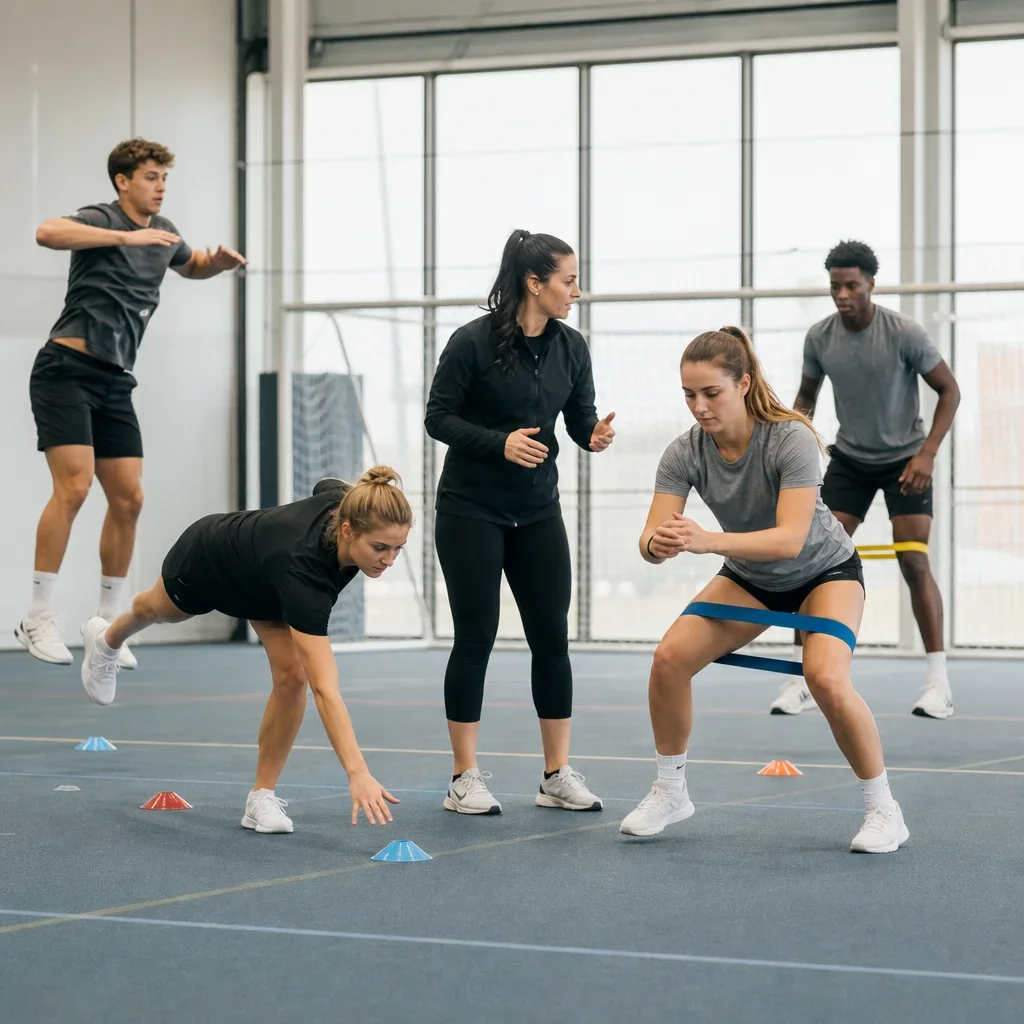
A useful ACL warm-up usually lasts 10 to 20 minutes and moves from general heat to sport-specific control. The sequence should raise pulse, open mobility, switch on key muscle groups, challenge balance, rehearse landing, then build into acceleration and deceleration.
A dynamic warm-up is usually more useful before sport than static stretching alone. Jogging, skips, shuffles, lunges, hip-openers, single-leg balance reaches, controlled hops, and cutting rehearsal prepare the body for fast movement patterns .
FIFA 11+ is a well-known soccer warm-up that was designed as an injury prevention program, and it is commonly used as a team-based template . It is a good reference point, but it is not the only option and it still needs consistent use and good coaching.
A practical printable-style warm-up checklist looks like this:
- 2 to 4 minutes of light jog, bike, skips, or shuffles
- 2 to 4 minutes of mobility drills like walking lunges, leg swings, and hip openers
- 2 to 4 minutes of activation like glute bridges, mini-band steps, and calf raises
- 2 to 4 minutes of balance and control like single-leg reaches or step-downs
- 2 to 4 minutes of landing and deceleration rehearsal like hop-and-stick, snap-downs, and controlled stops
- 1 to 3 minutes of sport-specific accelerations, cuts, or approach jumps
Best exercises for preventing ACL injuries
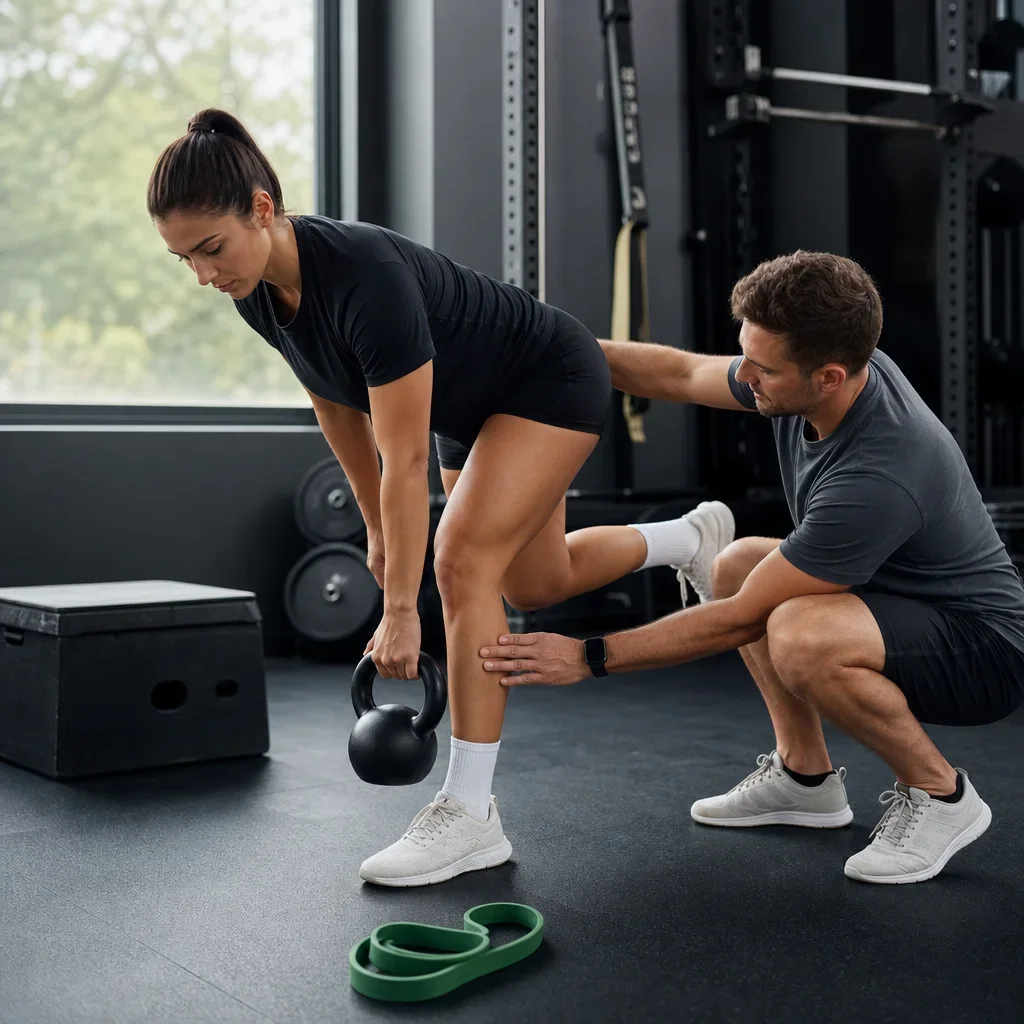
The best prevent ACL injury exercises train the muscles and movement patterns that protect the knee under speed. Most athletes should train hamstrings, glutes and hips, quads, trunk control, balance, plyometrics, and deceleration skills in the same week .
Hamstring work matters because the hamstrings help resist forward tibial movement that can stress the ACL. Good starting choices are bridges, sliders, Romanian deadlifts, and hamstring curls, usually for 2 to 4 sets of 5 to 12 reps depending on the exercise and training age.
Glute and hip work matters because the pelvis and femur need control during single-leg tasks. Squats, split squats, lateral band walks, step-downs, and single-leg RDLs are common choices, again usually for 2 to 4 sets of 5 to 12 reps .
Quad strength still matters because the knee must tolerate bending under load. Squats, lunges, step-ups, and controlled deceleration drills help build that tolerance when coached well .
Trunk control matters because athletes who lose their torso over the planted leg often lose knee alignment too. Planks, side planks, carries, anti-rotation presses, and split-stance trunk drills are simple ways to train it .
Balance and proprioception matter because single-leg sport happens fast. Single-leg balance, reach drills, step-downs, hop-and-stick landings, and uneven-task progressions can improve body awareness and control .
Plyometrics matter because the ACL is stressed during fast force absorption and re-use. Double-leg pogo hops, squat jumps, bounds, drop landings, and single-leg hops are useful only if the athlete can land quietly and keep the knee tracking over the foot .
Deceleration and change-of-direction drills matter because non-contact ACL injuries often happen on the way down, not on the way up. Snap-downs, stick-and-hold stops, shuffle-to-stop drills, planned cuts, then reactive cuts teach the athlete to lower the centre of mass before changing direction .
Beginner vs advanced exercise progressions
| Training level | Strength focus | Landing focus | Change-of-direction focus |
|---|---|---|---|
| Beginner | Bodyweight squat, split squat, bridge, band walks | Double-leg snap-down, hop-and-stick | Slow planned stops, low-speed cuts |
| Intermediate | Goblet squat, RDL, step-down, single-leg bridge | Box drop landing, repeated stick landings | Planned cuts with stronger deceleration |
| Advanced | Loaded squat, loaded RDL, rear-foot elevated split squat, single-leg RDL | Single-leg hops, reactive landing, higher-force jumps | Reactive agility, high-speed cutting, sport-specific chaos drills |
Progression should follow movement quality, not ego. If the athlete cannot control a bodyweight step-down, they are not ready for reactive single-leg depth landings .
How to land, stop, and pivot more safely

Good landing mechanics spread force through the hips, knees, and ankles instead of dumping it into one structure. The simplest cues are hips back, knees soft, chest controlled, knee tracking over the foot, and quiet contact with the floor .
A safer double-leg landing usually looks like this:
- Land softly, not stiffly
- Bend at hips and knees together
- Keep knees from collapsing inward
- Keep the trunk from whipping side to side
- Hold the position for 1 to 2 seconds to prove control
Poor landing mechanics usually look like this:
- Upright torso
- Loud contact
- Locked or barely bent knees
- One foot landing earlier than the other
- Knees diving inward
Safer stopping mechanics start with deceleration, not the final plant. Lowering the centre of mass early, using multiple controlled steps when needed, and avoiding an upright hard stop on a near-locked knee usually makes the knee safer and the athlete more efficient .
Safer cutting mechanics depend on control before redirection. Planting under the body, keeping the trunk and pelvis organized, and resisting inward knee collapse reduce the bad positions that often show up during non-contact injuries .
Planned drills are the first layer, but game sport is reactive. Athletes should eventually practice landing mechanics and cutting mechanics under unplanned cues, visual targets, or ball-play demands once the basic pattern is solid .
How to spot early warning signs before injury happens
The easiest early warning signs are visible changes in control. Knee drift inward during squats or jumps, trunk sway on one leg, uneven landings, noisy landings, and form breakdown late in sessions all suggest the athlete may need movement work .
Confidence is also a useful clue. Athletes who hesitate to plant, avoid one side, or look stiff during cutting after a previous knee issue often need assessment even if they can still train .
These are screening clues, not a diagnosis. If the pattern keeps showing up, a sports medicine Toronto or physiotherapy Toronto assessment can look at strength, timing, balance, and sport demands in more detail .
Simple self-checks for hamstring, glute, hip, and balance deficits
Informal self-screens can show you where control breaks down. They do not diagnose an ACL problem, but they can help you decide where training or a formal assessment should start .
A bodyweight squat can show global control. Watch whether the feet stay planted, the knees track in line with the feet, and the trunk stays centred instead of shifting off one side .
A single-leg squat or step-down can show hip and knee control. If the knee caves inward, the pelvis drops, or balance is lost quickly on one side, that side may need more targeted work .
A single-leg balance hold for 20 to 30 seconds can expose basic control deficits. Excessive wobbling, repeated toe grabs, or big trunk shifts suggest the athlete is struggling to organize over one leg.
A hop-and-stick test can show whether power and control work together. If the landing is loud, unstable, or very different side to side, the athlete likely needs a simpler landing progression before faster plyometrics .
A bridge hold comparison can hint at posterior-chain endurance differences. If one hamstring cramps immediately or one side drops much sooner, that is useful programming information even without a strict pass-fail cut-off .
A practical weekly ACL injury prevention program

Most athletes do well with 2 to 3 focused prevention sessions per week plus a dynamic warm-up before practices and games. That is enough structure for progress without turning prevention into a separate sport.
A simple pre-season week might look like this:
- Day 1: warm-up, strength, landing drills
- Day 2: warm-up, cutting and deceleration drills, conditioning
- Day 3: warm-up, strength, single-leg control, low-level plyometrics
- Team sessions: shorter ACL warm-up before each practice
A simple in-season week might look like this:
- 1 to 2 shorter strength sessions
- 1 focused neuromuscular session
- 10 to 20 minute prevention warm-up before each practice or game
- Reduced drill volume during congested match periods
A youth team version should stay simple and repeatable. Coaches usually get better buy-in when the warm-up takes 10 to 15 minutes and the same movement cues show up every practice.
A recreational adult version should fit real life. Two gym sessions and one field or court movement session each week is a practical starting point for many active adults if the total load matches their current conditioning .
Teams do not need a separate long block if practice time is tight. We often tell coaches to place landing and deceleration drills into the first 10 to 15 minutes of practice, then revisit one movement-quality drill later when fatigue sets in.
Sports-specific prevention tips for soccer, football, basketball, and volleyball
How to prevent ACL tears in soccer starts with deceleration and one-leg plant control. Soccer adds repeated cuts, reaching tackles, awkward passing positions, and late-match fatigue, so warm-up adherence and clean first-step mechanics matter .
How to prevent ACL tears in football requires attention to both contact and non-contact situations. Athletes need strong acceleration and braking mechanics, plus enough strength and trunk control to handle awkward positions around other players .
How to avoid ACL injury in basketball usually comes back to jump-landing volume and quick direction changes. Rebounding, closeouts, layup traffic, and one-foot takeoffs all demand quiet landings, hip control, and the ability to stop before the knee falls inward .
How to prevent ACL tears in volleyball depends heavily on repeated jump-land cycles. Approach jumps, block landings, and transitions off the net reward athletes who can land softly, re-balance quickly, and control both double-leg and single-leg positions .
Fatigue, rest, sleep, and cross-training
Fatigue matters because mechanics often get worse when the athlete is tired. Late in games, late in practices, and during tournament weekends, you often see noisier landings, slower hip control, and harder upright stops .
Rest days matter because tissue and nervous system recovery need room to happen. Sudden spikes in training volume or intensity are a common setup for poor movement quality, especially after time off or during dense competition periods .
Sleep matters because reaction time, coordination, and recovery all depend on it. Public health sleep targets for school-age children are about 9 to 12 hours per night, teens about 8 to 10 hours, and adults 7 or more hours .
Cross-training can help reduce repetitive load from one sport all year. It also broadens movement skills, which is useful for athletes who otherwise only sprint, jump, or cut in one narrow pattern for months at a time .
Do braces, footwear, orthotics, or compression sleeves help?
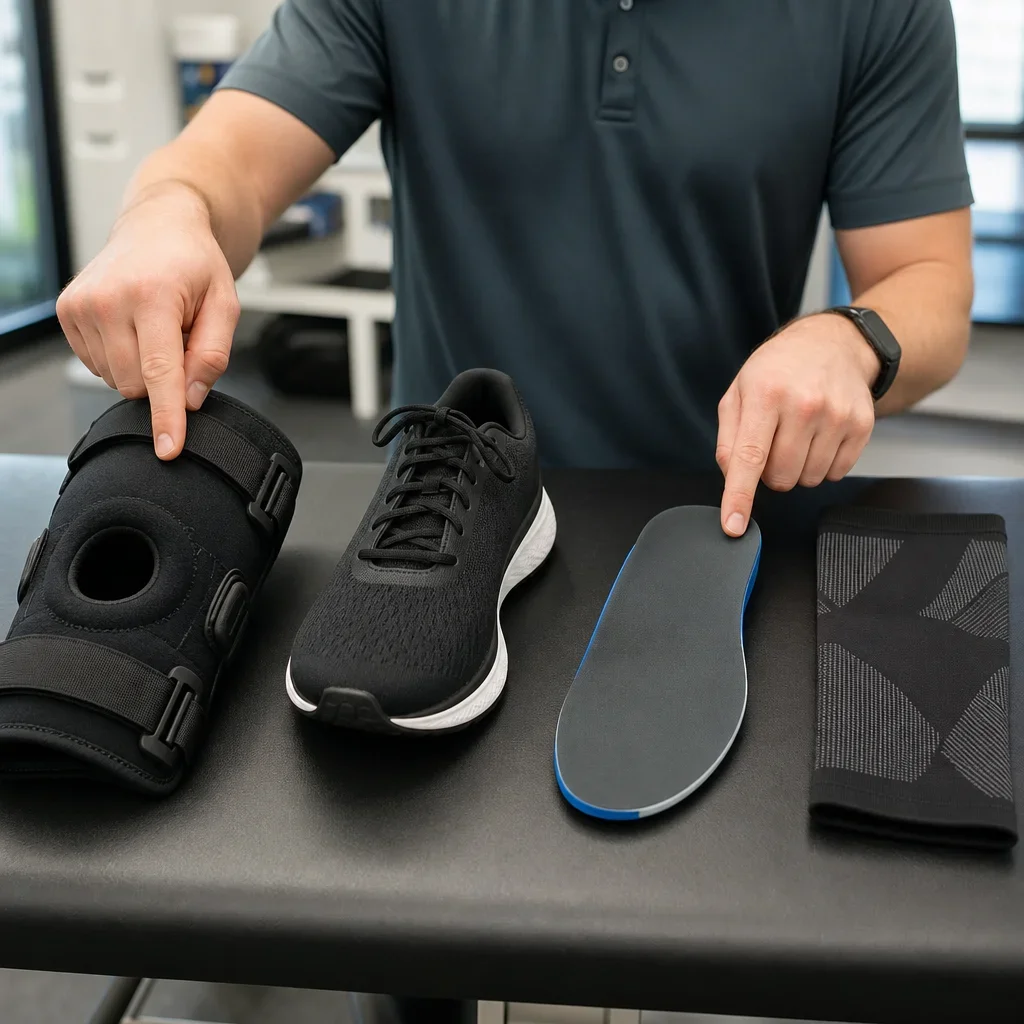
Gear can play a role, but it should not replace training-based prevention. A knee brace, footwear change, orthotic inserts, or compression sleeves may help comfort, confidence, or load management in some cases, especially after prior injury, but the foundation is still strength and movement quality .
Braces may be considered after previous injury or in specific sport contexts, but they are not a guarantee against ACL tears. If an athlete feels unstable, the answer is not to skip assessment and hide the issue under a brace .
Footwear matters most when it affects traction and control. Too much grip on a planted foot can be a problem in some environments, while poor shoe condition can also reduce confidence and stability .
Orthotics can be reasonable when foot mechanics, pain, or previous injury history point that way, but they should be individualized. They are not a universal ACL prevention tool and should not be sold as one .
Compression sleeves may improve comfort or body awareness for some athletes, but they do not replace a proper ACL injury prevention program .
What to do right away after a suspected ACL injury
Stop playing immediately if you suspect an ACL injury. Continuing to run, pivot, or test the knee can make the situation worse, especially if the knee feels unstable or gives way .
Three common signs of an ACL tear are a pop at the time of injury, rapid swelling, and a feeling that the knee is unstable or giving way. Pain can be present, but the combination of swelling and instability is often what athletes remember most clearly .
You may still be able to bend the knee or even walk with a torn ACL. That ability does not rule the injury out, which is why self-diagnosis is unreliable .
The safest first steps are relative rest, compression, elevation, and a timely medical or rehab assessment. If pain is severe, swelling is rapid, or the knee cannot bear weight safely, urgent medical evaluation is appropriate .
The movements to avoid after a suspected tear are pivoting, cutting, twisting on the planted leg, jumping, and any activity that triggers giving way. The goal is to protect the knee until it is assessed properly .
Swelling can be reduced with relative rest, compression, elevation, and load reduction in the first phase. A clinician can guide the next steps once the knee is examined and the mechanism is clearer .
Can a torn ACL heal on its own? Recovery and return-to-sport basics
A torn ACL does not usually become normal again on its own in the way people hope, but management depends on the person and the knee. Treatment decisions vary based on instability, sport demands, associated injuries, age, and goals, so this is general information, not a recommendation for your case .
Many athletes recover to a high level of function after ACL injury, with or without surgery depending on the case, but outcomes are individual. The better question is whether the athlete can regain strength, control, confidence, and sport tolerance safely .
Return to sport should be criteria-based, not calendar-only. Strength, hop performance, movement quality, swelling response, confidence, and sport-specific readiness all matter alongside time .
Nine months is commonly discussed because ACL reconstruction rehab often takes 9 to 12 months before return to pivoting sport in some cases , but it is not a universal sweet spot. Some athletes are not ready then, and some return phases are staged well before full competition.
Celebrity examples do not help much clinically. Tom Brady’s ACL timeline belongs to his situation, his surgery, his sport demands, and his medical team, so it should not guide your return-to-sport decisions .
When to get a professional ACL risk or knee assessment in Toronto
A professional assessment makes sense if you have a previous ACL tear, repeated knee pain, giving-way episodes, swelling after sport, poor confidence during cutting, or visible asymmetry after surgery. Parents and coaches should also act if a young athlete keeps showing the same poor landing pattern or avoids one leg .
A biomechanics-led assessment usually looks at how you squat, land, decelerate, and cut, then compares that to your sport demands. It can also look at strength deficits, single-leg control, trunk position, and whether fatigue changes the pattern .
At a clinic offering physiotherapy Toronto and sports medicine Toronto services, the goal is not just to name the problem. The goal is to build an individualized plan for movement retraining, strength progressions, rehab, and return-to-sport decisions that fit the athlete in front of us .
If you want a clearer starting point, book an ACL risk assessment or knee movement screening at Studio Athletica in downtown Toronto. A good assessment can show whether your next priority is landing mechanics, cutting control, strength, workload changes, or post-injury planning .
FAQ
Can ACL injuries be prevented completely?
No. Risk can be reduced, sometimes substantially, but no program can remove risk entirely .
What are three signs of an ACL tear?
A pop, rapid swelling, and instability or giving way are three classic signs .
Can a torn ACL heal on its own?
The ligament usually does not return to normal on its own the way patients often mean, and treatment depends on instability, associated injury, and sport demands .
Can you bend your knee with a torn ACL?
Yes, some people can still bend the knee and even walk, so movement alone does not rule out a tear .
What movements should you avoid with a torn ACL?
Avoid pivoting, cutting, twisting on a planted foot, jumping, and anything that causes giving way until you are assessed .
How do you reduce ACL tear swelling?
Use relative rest, compression, elevation, and load reduction early, then follow medical or rehab guidance after assessment .
Can you recover 100% from a torn ACL?
Many people return to high function, but no one can promise a perfect recovery. Outcomes depend on the injury, treatment path, rehab quality, and sport demands .
Is 9 months the sweet spot for ACL recovery?
It is a commonly discussed timeframe after reconstruction, but it is not a rule. Return to sport should be based on criteria, not just the calendar .
What is FIFA 11+ and does it help prevent ACL injuries?
It is a structured soccer warm-up used for injury prevention. It is a useful template, but it still needs consistent use and proper coaching .
Do knee braces help prevent ACL tears?
They may help in certain contexts, especially after previous injury, but they do not replace a proper training program and they do not guarantee protection .
The bottom line is simple: compare your movement quality, not just your effort. If your knee caves, your landing is loud, or your cut feels out of control, fix that before the season asks for speed.