
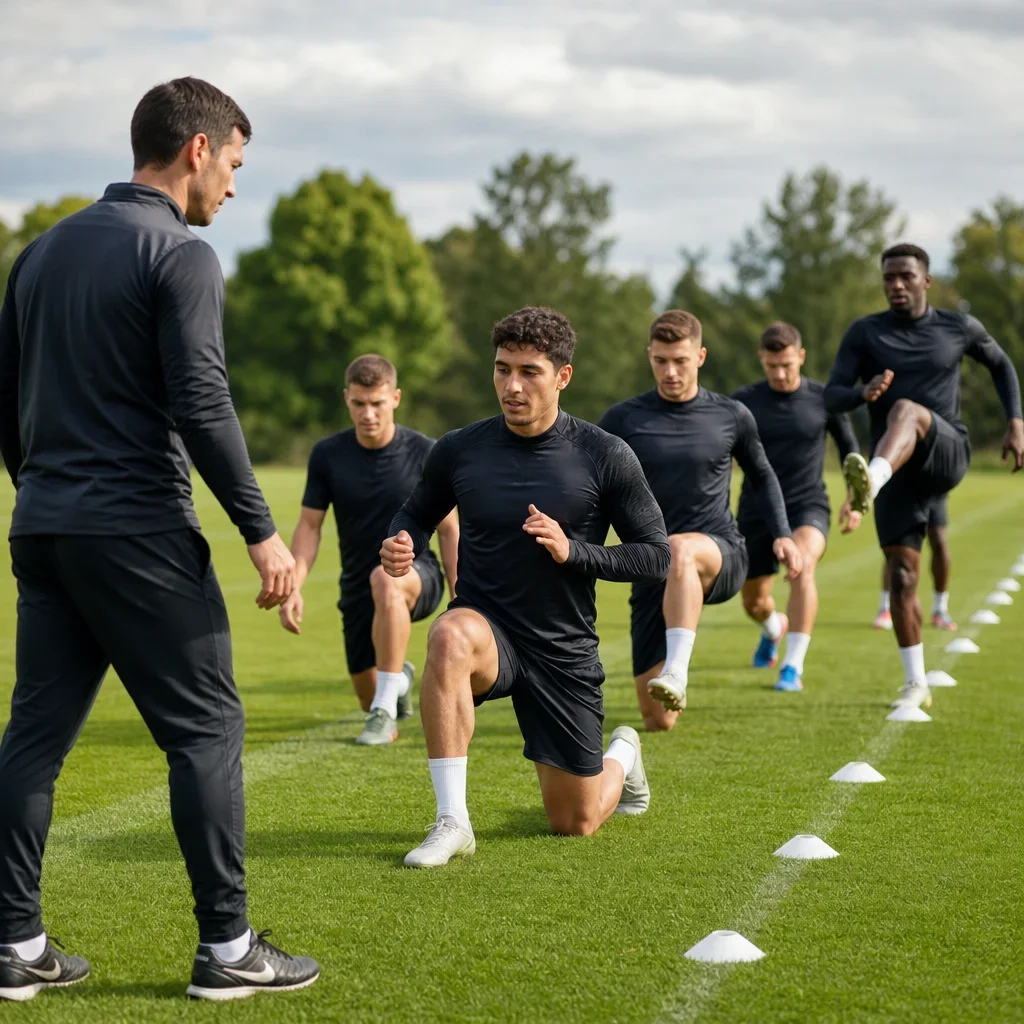
A good acl prevention warm up soccer routine is not just a jog and a few stretches. It is a short, structured sequence that prepares players to land, decelerate, cut, balance, and change direction with better control.
What an ACL prevention warm-up for soccer should actually do
The best soccer ACL warm-up prepares players for soccer while targeting the movement qualities linked to cleaner cutting and landing mechanics. It should include dynamic movement, single-leg control, trunk stability, hamstring involvement, plyometrics, and change-of-direction work rather than only easy running or static stretching.
No warm-up can guarantee ACL injury prevention soccer outcomes. A structured neuromuscular warm-up is better framed as a way to lower injury risk, improve movement quality, and increase readiness for training or matches.
A general warm-up raises body temperature and gets players moving. An ACL-focused warm-up goes further by coaching knee alignment, deceleration, landing control, and hip-trunk mechanics that matter when players sprint, stop, pivot, and challenge for the ball.
Evidence-backed systems such as the FIFA 11+ warm-up and the PEP warm-up are useful reference points, but consistency and execution matter more than the program name on the page. Players need repeatable coaching cues and enough practice exposures across a season for the routine to do anything useful.
A practical ACL prevention warm-up soccer routine: phase by phase
A practical routine usually takes about 10 to 20 minutes depending on the setting. Training sessions can handle the full version, while match day usually needs a shorter version that keeps the highest-value elements.
The simplest field-ready structure uses 5 phases. Start with pulse raise, then dynamic mobility, then activation and control, then landing and deceleration mechanics, then agility and soccer-specific movement.
Each phase only needs 1 to 3 drills if the setup is clean and the coaching is clear. That keeps a full team moving without turning the warm-up into a conditioning block.
Phase 1: Raise temperature and groove running mechanics
This opening phase should take about 2 to 5 minutes. The goal is to raise temperature gradually before you ask players to cut, jump, or stop hard.
Use low-speed jogs, skips, lateral shuffles, backpedals, and controlled direction changes over short lanes. Keep posture tall, foot strike under the body, arms organized, and the torso quiet instead of letting players flail through the first few minutes.
This phase is only the foundation. It helps players transition into sharper movement, but by itself it is not an ACL program.
Phase 2: Dynamic mobility and movement prep
This phase usually takes about 2 to 4 minutes. It should build active range of motion and control, not turn into long static stretching.
Useful soccer warm-up exercises here include hamstring sweeps, walking lunges, hip openers, calf and ankle drives, lateral lunges, and adductor-focused movement prep. Those drills target areas that influence how players decelerate, plant, and rotate through the lower body.
Ankle, hip, and trunk mobility matter because players cannot consistently hold knee position if the joints above and below the knee are stiff or poorly controlled. Better movement options do not guarantee safer mechanics, but they make good mechanics easier to coach.
Phase 3: Activation and control drills
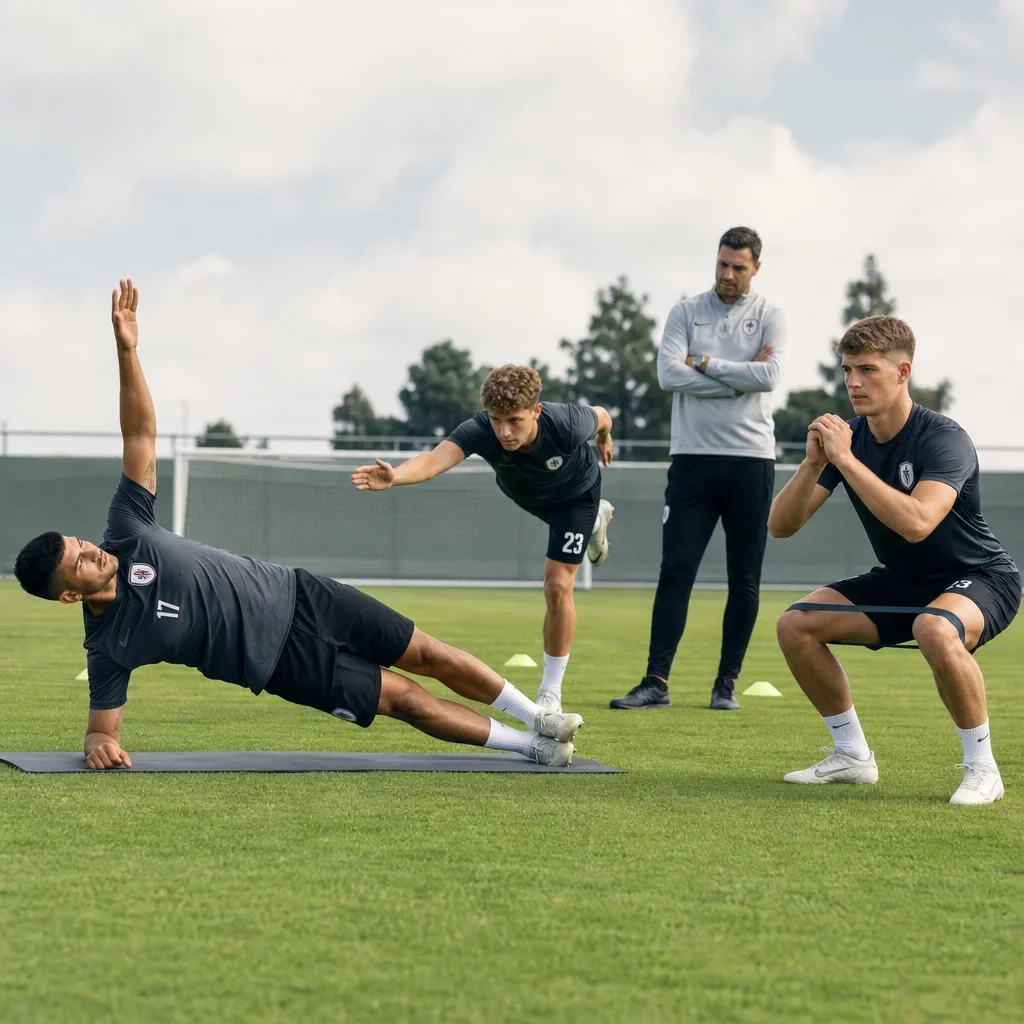
This phase wakes up trunk, hip, and hamstring control before faster movement starts. Keep work bouts short, usually 15 to 30 seconds or about 4 to 8 reps per drill, so players stay sharp.
Planks and side planks train trunk stiffness when they are coached well. The goal is a straight line from shoulders to hips to ankles, steady breathing, and no sagging through the lower back.
Single-leg balance and reach drills teach players to own one leg before they cut off it. Watch for the pelvis staying level, the knee tracking over the foot, and the trunk staying controlled instead of tipping and twisting.
Mini-squat holds and split-stance control drills build awareness of hip loading. Players should feel the hips working, pressure through the whole foot, and the knee staying aligned with the toes rather than collapsing inward.
Partner hamstring drills can be useful, but they need to be dosed carefully in a warm-up. If you use a Nordic-style or PEP warm-up hamstring partner drill, keep the volume low and the range controlled so players are prepared, not fatigued.
Beginners and younger athletes should regress to supported balance, double-leg squats, and slower tempo work if they cannot control single-leg stance. Progressing too quickly defeats the purpose of the phase.
Phase 4: Landing, jumping, and deceleration mechanics
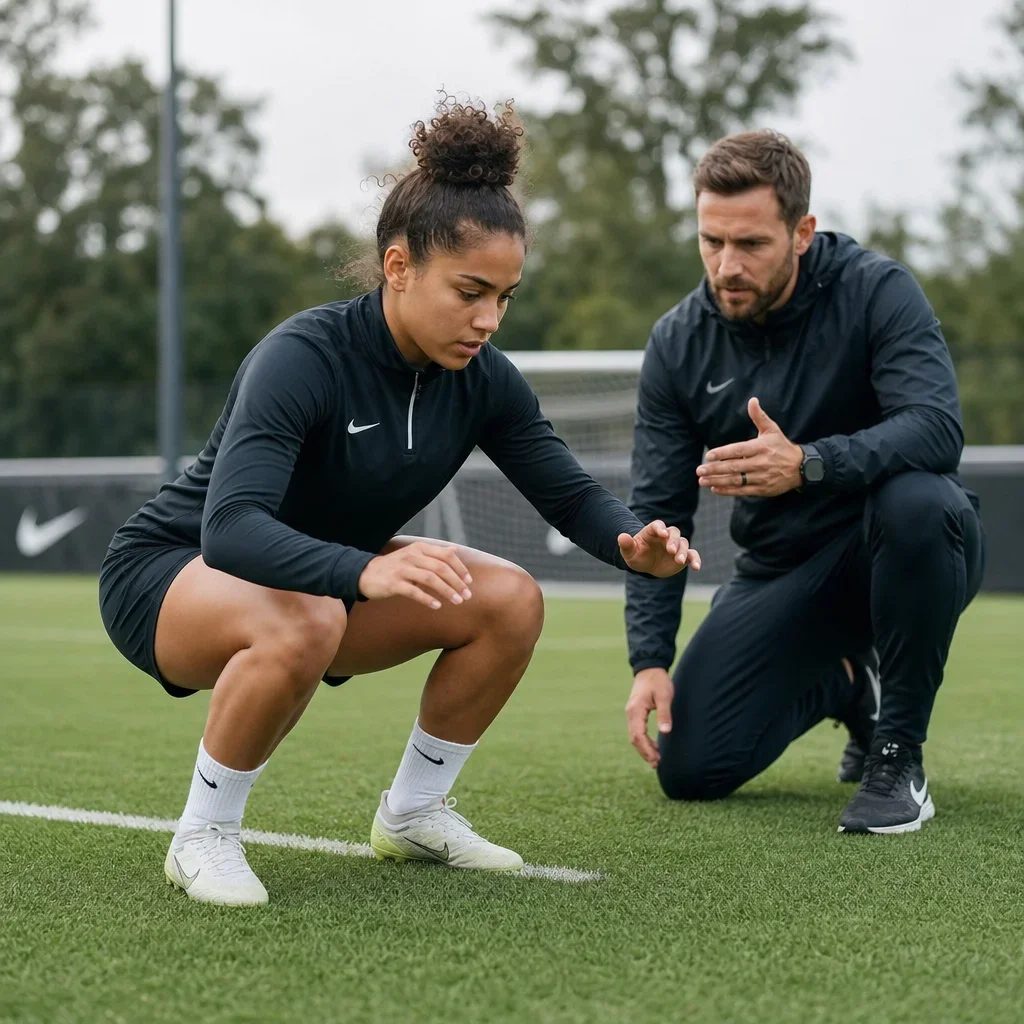
This is the highest-value phase for many players because it teaches how to absorb force before sport speed rises. Keep jump and landing volume low, usually about 3 to 6 reps per drill.
Start with squat-to-stick and vertical jump-to-stick drills. The best cue is simple: land softly, hips back, chest controlled, and knees tracking over toes.
Drop landings and low pogo variations add stiffness and timing when players already show control. The landing should be quiet, balanced, and owned for a second instead of rushed into the next rep.
Single-leg landing progressions belong later and only for athletes who can control double-leg mechanics first. If the knee dives inward, the trunk whips sideways, or the athlete hops around to save the rep, regress the drill.
The main error to coach here is dynamic knee valgus, often called the knee collapsing inward. Coaches should also watch for stiff noisy landings, trunk sway, heels crashing down, and players chasing height before they can control the landing.
These drills matter because soccer repeatedly asks players to land from headers, stop after sprints, and absorb contact in transition. The warm-up is the place to rehearse that control at low fatigue first.
Phase 5: Agility, cutting, and pivoting patterns for soccer
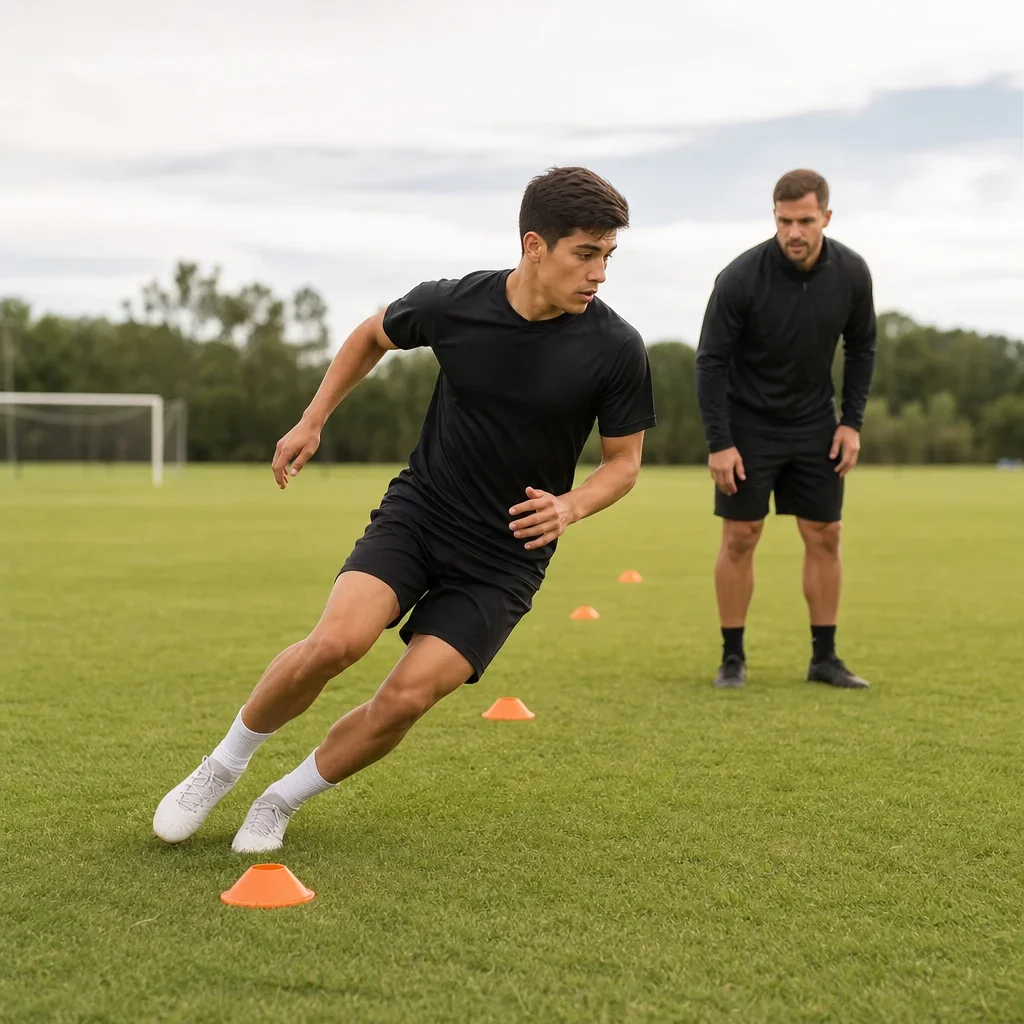
This phase translates earlier mechanics into soccer actions. Keep the distances short, usually about 5 to 10 metres, so quality stays high and players stay fresh.
Good team-friendly acl prevention warm up soccer drills include shuffle-to-cut, forward run to decelerate and backpedal, planned 45-degree cuts, planned 90-degree cuts, and controlled pivots. The first coaching priority is decelerate before the direction change, not during it.
Players should plant under control, keep the trunk organized, and avoid the knee collapsing inward when the foot hits the ground. A clean plant and push is more useful than a flashy reactive drill with poor mechanics.
Reactive cutting is a progression, not the starting point. Add visual or coach-call cues only after players can hit the planned patterns with consistent control.
Optional phase: Ball-based progressions that keep ACL-prevention intent
Ball work can fit the routine if it comes after the key movement-quality pieces. It should support the goal, not replace landing, deceleration, and single-leg control work.
Useful soccer warm up drills with the ball include pass-and-move with a controlled stop, receive-turn-pass with a planted cut, and cone dribbling with planned changes of direction. Those drills let players rehearse scanning and touch while keeping the movement pattern honest.
A ball-based block usually only needs about 2 to 5 minutes if it is included. On tight match-day timelines, it can stay brief as long as the team still completes dynamic prep, activation, and a small amount of landing and cutting work first.
Training day vs match day: how to change the routine
Training days usually suit the full version at about 15 to 20 minutes. Match day usually suits a condensed version at about 8 to 12 minutes.
The full training version should keep all five phases because that is where players get more repetition, more coaching, and better long-term buy-in. This is also the better day for slightly longer holds, more detailed cueing, and a few extra controlled landings or cuts.
The match-day version should keep dynamic prep, activation and control, a small amount of landing quality, and a few soccer-specific accelerations or cuts. Trim extra volume, long floor holds, repeated explanations, and any drill that adds fatigue without adding readiness.
Field access, weather, bench size, kickoff timing, and player nerves all matter. A short routine done well is better than a full routine rushed and sloppy.
FIFA 11+ vs PEP vs a custom clinic-led soccer ACL warm-up
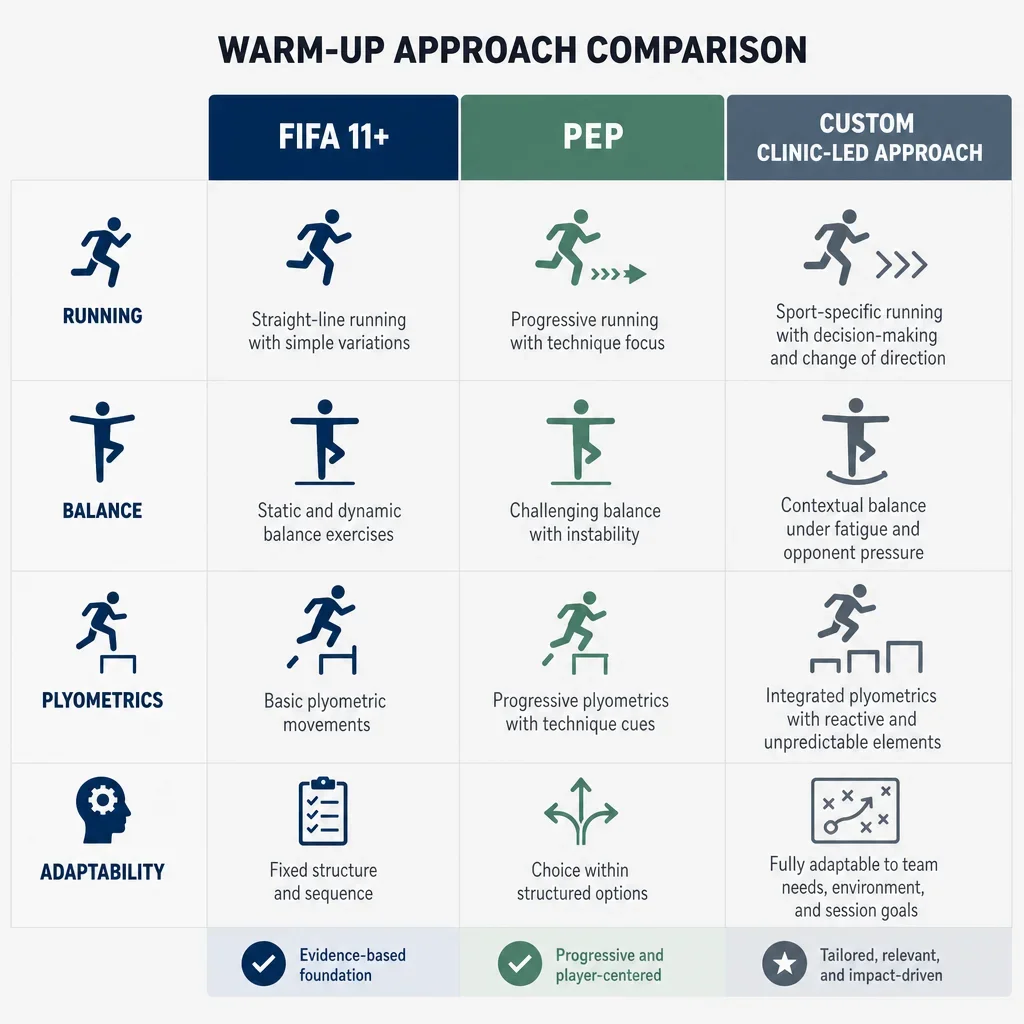
The FIFA injury prevention program most coaches recognize is the FIFA 11+, while the PEP program is another established neuromuscular warm-up. A custom clinic-led routine can make more sense when a team has age-specific needs, limited space, mixed injuries, or return-to-play athletes.
| Program | Typical use | Structure | Strengths | Limits | Best fit |
|---|---|---|---|---|---|
| FIFA 11+ | Team warm-up | Progressive running, strength, balance, plyometrics, higher-speed running | Standardized, well known, easy to teach over time | Can feel rigid if space or age group changes | Clubs that want a consistent, repeatable system |
| PEP warm-up | Team injury-prevention warm-up | Running, stretching, strengthening, plyometrics, agility | Clear prevention focus, easy to organize in lines | Some teams need more soccer-specific adaptation | Coaches who want a simple scripted routine |
| Custom clinic-led approach | Team or individual use | Built around roster age, injury history, field setup, and season stage | Easier to adapt for youth, beginners, and return-to-play needs | Requires more planning and coaching skill | Teams with mixed needs or ongoing injury concerns |
No program is universally best for every roster. I would compare fit, consistency, coaching quality, and how easily the staff can repeat it two or more times per week rather than chasing a branded template alone.
How often to do the warm-up and why consistency matters
These warm-ups work best when done multiple times per week across the season. Sporadic use does not give players enough repetition to change habits or team culture.
Adherence is a real performance and health issue, not just an admin detail. Teams that use the same setup, same sequence, and same cue words usually run the routine faster and with better quality over time.
A simple tracking system helps. Log whether the team completed the full or condensed routine, who led it, and whether any drill needed modification.
Coaches get better compliance when they assign leaders, laminate a checklist, and build the warm-up into every session plan instead of treating it as optional. A good acl prevention warm up soccer pdf substitute is a one-page printed checklist even if no downloadable PDF exists.
Youth, girls, boys, and beginners: how to adapt the warm-up safely
Youth players need simpler cues and lower complexity. Start with bilateral control, planned cuts, and low-level landing drills before moving into single-leg and reactive work.
The FIFA 11+ KIDS program is designed for younger players and is commonly referenced for children under 14.
For beginners, the best acl prevention warm up soccer routine is usually shorter, less chaotic, and more repetitive than an adult version. Players learn faster when coaches use a few cues well instead of ten cues poorly.
Girls’ and boys’ teams both benefit from the same core priorities: strength, landing quality, trunk control, and organized cutting mechanics. Good coaching should focus on the athlete in front of you rather than broad assumptions about sex or age.
Very young players often respond better to a movement-quality warm-up than an adult-style protocol. Skips, sticks, balance games, simple decelerations, and partner cues can keep the session playful without losing the goal.
Who should modify or avoid certain drills
Players with current pain, swelling, repeated giving-way, recent injury, post-operative status, acute hamstring strain, or obvious single-leg control loss should modify the warm-up. Those are not situations for forcing full plyometrics or aggressive cutting.
A prevention warm-up is not the same thing as rehab or return to sport. Athletes coming back after ACL reconstruction or another significant knee injury usually need individualized progressions beyond a team warm-up.
The safest regression path is double-leg before single-leg, slower before faster, planned before reactive, and smaller amplitude before bigger amplitude. Supported balance, shorter cuts, and low-level hops are usually better options than skipping the session entirely.
Ongoing symptoms should be assessed by a physiotherapist or sports medicine clinician. That is especially true if a player cannot land softly, cannot trust the knee, or keeps losing alignment under simple load.
Does this warm-up replace strength training or rehab?
No. A warm-up supports preparation and risk reduction, but it does not replace separate strength work, rehabilitation, or individualized return-to-play programming.
Hamstrings, glutes, calves, trunk strength, and deceleration capacity still need dedicated training outside the warm-up. The warm-up rehearses positions and movement quality; it does not build all the physical capacity players need on its own.
Players with prior ACL injury, current knee pain, or post-surgical history usually need more than a generic soccer ACL warm-up. They often need graded loading, strength testing, movement assessment, and sport-specific progression.
Equipment, space, and how to run it with a full team
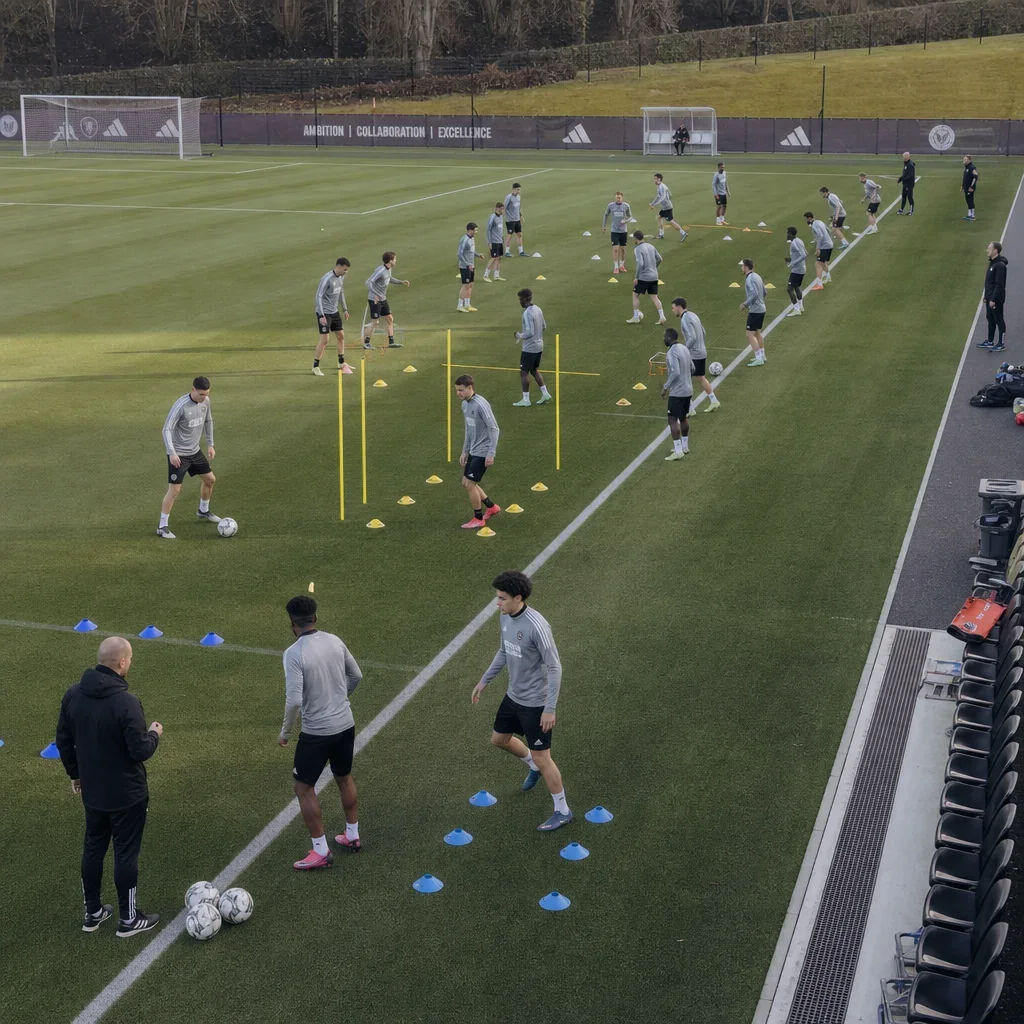
You do not need much equipment to run this well. Cones, a marked lane or small grid, and optional mini bands cover most setups, while partner work can replace some equipment-heavy drills.
A lane-based setup works well for larger squads because it keeps players moving in straight lines and short turns. A station-based setup works better when you want one coach cueing landings while another manages flow.
Small spaces can still work. Use shorter 5-metre lanes, lower-amplitude jumps, and planned cuts instead of wide reactive drills when you are on a sideline, half field, or crowded turf.
If coaches want a printable setup guide, the best option is a checklist-style handout with lane order, cue words, and drill order. That covers the practical intent behind searches for an acl prevention warm up soccer drills pdf without pretending a download exists when it does not.
A simple coaching checklist: cues and common mistakes
The best cue list is short and repeatable. Use the same words every session so players know what quality looks like before intensity rises.
Universal coaching cues
- Knees track over toes.
- Land softly and quietly.
- Hips back, chest controlled.
- Decelerate before cutting.
- Own one leg before progressing.
- Stop or regress if mechanics break down.
Common mistakes by drill family
- Running prep: overstriding, flared arms, sloppy torso position.
- Balance drills: pelvis dropping, knee drifting inward, eyes darting everywhere.
- Squat patterns: heels lifting, knees caving, trunk collapsing forward.
- Jump and land drills: loud landing, stiff knees, no stick, rushing the next rep.
- Cutting drills: planting too far outside the body, no deceleration, trunk falling sideways.
- Match-day warm-ups: too much volume, too many jumps, and not enough freshness left for kickoff.
How to build this into a full practice plan
This warm-up should happen before technical drills, small-sided play, sprint work, or finishing. The key reason is simple: deceleration and landing quality are best coached before fatigue muddies the picture.
A practical session flow is warm-up, then technical or tactical work, then higher-speed or game-like blocks, then cooldown or recovery. That sequence keeps quality work early and lets the main session become more soccer-specific as readiness rises.
If the session already includes intense plyometrics or heavy strength work later, keep the warm-up volume conservative. The goal is preparation, not using up the best movement reps before the session starts.
Evidence snapshot: what the research suggests
Research on structured neuromuscular warm-ups suggests they are associated with lower injury rates and improved movement quality in some soccer populations. The effect is not identical across every age group, competition level, or implementation style.
The honest takeaway is that warm-ups like the FIFA 11+ warm-up appear useful when teams do them consistently and coach them well. They should be described as evidence-informed risk-reduction tools, not guarantees against ACL tears.
Execution quality, season-long adherence, and athlete population all change the result. That is why a program can look good on paper and still underperform on the field if the coaching is rushed or players treat it like a box-ticking exercise.
When to see a physiotherapist or sports medicine clinician
Players should get assessed if they have recurrent knee pain, instability, repeated ankle or knee injuries, obvious side-to-side asymmetry, poor landing control, or uncertainty during return to sport. Those are screening and rehab questions, not just warm-up questions.
A biomechanics-led assessment can help identify whether the issue is load tolerance, movement control, strength, confidence, or a mix of factors. That is where physiotherapy Toronto and sports medicine Toronto support the athlete beyond a generic field warm-up.
At Studio Athletica, we look at movement, force control, rehab progression, and return-to-sport planning for active people and soccer athletes. If a player has knee pain, repeated instability, or is coming back after ACL injury or surgery, the next step is an assessment rather than guessing through another team warm-up.
FAQ
What is the best warm up for ACL prevention in soccer?
The best warm-up is a structured neuromuscular routine that prepares players for landing, deceleration, cutting, balance, trunk control, and soccer-specific movement. It should be short enough to use consistently and specific enough to coach quality, not just get players sweating.
How long should an ACL prevention warm-up take before soccer?
A full version usually takes about 15 to 20 minutes, while a condensed match-day version usually takes about 8 to 12 minutes. Very short versions can still work if they keep the highest-value pieces.
Should players do the full ACL warm-up before training and a shorter one before matches?
Yes, that is usually the most practical setup. Training is the better time for full progression and teaching, while match day should keep key drills and trim extra volume.
Does the FIFA 11+ warm-up help reduce ACL or knee injury risk?
Evidence suggests structured warm-ups like FIFA 11+ can be associated with lower injury rates in some soccer groups when they are done consistently. It should not be sold as a guarantee or a stand-alone answer for every athlete.
What is the difference between FIFA 11+ and the PEP warm-up?
Both are structured injury-prevention warm-ups. FIFA 11+ is the more widely recognized soccer template, while PEP is another established prevention-focused sequence that includes running, strengthening, plyometrics, and agility elements.
Can soccer warm-up exercises with the ball still help with ACL prevention?
Yes, if ball work is added after core movement-quality drills rather than replacing them. Passing, receiving, and dribbling patterns can reinforce controlled stops and cuts when they are coached well.
Is there an ACL prevention warm-up for youth soccer players?
Yes. Youth players usually need a simpler, lower-complexity version with fewer reactive demands, more repetition, and cleaner cues. FIFA 11+ KIDS is one commonly referenced example for younger players.
Does an ACL prevention warm-up replace strength training or rehab?
No. It supports readiness and movement quality, but it does not replace strength training, rehabilitation, or post-ACL return-to-sport work.
What drills should be avoided if a player already has knee pain?
Painful high-impact jumps, uncontrolled single-leg landings, and aggressive cutting drills should usually be regressed or removed until the athlete is assessed. The better approach is to scale to supported balance, double-leg control, and lower-speed patterns.
How often should a soccer team do an ACL prevention warm-up?
The useful answer is multiple times per week across the season. Consistency matters more than doing one perfect session every few weeks.
If a player is dealing with knee pain, repeated instability, poor landing control, or a return after ACL injury or surgery, book an assessment at Studio Athletica. A proper movement and rehab plan is far more useful than guessing which drill to add next.