
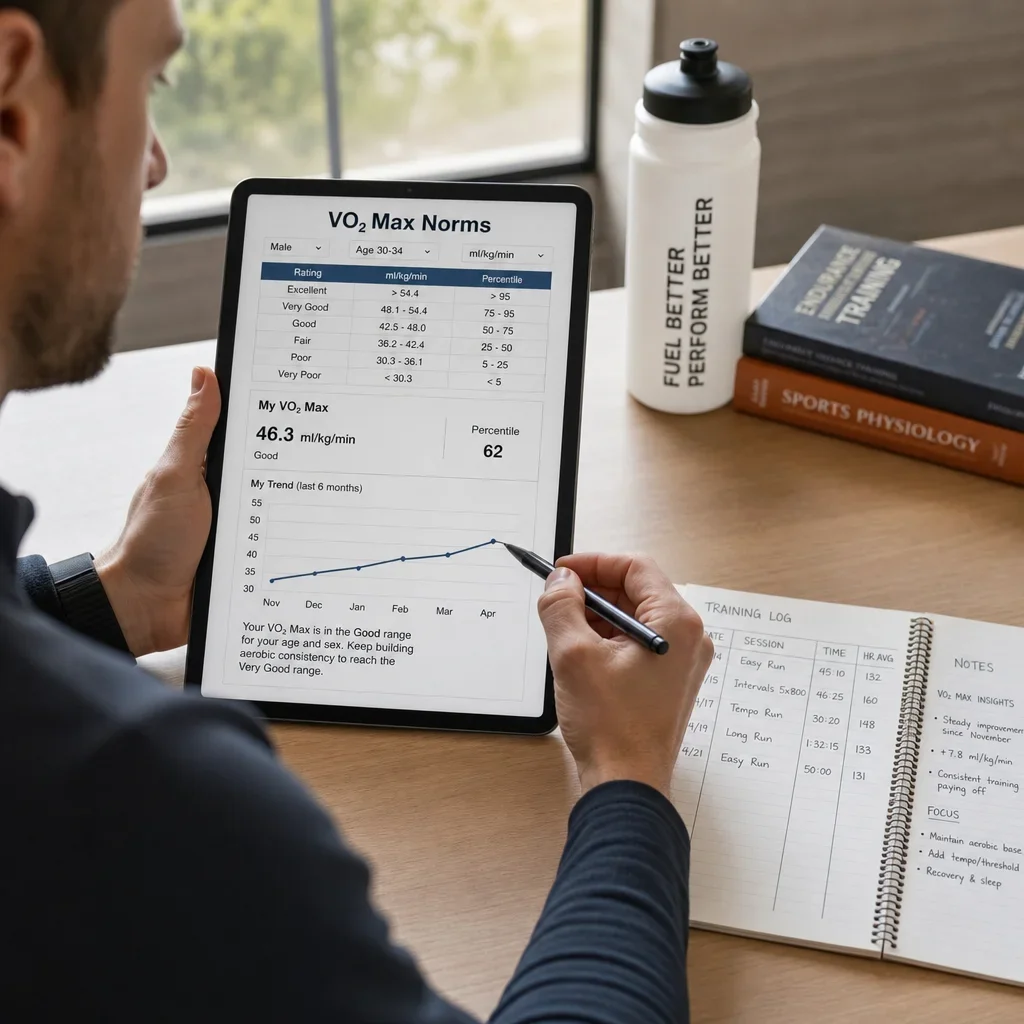
The biggest mistake athletes make with athlete VO2 max is treating one score like a verdict. VO2 max matters, but race results and training response still depend on threshold, economy, durability, skill, pacing, fueling, and whether you can stay healthy enough to train.
What athlete VO2 max means and why it matters
VO2 max is your maximal oxygen uptake, usually reported in millilitres of oxygen per kilogram of body weight per minute, written as mL/kg/min. In plain English, it is a measure of your peak aerobic capacity during hard exercise, and some tests also report an absolute value in litres per minute, written as L/min.
VO2 max matters because aerobic ATP production supports sustained endurance work, but it is not the only performance marker that counts. A triathlete with a lower score can still beat a higher-scoring athlete through better lactate threshold, movement economy, pacing, transitions, and fueling.
You do not need an elite VO2 max to finish a triathlon, train for a marathon, or perform well recreationally. For most active adults, the practical use of VO2 max is benchmarking aerobic capacity, tracking trends, and guiding training blocks rather than chasing a number for its own sake.
What is a good VO2 max for an athlete?
A good score depends first on age and sex, then on sport, then on your own trend over time. That is why one internet cutoff is not useful, and why any VO2 max chart should be read as a reference point rather than a final judgment.
The chart below gives broad adult norms by age and sex from commonly used population-based reference ranges, and cross-source labels can differ because test methods and populations differ.
| Age | Female low | Female average | Female good-excellent | Male low | Male average | Male good-excellent |
|---|---|---|---|---|---|---|
| 20-29 | <29 | 29-38 | 39+ | <36 | 36-45 | 46+ |
| 30-39 | <27 | 27-35 | 36+ | <34 | 34-42 | 43+ |
| 40-49 | <25 | 25-33 | 34+ | <31 | 31-39 | 40+ |
| 50-59 | <22 | 22-30 | 31+ | <28 | 28-36 | 37+ |
| 60+ | <20 | 20-28 | 29+ | <25 | 25-33 | 34+ |
A competitive athlete will often sit above age-group general-population norms, but athlete standards still vary a lot by sport and level. A recreational runner, a trained cyclist, and an elite rower should not be judged against the same target, even if they are the same age.
A useful way to answer what is a good VO2 max for an athlete is this: first compare yourself to your age and sex band, then compare yourself to athletes in your own sport tested the same way, then compare the result to your own last test. That third comparison is usually the most actionable one.
Athlete VO2 max by sport: running vs cycling vs swimming
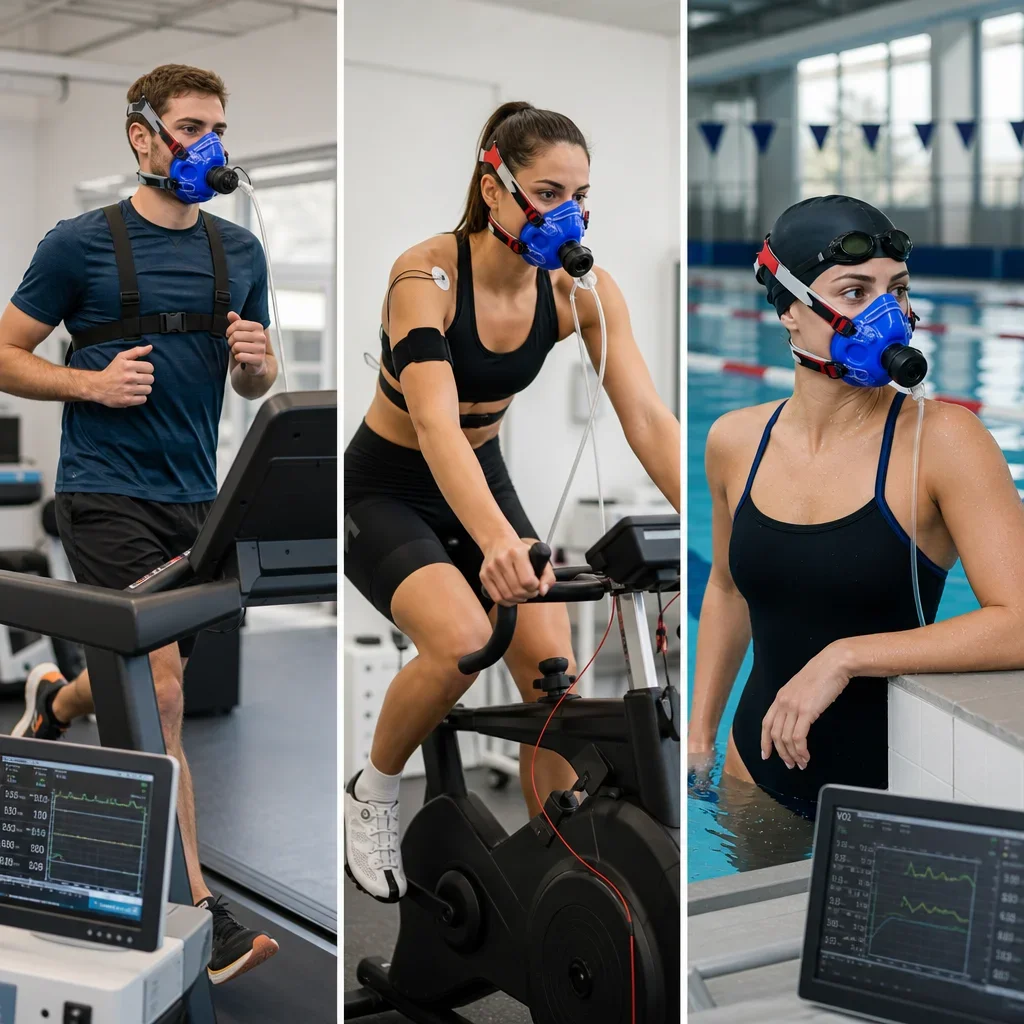
VO2 max for runners, cyclists, and swimmers can differ because the movement pattern, muscle mass used, posture, and testing modality all change the result. A treadmill test often produces a different value than a bike test for the same athlete, especially if that athlete is much more trained in one mode than the other.
Runners often test well on treadmill protocols because running uses a large amount of muscle mass in a weight-bearing pattern they train specifically. Cyclists can produce stronger numbers on cycle ergometers when they are highly bike-trained, but runners who are not adapted to cycling often underperform on bike tests because local leg fatigue arrives before their aerobic ceiling.
Swimmers are the hardest group to compare fairly outside sport-specific testing because breathing pattern, technique, body position, and test setup matter so much. If you want to compare your score meaningfully, compare it with athletes tested in the same sport and with the same method whenever possible.
Athlete VO2 max female: how women should interpret the number
Female athletes should compare their score against female norms first, not mixed charts copied without context. That matters because average values differ by sex for physiological reasons, but that does not say anything negative about training potential, competitiveness, or endurance ability.
Average female VO2 max values are often lower than average male values because body size, body composition, blood volume, hemoglobin concentration, and oxygen-carrying capacity differ on average between sexes. The right comparison is woman to woman, sport to sport, and test to test.
What is a good VO2 max female score depends on age, training history, and sport, but women who train consistently for endurance often sit above general-population norms. Elite athlete VO2 max female values can be very high, but exact ranges vary by discipline and protocol, so broad benchmarking is safer than chasing unsourced hero numbers from social media.
Short training interruptions can also shift the reading without erasing fitness completely, and life stage matters. Postpartum return, perimenopause, illness, and reduced training load can all change test outcomes and recovery patterns, so trend interpretation matters more than a single isolated score.
How to measure VO2 max: lab test vs field test vs wearable
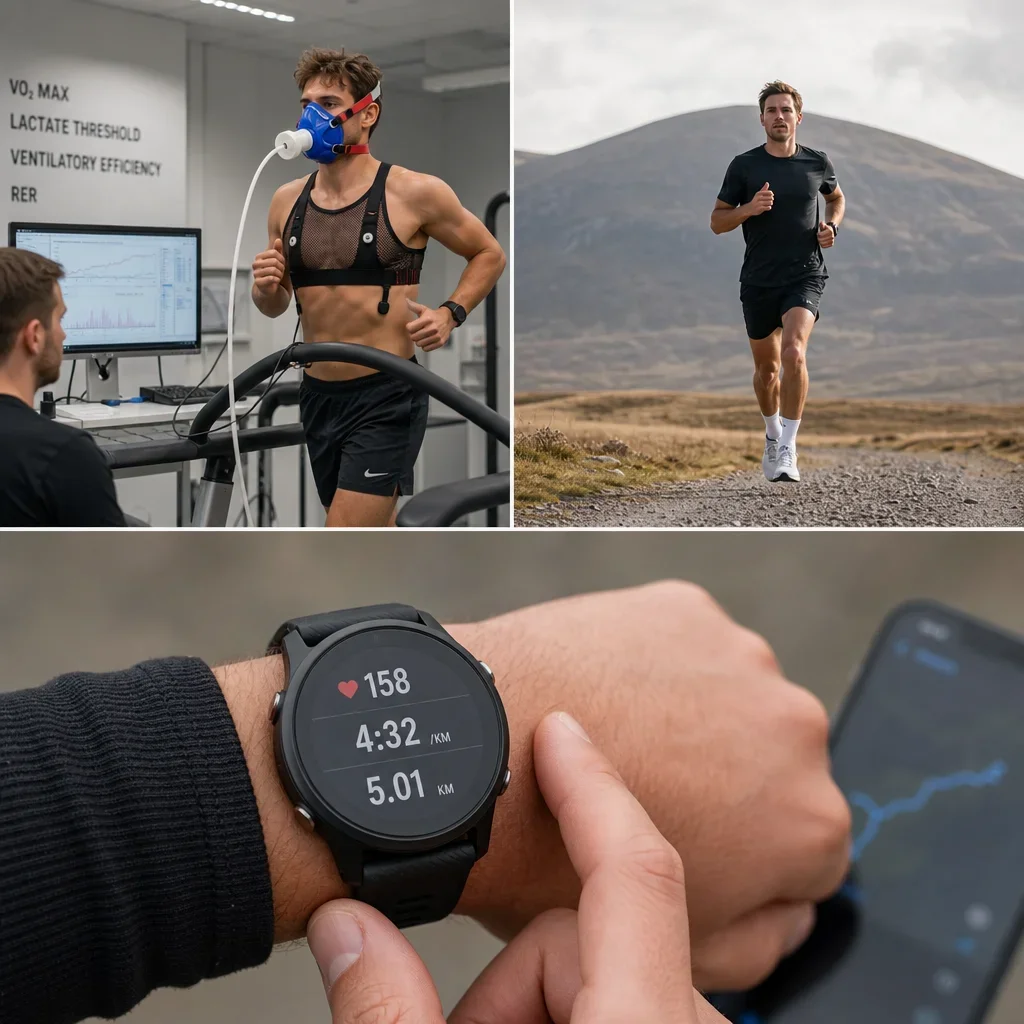
The best test depends on whether you want maximum accuracy, simple trend tracking, or a low-cost estimate. Direct lab testing is the gold standard, field tests are practical estimates, and a wearable VO2 max estimate is most useful for watching direction over time.
| Method | What it measures | Accuracy use | Effort required | Best for | Main limitation |
|---|---|---|---|---|---|
| Lab gas analysis | Direct breath-by-breath oxygen use | Highest | Maximal | Performance assessment, detailed testing | Access and protocol selection matter |
| Field test | Performance-based estimate | Moderate | Usually hard | Budget-friendly benchmarking | Sensitive to pacing, terrain, motivation |
| VO2 max calculator | Formula-based estimate | Low to moderate | Low to moderate | Rough screening | Depends heavily on assumptions |
| Wearable estimate | Algorithm using heart rate plus pace or power | Best for trends | Normal training | Ongoing monitoring | Device error and changing conditions |
If you need the cleanest answer, use a lab test matched to your sport. If you mainly want to see whether training is moving the right way, consistent wearable data or repeated field tests can do the job.
Retesting after a meaningful training block is more useful than retesting every week, and 6-12 weeks is a practical window for many athletes. Your actual retest timing should fit your training phase, injury status, and the method you are using.
Direct VO2 max testing: what happens in a lab test
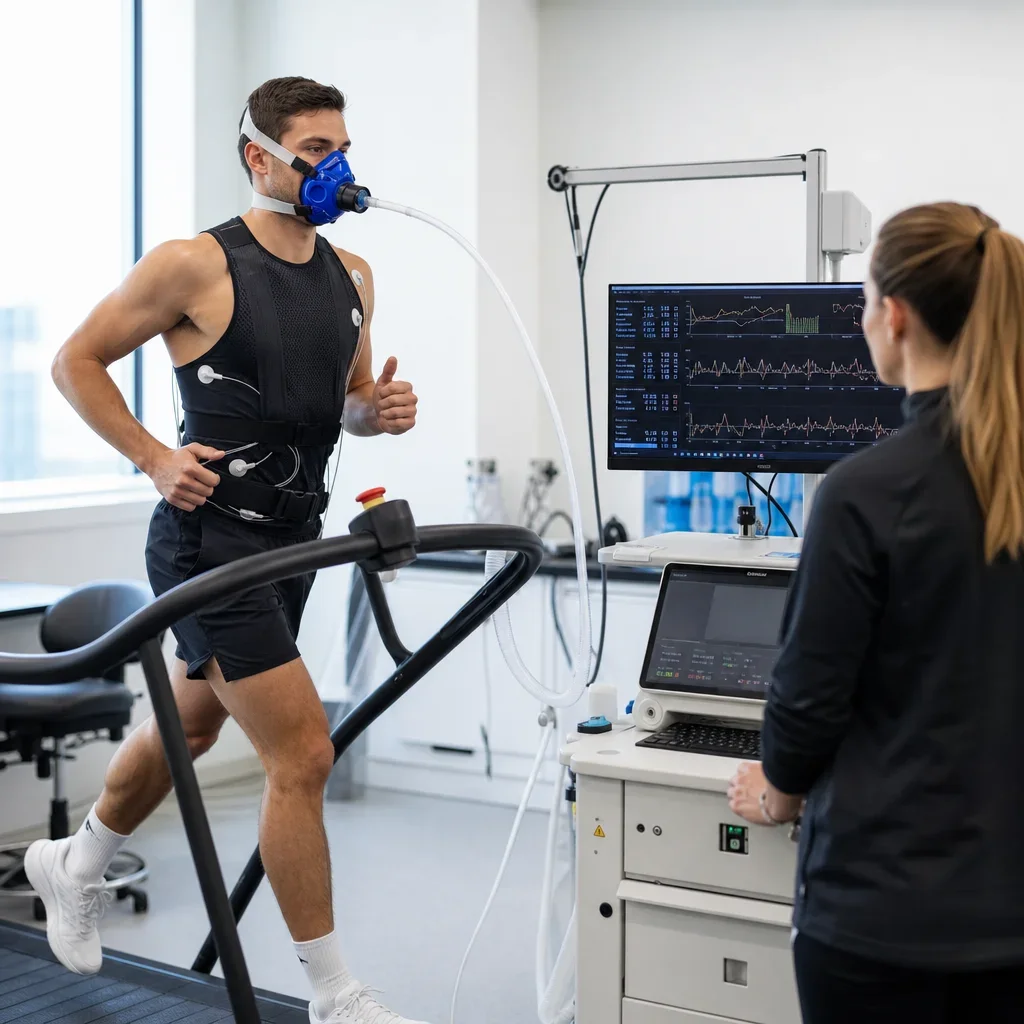
The gold-standard VO2 max test is a graded exercise test with gas analysis performed on a treadmill or cycle ergometer. You wear a mask, the workload increases in stages, and the system measures inhaled and exhaled gases until you reach maximal effort or the test is stopped.
A lab test can also report heart-rate response, speed or power at peak effort, ventilatory data, and sometimes threshold-related markers depending on the protocol used. For endurance athletes, that added context is often more useful than the headline score alone.
The best protocol usually matches the athlete’s sport as closely as possible. A runner should usually test on a treadmill, and a cyclist should usually test on a bike, because specificity affects both the number and how you use it in training.
Testing suitability depends on health status and screening before the session. If you have symptoms, known medical issues, recent illness, or are returning after injury, a qualified professional should decide whether maximal testing is appropriate.
Field tests and VO2 max calculators: useful, but know the limits
Field tests estimate VO2 max rather than measuring it directly. That makes them useful for consistency and trend tracking, but weaker for exact comparison with a lab value.
Common methods include the Cooper 12-minute test, Rockport walking test, Astrand-style bike protocols, and heart-rate ratio approaches. Each one works best in the population it was designed for, which means a trained athlete can get a misleading result if the test is too easy, poorly paced, or used outside its intended context.
An Astrand test is a submaximal cycle protocol that estimates aerobic capacity from steady-state heart rate at a known workload. That is practical when maximal testing is not available, but the estimate can drift if your heart rate is affected by heat, caffeine, fatigue, illness, or medication.
A VO2 max calculator can be a starting point if you understand it is only an estimate. I would use a calculator for rough orientation, not for making strong claims about fitness change unless the same method is repeated under similar conditions.
Can a fitness watch estimate VO2 max?
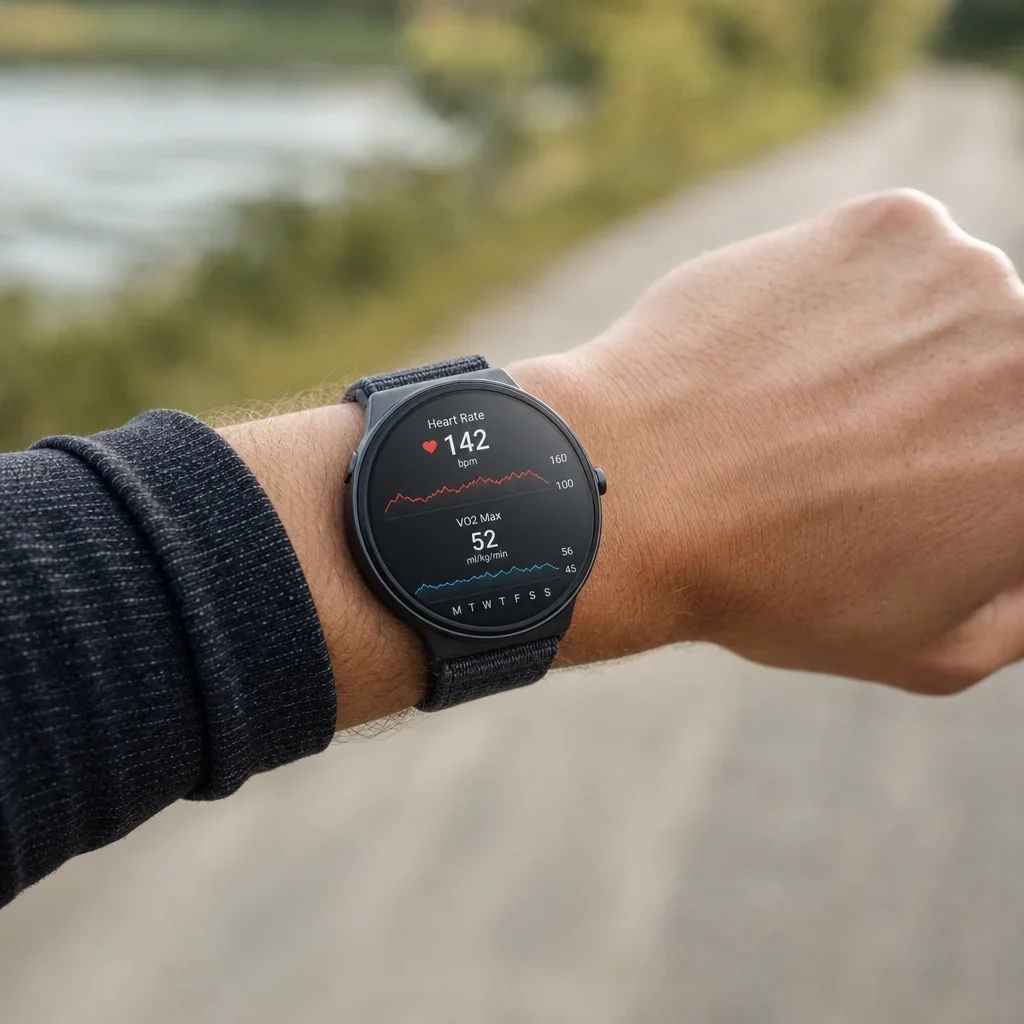
A smartwatch or bike computer can estimate VO2 max, but it does not measure oxygen use directly. Most devices infer the number from combinations of heart rate, pace, power, speed, and proprietary algorithms.
A wearable VO2 max estimate is most useful when you treat it as a trend line, not a lab substitute. If your score drifts over several weeks in the same direction while training quality and fitness markers agree, that is more meaningful than one surprising daily reading.
Day-to-day fluctuations happen because heart rate and pace data are noisy in the real world. Heat, dehydration, poor sleep, fatigue, illness, hills, headwind, indoor versus outdoor conditions, wrist-sensor error, and GPS quality can all move the estimate.
You will usually get cleaner data by using the same device, keeping your profile details updated, using a reliable heart-rate source, and collecting enough steady efforts in similar conditions. For runners, steady outdoor runs with solid GPS and heart-rate data usually work better than stop-start sessions. For cyclists, a consistent power source improves the estimate when the platform supports it.
How to interpret your VO2 max correctly: age, body weight, sport, and trends
Relative and absolute VO2 max are not the same thing. Relative VO2 max is expressed in mL/kg/min, while absolute VO2 max is expressed in L/min.
Losing weight can increase your relative VO2 max even if your actual oxygen-processing ability barely changes. That is because the denominator in mL per kilogram gets smaller, so the score can rise mathematically without a matching change in engine size.
A cleaner interpretation framework is simple: compare the same test method, compare within the same sport, and compare your own trend before comparing yourself with elite norms. That approach avoids one of the biggest reading mistakes athletes make online.
> Myth: A higher VO2 max always means the faster athlete wins. > Reality: Threshold, economy, race execution, fueling, and durability can outweigh a VO2 max advantage.
VO2 max vs lactate threshold vs running economy vs vVO2max: what matters most?
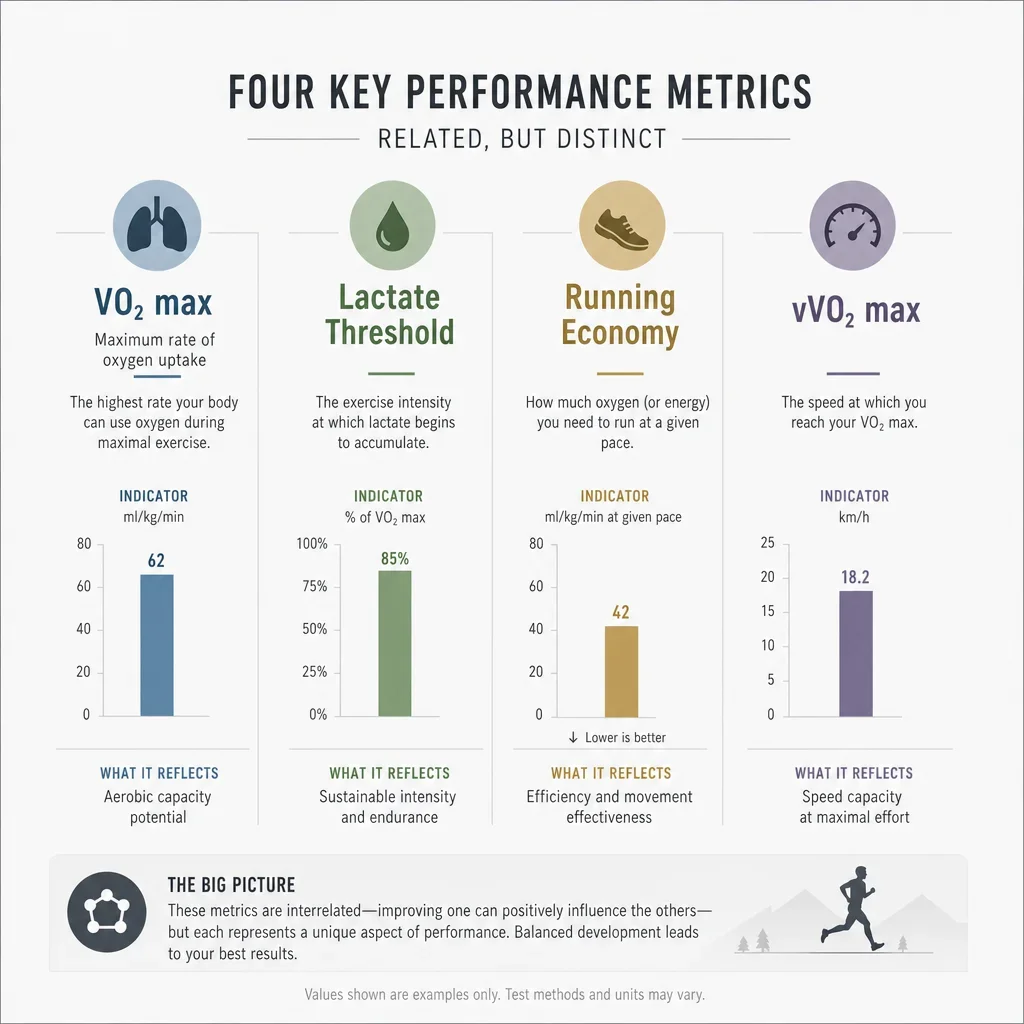
VO2 max tells you the size of the aerobic engine, but not how well you can use it in competition. Lactate threshold is the highest intensity you can sustain before fatigue rises sharply, running economy is how much oxygen you need at a given pace, and vVO2max is the minimal speed that elicits VO2 max.
Threshold and economy are often more predictive than VO2 max for endurance race performance among athletes who are already trained. That is why two runners with similar VO2 max can race very differently.
Beginners usually benefit from using VO2 max as a broad fitness marker while building general aerobic capacity and consistency. Recreational racers should care more about threshold pace, sustainable power, and race durability. Experienced endurance athletes often gain more from refining economy, event-specific intensity, and recovery management. Returning-from-injury athletes usually need load tolerance and movement quality before they need another hard VO2 block.
VLamax is an advanced concept related to anaerobic glycolytic power rather than a standard first-line metric for most readers. It can influence how an athlete responds to aerobic training, but it is not where most recreational runners, cyclists, or triathletes should start.
How to improve VO2 max: the training principles that actually help
VO2 max improves through a mix of hard aerobic intervals, easy volume, progressive overload, and enough recovery to absorb the work. Most athletes do better with 1-2 VO2-focused sessions per week during the right phase, not all year round.
High-intensity intervals help because they keep you near the upper end of aerobic demand long enough to stimulate adaptation. Easy training still matters because it supports volume, capillary and mitochondrial adaptation, recovery, and long-term durability.
Threshold work belongs in the plan too, because endurance performance is not just about your ceiling. An athlete with a modest VO2 max but a strong threshold and good economy can outperform an athlete who only chases hard interval numbers.
Recovery habits shape the result as much as the workout choice. Sleep, carbohydrate availability, illness, low energy availability, and iron status can all affect adaptation and test outcomes.
Example VO2 max workouts for runners, cyclists, and field-sport athletes
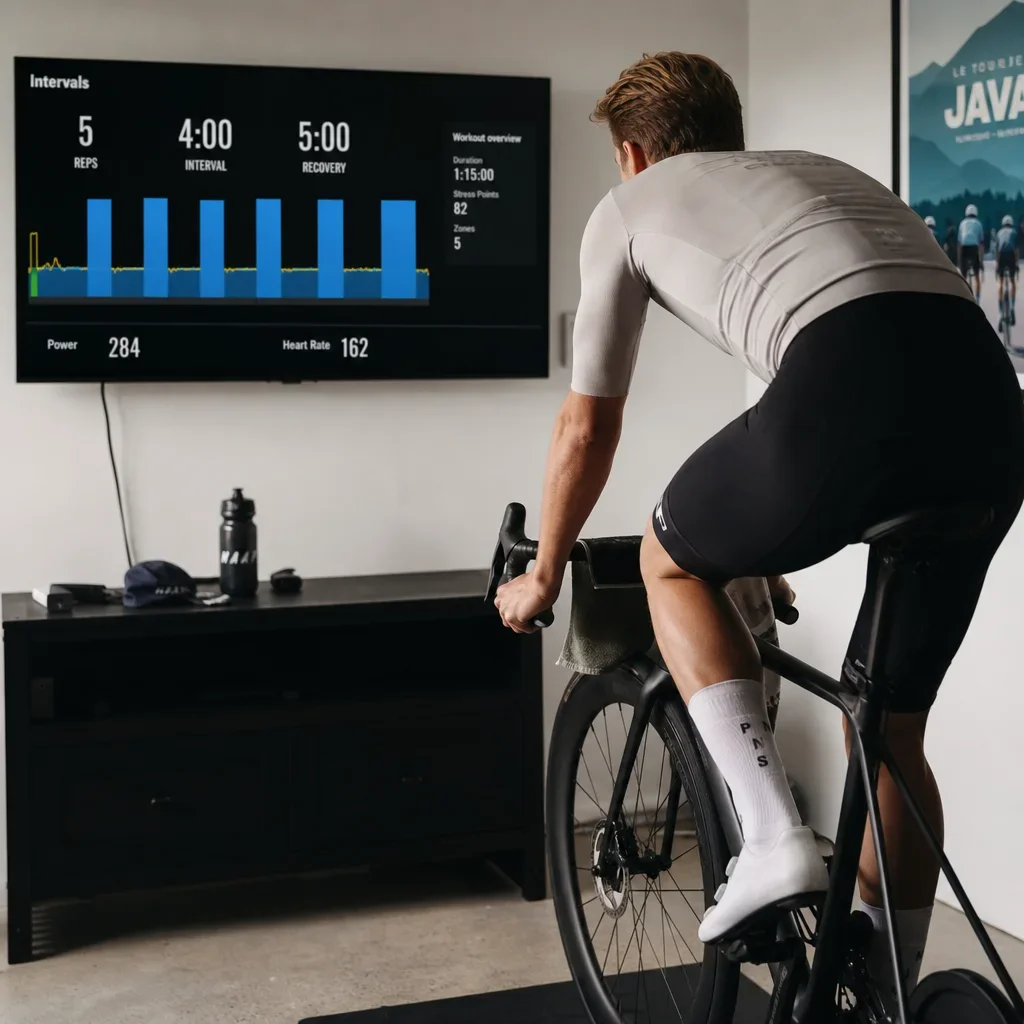
The best VO2 max workout depends on your sport, training history, and injury profile. The session should be hard enough to challenge aerobic power, but repeatable enough that quality stays high.
A classic Norwegian 4×4 session uses 4 repetitions of 4 minutes hard with about 3 minutes easy between reps. This format suits athletes who tolerate longer intervals well and want sustained time at high aerobic demand.
A 5 x 3 minute session with 2-3 minutes easy recovery is a practical alternative when 4-minute reps are too heavy or pacing falls apart. Runners can use controlled hard efforts by pace or grade, and cyclists can use power when they have reliable data.
Short-interval formats like 40/20 or 30/15 break the work into repeated short efforts and recoveries, such as 40 seconds hard and 20 seconds easy repeated in sets. These can help athletes accumulate a lot of high aerobic work with slightly less local muscular strain than longer continuous reps.
Every VO2 session needs a proper warm-up and cool-down. A solid structure is 10-20 minutes easy before the main set and 10-15 minutes easy after it.
How much can VO2 max improve, how long does it take, and when should you retest?
VO2 max can improve, but the size of the change depends heavily on baseline fitness, age, genetics, training history, sport, and consistency. Across different populations and training statuses, a rough improvement range of about 5-20% is a reasonable broad frame, with beginners often changing faster than highly trained athletes.
Meaningful change usually takes several weeks to a few months, not a few watch uploads. Highly trained athletes may see smaller gains that are harder won, while newer athletes can improve more quickly once training becomes structured.
A retest after about 6-12 weeks of consistent training is usually more useful than frequent spot checks. If you are using a wearable, weekly noise matters less than the trend across a full block.
Why your VO2 max is not improving: common mistakes athletes make
VO2 max often stalls because the training mix is wrong, not because the athlete lacks talent. The most common blockers are too much intensity, too little easy volume, poor recovery, poor workout spacing, inconsistent training, under-fueling, illness, and comparing different test methods.
Hard sessions stop working when fatigue stays too high to produce quality efforts. If every interval day feels flat, pace or power falls early, and recovery markers keep slipping, the issue may be load management rather than motivation.
Bad data can also fake a plateau. Changing devices, using weak wrist heart-rate data, switching from outdoor runs to indoor treadmill estimates, or comparing a bike-based score with a run-based score can all muddy the picture.
Injury history matters more than many athletes realize. If calf, Achilles, knee, or hip pain keeps limiting training quality, a performance problem may really be a movement and load-tolerance problem. For athletes in downtown Toronto dealing with recurring pain, a biomechanics-led assessment through physiotherapy Toronto or sports medicine Toronto can help identify barriers to consistent training without pretending treatment alone will raise VO2 max.
Famous athletes VO2 max: useful inspiration, weak benchmarking
Most famous athletes VO2 max numbers online are not reliable benchmarks. Many are unsourced, estimated, taken from different protocols, or repeated so often that people assume they are verified when they are not.
Searches for what is Michael Phelps VO2 max, what is Messi VO2 max, what was Kipchoge’s VO2 max, or what was Lance Armstrong’s VO2 max usually lead to secondary reporting rather than primary test data. That makes exact comparison risky and often pointless.
Even a real number would still be hard to use because sport, body size, era, protocol, and event demands differ so much. A safer benchmark is validated age- and sex-based norms, sport-specific testing, and your own trend under the same method.
When an athlete should seek professional assessment
Professional assessment makes sense when pain, recurring injury, asymmetry, or return-to-sport barriers are stopping you from training well. That includes repeated plateau with pain during hard running or cycling, recurring calf or Achilles issues, knee pain, post-surgery return, or unexplained drop in performance despite reasonable programming.
A sports medicine, physiotherapy, or biomechanical assessment can help identify load-management problems, movement restrictions, and return-to-performance barriers. That is different from promising direct VO2 max gains. The real goal is to remove musculoskeletal limits that keep interrupting training quality and consistency.
If hard training keeps causing setbacks, the next useful step is usually not another random interval session. It is getting clear on whether the limiter is aerobic, mechanical, or recovery-related.
FAQ
What is a good VO2 max for an athlete? A good score depends on age, sex, sport, and training history. Compare your result to your age and sex band first, then to athletes in your own sport using the same testing method.
Is VO2 max different for female athletes? Yes. Average values differ by sex because of physiology such as body size and hemoglobin levels, so women should use female norms and sport-specific context.
Can a smartwatch measure VO2 max accurately? It can estimate VO2 max, but it does not measure oxygen use directly. It is better for trend tracking than exact comparison with lab testing.
How often should I retest my VO2 max? A practical retest window is about 6-12 weeks after a consistent training block. Daily wearable fluctuations are not the same thing as a true retest.
Does losing weight improve VO2 max? It can improve relative VO2 max mathematically because the score is divided by body weight. That does not always mean your actual aerobic capacity improved.
What matters more than VO2 max for race performance? For many trained athletes, lactate threshold, economy, pacing, fueling, and durability matter as much or more.
Can I improve VO2 max without doing all-out intervals? Yes. Structured threshold work, aerobic base training, progressive overload, and consistency can help, though high-intensity work is still a common tool.
Do runners and cyclists have different VO2 max values? They can, because testing mode and training specificity affect the result. A runner may score differently on a treadmill than on a bike.
Are famous athlete VO2 max numbers reliable? Often no. Many are unsourced or reported without enough context to compare fairly.
Should I book a performance or rehab assessment if hard training keeps causing pain? Yes, if pain, asymmetry, recurring breakdown, or return-to-sport issues are limiting training quality. That is where biomechanics, rehab planning, and movement assessment can help.
Your next step is simple: compare the method before you compare the number. If your score is dropping and your training is being limited by pain or recurring breakdown, that is when a proper movement and return-to-performance assessment can earn its place.